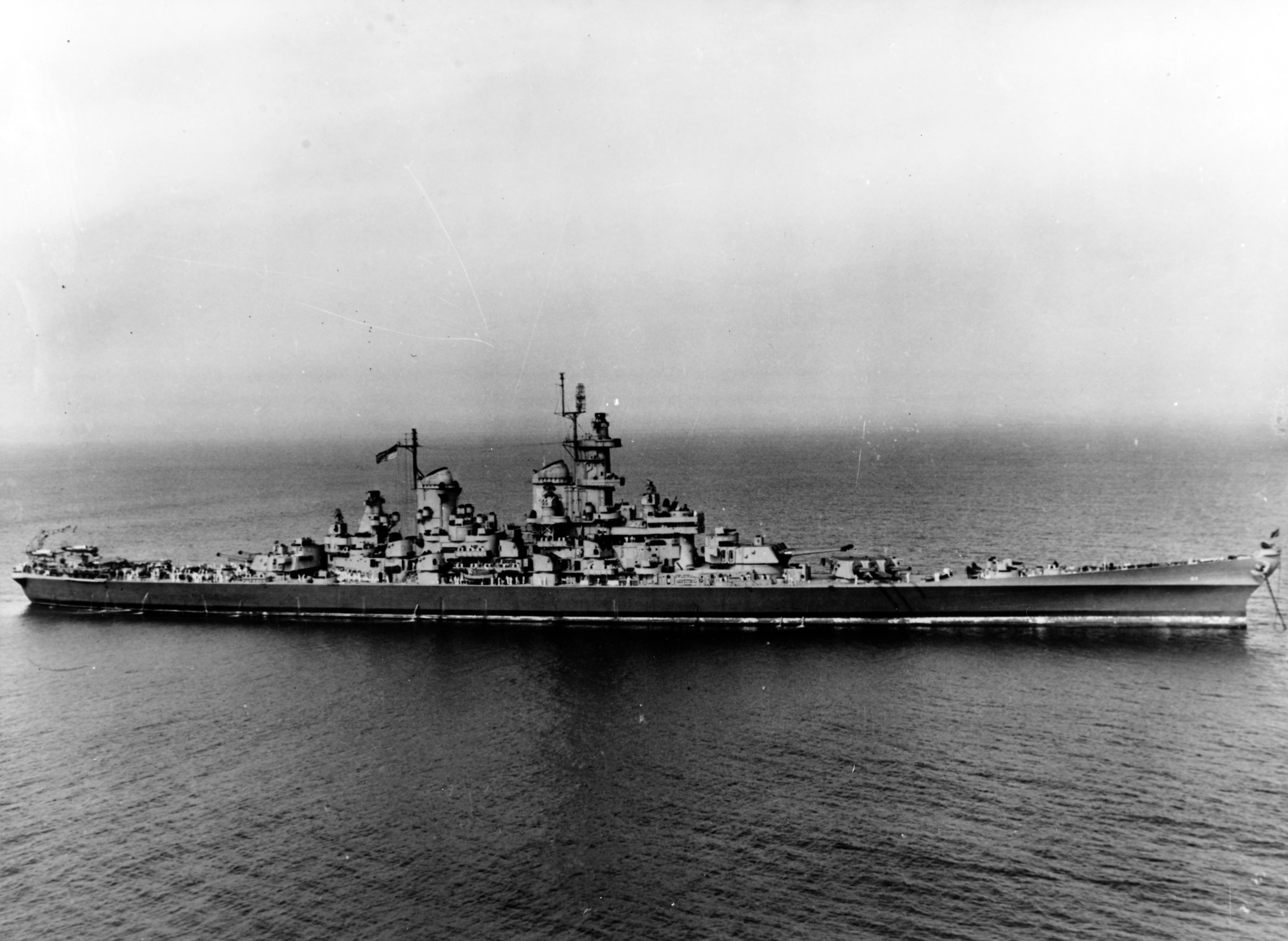
USS Wisconsin (BB-64)
Congress is not done with her yet. When the Secretary of the Navy struck USS Wisconsin from the Naval Vessel Register in 2006, clearing the way for her donation as a museum ship, lawmakers inserted a remarkable condition: the battleship must be preserved in a state of readiness for rapid reactivation in the event of a national emergency. Her gun barrels, spare parts, and projectiles must be maintained in adequate numbers to support her return. No other museum ship in America carries this stipulation. Moored today at Nauticus in downtown Norfolk, Virginia, Wisconsin is both a memorial and a contingency plan, a warship that served in three wars and is technically still waiting for orders.
Born for Speed and Firepower
The Iowa class was designed in the late 1930s because American admirals had a problem: the Japanese fleet was faster. Previous U.S. battleship designs had favored heavy armor and armament over speed, but Navy planners realized those ships would never catch Japan's fast battleships and carrier groups. The Iowa class resolved the dilemma. Wisconsin, commissioned on April 16, 1944, carried nine 16-inch/50-caliber Mark 7 guns in three triple turrets, backed by twenty 5-inch dual-purpose guns and a forest of anti-aircraft weapons. Her four General Electric steam turbines could push her well above 30 knots. She was numerically the highest-numbered U.S. battleship ever built, and though her keel was laid after sister ship Missouri, she was commissioned two months earlier. Her wartime crew numbered 173 officers and 2,738 sailors.
The Pacific Crucible
Wisconsin departed Norfolk on July 7, 1944, and after a shakedown cruise in the Caribbean, transited the Panama Canal to join the Pacific Fleet. Assigned to Admiral Halsey's Fast Carrier Task Force, she shielded aircraft carriers as they struck Japanese airfields across the Philippines, Formosa, and Okinawa. She survived Typhoon Cobra in December 1944, which capsized three destroyers and damaged nine other ships. In January 1945, she escorted strikes on targets from the South China Sea to Hong Kong to Hainan Island. On March 24, she joined Missouri and New Jersey in bombarding southeastern Okinawa to deceive the Japanese about the real landing beaches. She arrived in Tokyo Bay on September 5, 1945, three days after the formal surrender aboard Missouri. In her brief World War II career, Wisconsin shot down three enemy aircraft and fueled her screening destroyers on some 250 occasions.
A Borrowed Bow
On May 6, 1956, operating in heavy fog off the Virginia Capes, Wisconsin collided with the destroyer USS Eaton, suffering extensive bow damage. What followed was an engineering feat that became legendary in naval circles. A 120-ton, 68-foot section of the bow from Wisconsin's incomplete sister ship USS Kentucky was loaded onto a barge at Newport News Shipbuilding, floated across Hampton Roads to Norfolk Naval Shipyard, and grafted onto the damaged battleship. The transplant worked so well that Wisconsin was able to carry out her scheduled midshipman training cruise that summer, sailing through the Panama Canal to Valparaiso, Chile, and back. Kentucky, which was never completed, donated her bow so Wisconsin could keep sailing.
Tomahawks and Drones
After decades in mothballs, Wisconsin was reactivated in 1986 as part of the Reagan-era push for a 600-ship Navy. The modernization transformed a World War II-era battlewagon into a hybrid of old firepower and new technology. Workers installed four quad-cell launchers for 16 Harpoon antiship missiles, eight armored box launchers for 32 Tomahawk cruise missiles, and four Phalanx close-in weapon systems. Eight RQ-2 Pioneer unmanned aerial vehicles replaced the helicopters once used for spotting her big guns. In January 1991, Wisconsin launched Tomahawk strikes against Iraqi targets during Operation Desert Storm and served as the antisurface warfare coordinator for the Northern Persian Gulf. Her Pioneer drones flew reconnaissance missions over occupied Kuwait before the coalition ground offensive. She was decommissioned for the last time in September 1991, after 14 years of total active service and six battle stars.
The Battleship That Cannot Retire
Wisconsin was formally transferred to the city of Norfolk on April 16, 2010, and listed on the National Register of Historic Places on March 28, 2012. She is operated as a museum ship by Nauticus on Norfolk's waterfront. Visitors can walk her teak decks and stand beneath the massive barrels of her forward turrets. In 2023, crew members from the Royal Navy's HMS Prince of Wales volunteered to help clean and repaint the ship while their carrier was in Norfolk for aviation trials. But Wisconsin is more than a museum piece. The National Defense Authorization Act of 2006 requires that she not be altered in any way that would impair her military utility, that cathodic protection and dehumidification systems keep her preserved, and that the Navy maintain plans for her rapid reactivation. She is the last battleship in the world with even a theoretical path back to active service.
From the Air
Located at 36.85N, 76.30W at the Nauticus museum on Norfolk's downtown waterfront, along the Elizabeth River. The ship's 887-foot hull is unmistakable from the air, moored parallel to Waterside Drive. Her three massive gun turrets and distinctive Iowa-class profile are clearly visible. The ship sits near the entrance to Norfolk's harbor, with Naval Station Norfolk visible to the northwest. Nearest airports: Norfolk International (KORF) approximately 4 miles northeast. The Hampton Roads Bridge-Tunnel crosses the water to the north. Best viewed at 2,000-3,000 feet AGL to appreciate the full length of the hull against the waterfront.