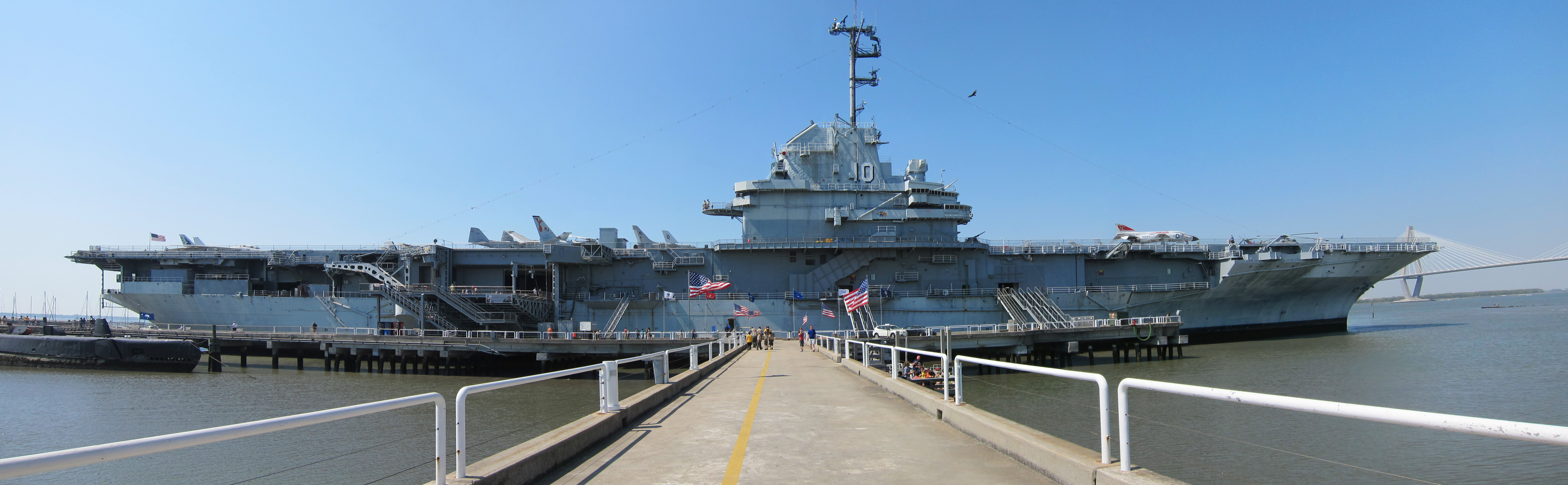
USS Yorktown (CV-10)
She was supposed to be named Bonhomme Richard. But six days after workers laid her keel at Newport News, Virginia, on December 1, 1941, Japanese aircraft attacked Pearl Harbor. Nine months later, when the original USS Yorktown went down at the Battle of Midway, the Navy renamed the half-built carrier in her honor. Eleanor Roosevelt smashed a bottle of champagne against the hull on January 21, 1943, and by April, USS Yorktown (CV-10) was commissioned and ready for war. Over the next three decades, this Essex-class carrier would fight across the Pacific in World War II, return for the Korean War, provide anti-submarine support during the Vietnam War, and pluck the Apollo 8 astronauts from the ocean after humanity's first voyage to the Moon. Today she sits in the still waters off Mount Pleasant, South Carolina, at Patriots Point -- 888 feet of steel, memory, and sacrifice, open to anyone willing to climb her ladders and walk her flight deck.
The Fighting Lady
Yorktown entered the Pacific war in the summer of 1943 and never slowed down. Her first combat strikes hit Marcus Island on August 31, followed by Wake Island in October. By November, she was part of Task Force 38 during the assault on the Gilbert Islands, her aircraft suppressing enemy airpower at Tarawa and Makin. In early 1944, she ranged from the Marshall Islands to Truk Atoll to the Marianas, her air groups striking Japanese installations across thousands of miles of ocean. During the Battle of the Philippine Sea in June 1944, Yorktown's pilots claimed 37 enemy planes destroyed in a single day and dropped 21 tons of bombs on Guam's airfields. She supported the invasions of Saipan, the Philippines, and Iwo Jima. On March 18, 1945, a Japanese dive-bomber planted a bomb on her signal bridge that punched two holes through the hull, killed five men, and wounded twenty-six. Yorktown stayed operational and kept launching strikes. She helped sink the battleship Yamato on April 7, 1945, during the doomed warship's final sortie. By war's end, she had earned 11 battle stars and the Presidential Unit Citation.
Three Wars and the Moon
Decommissioned in 1947, Yorktown was pulled from the mothball fleet in 1952 and modernized as an attack carrier for the Korean War era. She received an angled flight deck in 1955 to handle jet aircraft, then was reclassified as an anti-submarine carrier in 1957. During the Vietnam War, she ran anti-submarine patrols and search-and-rescue missions on Yankee Station, earning five additional battle stars. In early 1968, she rushed to the Sea of Japan after North Korea seized the USS Pueblo. But her most famous postwar mission came in December 1968, when she served as the prime recovery ship for Apollo 8 -- the first crewed spacecraft to orbit the Moon. Yorktown's crew fished Frank Borman, Jim Lovell, and William Anders out of the Pacific after their historic flight, placing the command module on the carrier's deck where it sat beneath the open sky, still warm from reentry.
From the Screen to the Shore
Yorktown had a brief Hollywood career. In late 1968, filmmakers used the carrier to recreate the Japanese attack on Pearl Harbor for the 1970 film Tora! Tora! Tora!, dressing the flight deck with period aircraft and pyrotechnics. The ship also appeared in the 1984 science fiction film The Philadelphia Experiment. Earlier in her career, she served as the filming platform for the Academy Award-nominated documentary short Jet Carrier. These productions captured something that static displays cannot: the organized chaos of a working flight deck, the thunder of aircraft launching into headwinds, the peculiar intensity of a crew numbering in the thousands operating as a single machine. When Yorktown was decommissioned on June 27, 1970, at Philadelphia, she had served the Navy for twenty-seven years across three wars, one space mission, and two movies.
Steel Against Salt Water
In 1974, the Navy approved donating Yorktown to the Patriots Point Development Authority. She was towed from Bayonne, New Jersey, to Charleston Harbor in June 1975 and formally dedicated as a memorial on October 13, 1975 -- the 200th anniversary of the United States Navy. Patriots Point museum opened to the public on January 3, 1976, making Yorktown the first aircraft carrier in the world converted into a museum ship. She was designated a National Historic Landmark in 1986. Through the 1990s, a public radio station broadcast from her primary flight control tower, overlooking the Charleston peninsula. Today the museum complex includes other vessels, a Vietnam Support Base replica, and the Medal of Honor Museum on Yorktown's hangar deck. But preserving 888 feet of warship against the corrosive power of saltwater is an endless battle. In 2015, engineers estimated $40 million in hull repairs were needed. By 2025, crews had removed 1.6 million gallons of waste fuel from her oil tanks -- a necessary first step before structural work can begin.
Walking Her Decks
Visitors to Patriots Point can climb through Yorktown's interior from the engine rooms to the bridge, passing through berthing compartments where sailors slept in bunks stacked four high, mess halls where three thousand men ate in shifts, and the combat information center where radar operators tracked incoming threats. The flight deck stretches more than two football fields long, lined with aircraft from different eras of naval aviation. Standing at the bow and looking aft, the deck narrows to a vanishing point against the sky. Across the harbor, the steeples of Charleston's churches punctuate the skyline. The Arthur Ravenel Jr. Bridge arcs overhead to the north. Fort Sumter sits in the harbor mouth to the south. Yorktown occupies the geographic center of Charleston's layered military history, a carrier that fought from the Gilbert Islands to Tokyo Bay, that carried astronauts home from the Moon, now resting in the same waters where the Civil War began.
From the Air
Located at 32.79°N, 79.91°W at Patriots Point Naval and Maritime Museum, Mount Pleasant, South Carolina. The 888-foot carrier is unmistakable from the air, moored along the western shore of Mount Pleasant with her flight deck clearly visible. The Arthur Ravenel Jr. Bridge crosses the Cooper River immediately to the north. Charleston International Airport (KCHS) is approximately 10 miles northwest. Charleston Executive Airport (KJZI) is 12 miles southwest. Best viewed at 1,000-2,000 feet altitude; the flight deck, island superstructure, and accompanying museum vessels are all clearly distinguishable. Fort Sumter is visible in the harbor mouth approximately 5 miles to the south-southeast.