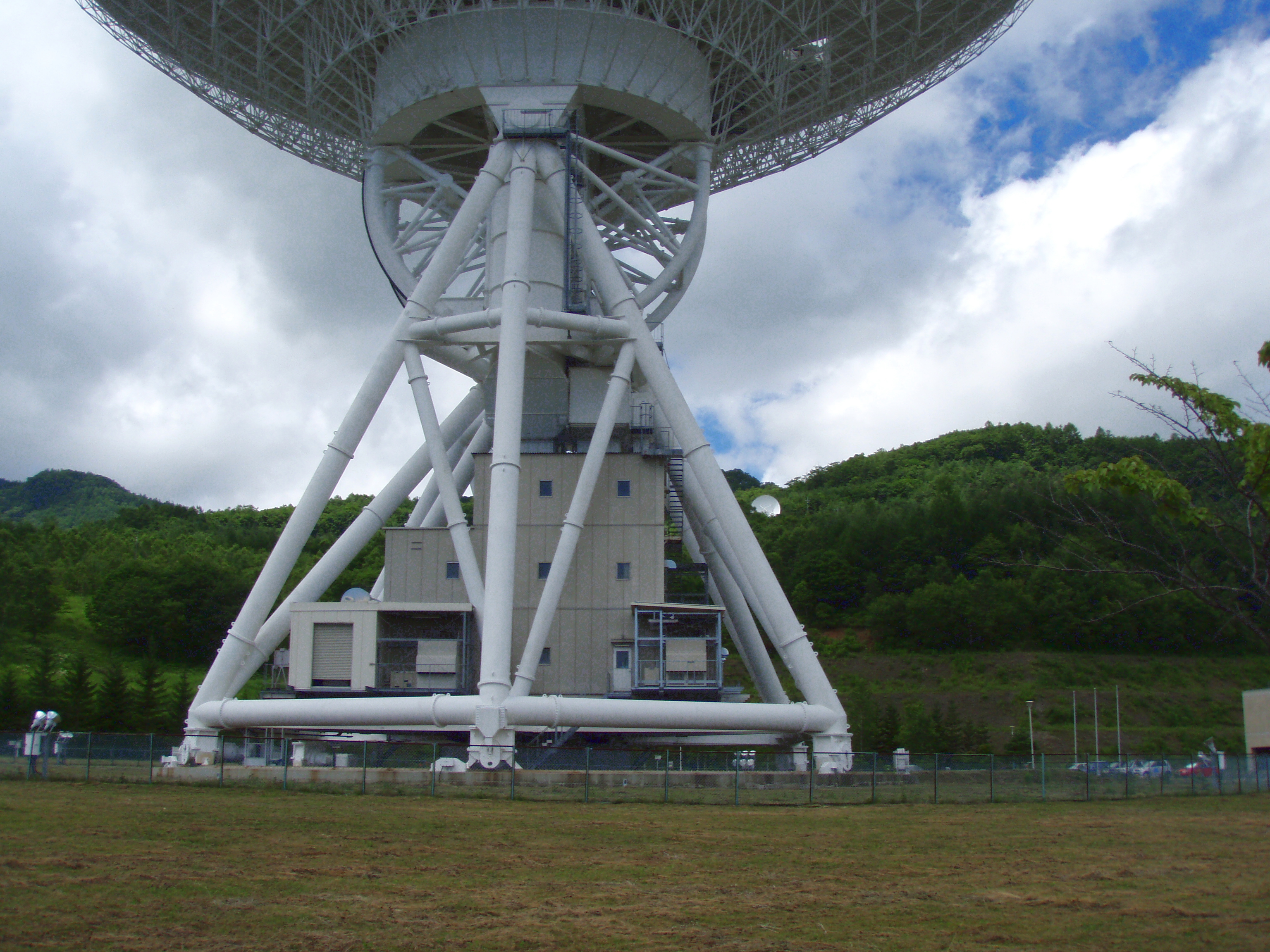
Usuda Deep Space Center
When Voyager 2 made its closest approach to Neptune in August 1989, Earth's rotation had carried every American tracking station below the horizon. The only antenna that could listen was a 64-meter dish tucked into the mountains of Nagano Prefecture, at a facility most of the world had never heard of. The Usuda Deep Space Center caught the signal, and the data it captured let scientists peer twice as deep into Neptune's atmosphere as they otherwise could have. It was exactly the kind of quiet, consequential moment that defines this place—Japan's primary link to its spacecraft scattered across the solar system.
A Revolutionary Dish in the Mountains
The Usuda Deep Space Center opened in October 1984, perched at 1,456 meters above sea level in what was then the town of Usuda, now part of Saku city. Its centerpiece was a 64-meter parabolic antenna weighing 1,980 tons, built by Mitsubishi Electric. What made this dish revolutionary was not just its size but its architecture: Usuda was the world's first deep-space antenna constructed with beam-waveguide technology, a method that routes radio signals through a series of mirrors inside the support structure rather than running cables up to a receiver at the dish's focus. Engineers had assumed this approach would introduce too much noise for deep-space work. They were wrong. When NASA's Jet Propulsion Laboratory tested the Usuda antenna, they found its noise performance actually surpassed their own conventional 64-meter dishes. JPL subsequently adopted beam-waveguide construction for every new antenna in its Deep Space Network.
Chasing Halley, Hearing Neptune
The antenna's first major test came quickly. In 1985, Japan launched twin probes—Sakigake and Suisei—to intercept Halley's Comet on its return through the inner solar system. Usuda tracked both spacecraft as they raced toward their 1986 encounters, establishing Japan as a serious player in interplanetary exploration. Three years later, the center took on an even more dramatic assignment: supporting Voyager 2's flyby of Neptune. An agreement between NASA and Japan's Institute of Space and Astronautical Sciences brought the Usuda antenna into the tracking network at a moment when no American ground station could see the spacecraft. The collaboration demonstrated that deep-space exploration was becoming a genuinely international endeavor, with critical infrastructure scattered across the globe.
The Hayabusa Drama
No mission tested Usuda's operators more than Hayabusa, Japan's audacious attempt to land on asteroid Itokawa and return a sample to Earth. In November 2005, as Hayabusa descended toward the tiny asteroid's surface, its high-gain antenna could not be used during the final approach. Communication was further disrupted during a handover between NASA's Deep Space Network and Usuda, creating an agonizing blackout. When contact was finally restored, controllers discovered the probe had lingered on the surface for 30 minutes before drifting 100 kilometers away. The spacecraft had crash-landed, taken damage, and entered safe mode. In the months that followed, Usuda's operators fought to maintain a fragile link with the crippled probe. Hayabusa eventually limped home in 2010, delivering asteroid samples to Earth—a feat that captivated Japan and vindicated the perseverance of the ground teams who never let go of the signal.
Passing the Torch
By the 2010s, the original 64-meter antenna had been operating for more than a decade past its designed service life. Some components could no longer be repaired. JAXA's answer was the Misasa Deep Space Station, a 54-meter dish built just 1.3 kilometers from the original antenna. Known during construction as GREAT—Ground Station for Deep Space Exploration and Telecommunication—the new dish uses an adaptive surface that can work at the higher Ka-band frequencies, making it the world's most sensitive antenna for Ka-band deep-space communication. Despite its smaller diameter, the increased frequency efficiency means higher data throughput. Completed in 2021, Misasa has taken over as the primary antenna, though the old 64-meter dish remains standing. Together, the two antennas continue to serve Japan's growing portfolio of deep-space missions, including Hayabusa2 and the Venus orbiter Akatsuki.
A Quiet Outpost With a Long Reach
Usuda sits in a mountain valley chosen precisely for its remoteness. The surrounding terrain shields the antennas from radio interference, and the elevation keeps them above much of the atmospheric moisture that degrades microwave signals. The general public can visit to observe the exterior installations and browse an exhibition room, though the operational heart of the facility remains restricted. For a place that has listened to spacecraft at Neptune, caught the whisper of a wounded probe tumbling past an asteroid, and changed how every space agency on Earth builds its antennas, Usuda carries its legacy with characteristic understatement. The dishes point silently upward, waiting for the next signal from the dark.
From the Air
Located at 36.133N, 138.362E in the mountains of Nagano Prefecture at 1,456 meters (4,777 feet) elevation. The 64-meter and 54-meter dishes are visible from above as large white circles in a forested mountain valley. Nearest airport is Matsumoto Airport (RJAF/MMJ), approximately 60 km to the southwest. Tokyo Narita (RJAA) is roughly 160 km to the southeast. Best viewed at altitudes below 10,000 feet for dish detail; the remote mountain setting makes the antennas stand out against the surrounding forest.