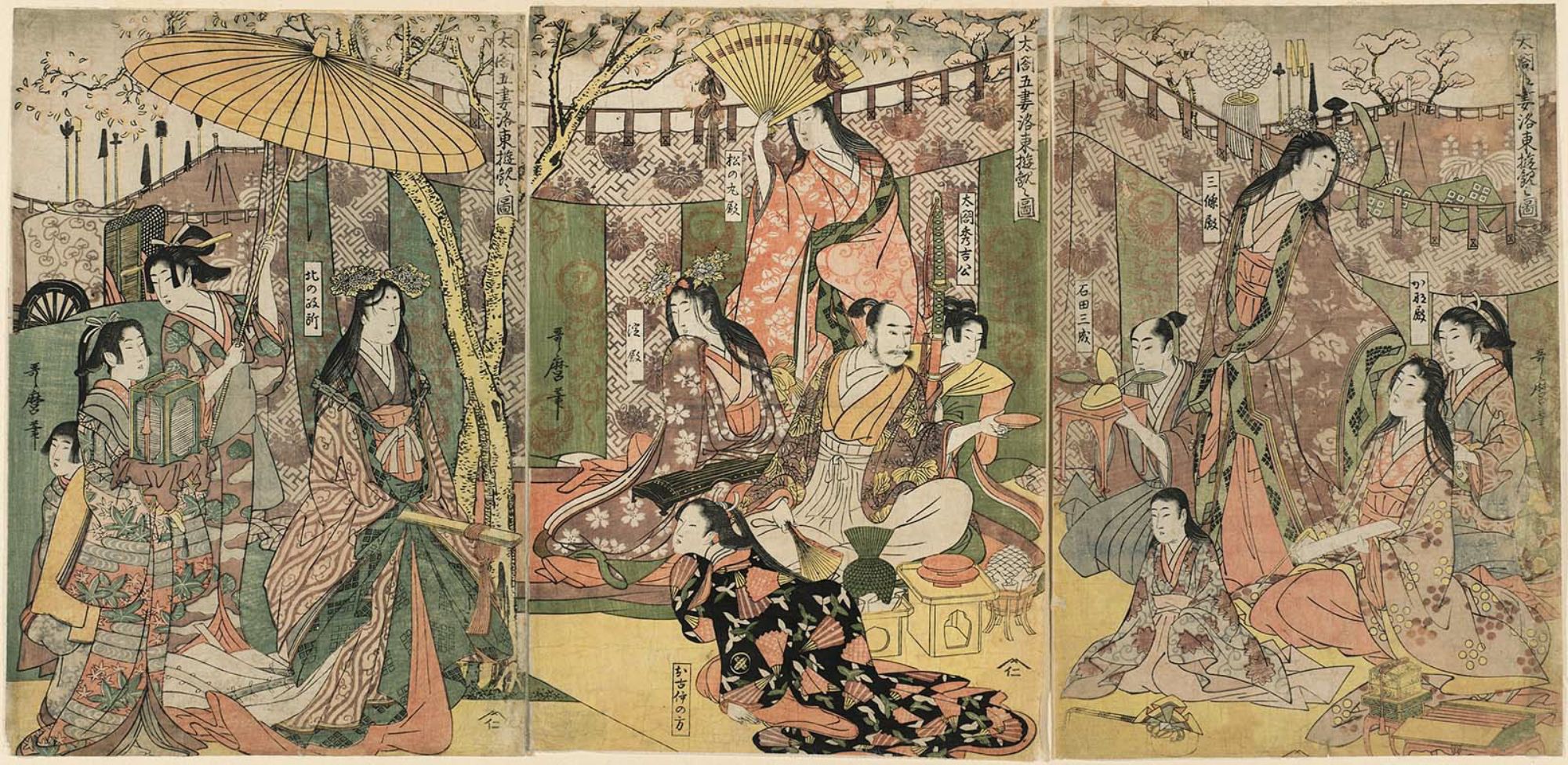
Utamaro
He signed some of his later prints "the genuine Utamaro" -- a strange boast for an artist, unless so many forgers were copying your work that you needed to remind the public who you were. Kitagawa Utamaro, active in Edo (modern Tokyo) during the late eighteenth century, produced over two thousand woodblock prints in his career, the finest of which captured the inner lives of women with a subtlety no Japanese artist had attempted before. His bijin okubi-e -- large-headed portraits of beautiful women -- used exaggerated, elongated features to convey mood rather than mere likeness. A century after his death, those prints would travel to Paris and help ignite Impressionism.
A Boy in the Floating World
Almost nothing about Utamaro's origins is certain. He was born Kitagawa Ichitaro around 1753, possibly in Edo, possibly in Kyoto, Osaka, or Kawagoe in Musashi Province -- no account has been verified. What is known is that as a child he entered the studio of Toriyama Sekien, a painter trained in the prestigious Kano school who had turned to ukiyo-e, the art of the "floating world." Sekien described his pupil as bright and devoted. Utamaro's first published work may have been a modest illustration of eggplants in a haikai poetry anthology printed in 1770. By 1775 he was producing kabuki playbook covers under the name Kitagawa Toyoaki, learning his craft in a city where art was commerce and commerce demanded speed.
Tsutaya's Prodigy
Utamaro's fortunes changed when the young publisher Tsutaya Juzaburo recognized his talent. In the autumn of 1782, Utamaro hosted a lavish banquet attended by leading artists including Kiyonaga, Kitao Shigemasa, and Katsukawa Shunsho, as well as the writer Ota Nanpo. It was at this gathering that he announced his new art name: Utamaro. He distributed a specially made print for the occasion featuring a self-portrait of himself making a deep bow before a screen bearing his guests' names. By about 1783, Utamaro moved into Tsutaya's household, becoming the firm's principal artist. Around 1791 he abandoned book illustration to concentrate on single half-length portraits of women -- a radical departure from the group scenes other ukiyo-e artists favored. The results were extraordinary: individuated faces that showed personality rather than the stereotyped, idealized beauty that had been the norm.
Women Seen, Not Posed
What set Utamaro apart was attention to interiority. His subjects were courtesans, mothers, wives, and working women from every social class, and he treated each as a specific person rather than a decorative type. He experimented with line weight, color layering, and mica-dusted backgrounds that glittered like frost. His series Ten Studies in Female Physiognomy, Twelve Hours in the Pleasure Quarters, and Great Love Themes of Classical Poetry remain touchstones of the form. He also produced nature studies -- illustrated books of insects rendered with scientific precision -- and shunga, erotic prints that circulated openly across all levels of Edo society. His output was staggering: over 120 bijin-ga print series, illustrations for nearly 100 books, about 30 paintings, and more than 30 shunga albums, published by at least 60 different firms.
Handcuffs and Silence
Tsutaya Juzaburo died in 1797, and friends noted that Utamaro was never the same. Government censorship tightened through the 1790s, requiring prints to carry official seals of approval. In 1804, Utamaro crossed a line. He produced a series of prints depicting the sixteenth-century warlord Toyotomi Hideyoshi -- identifying historical figures by name and showing Hideyoshi with courtesans of the pleasure quarters, both forbidden acts. One print showed the daimyo Kato Kiyomasa gazing lustfully at a Korean dancer; another depicted Hideyoshi holding his page Ishida Mitsunari's hand in a suggestive pose. Utamaro was arrested and manacled for fifty days alongside several other artists and the writer Jippensha Ikku. He died on October 31, 1806, barely two years later. With no heirs, his grave at Senko-ji Temple went untended until admirers restored it in 1917.
Across the Water
Utamaro's prints reached France in the mid-nineteenth century and landed in the hands of collectors who would remake Western art. Monet, Degas, Gauguin, and Toulouse-Lautrec all owned his work. The Impressionists adopted his emphasis on cropped compositions, partial views, and the interplay of light and shadow. An 1888 exhibition organized by the German-French dealer Siegfried Bing in Paris brought Utamaro's name to wide European attention, placing him alongside Hokusai and Hiroshige as one of the supreme masters of ukiyo-e. The American painter Mary Cassatt absorbed his compositional sense and tranquil palette into her own domestic scenes. In 2016, his print Fukaku Shinobu Koi set the auction record for a ukiyo-e work. Two centuries after his death in disgrace, Utamaro is recognized as one of the greatest figure artists in the history of Japanese art.
From the Air
Utamaro's life was centered in Edo, modern-day Tokyo. His likely residences included areas near Yoshiwara (the pleasure district in what is now Taito Ward, around 35.72N, 139.80E) and Bakuro-cho in Chuo Ward. His grave is at Senko-ji Temple. The geographic pin at approximately 35.680N, 139.595E falls in the western Tokyo area near Chofu. Nearest airports: Tokyo Haneda (RJTT) approximately 15 km south, Narita International (RJAA) approximately 65 km east. Best appreciated by overflying the historic Asakusa-Yoshiwara district at 2,000-3,000 feet, where the grid of old Edo's pleasure quarters can still be traced in the modern street plan.