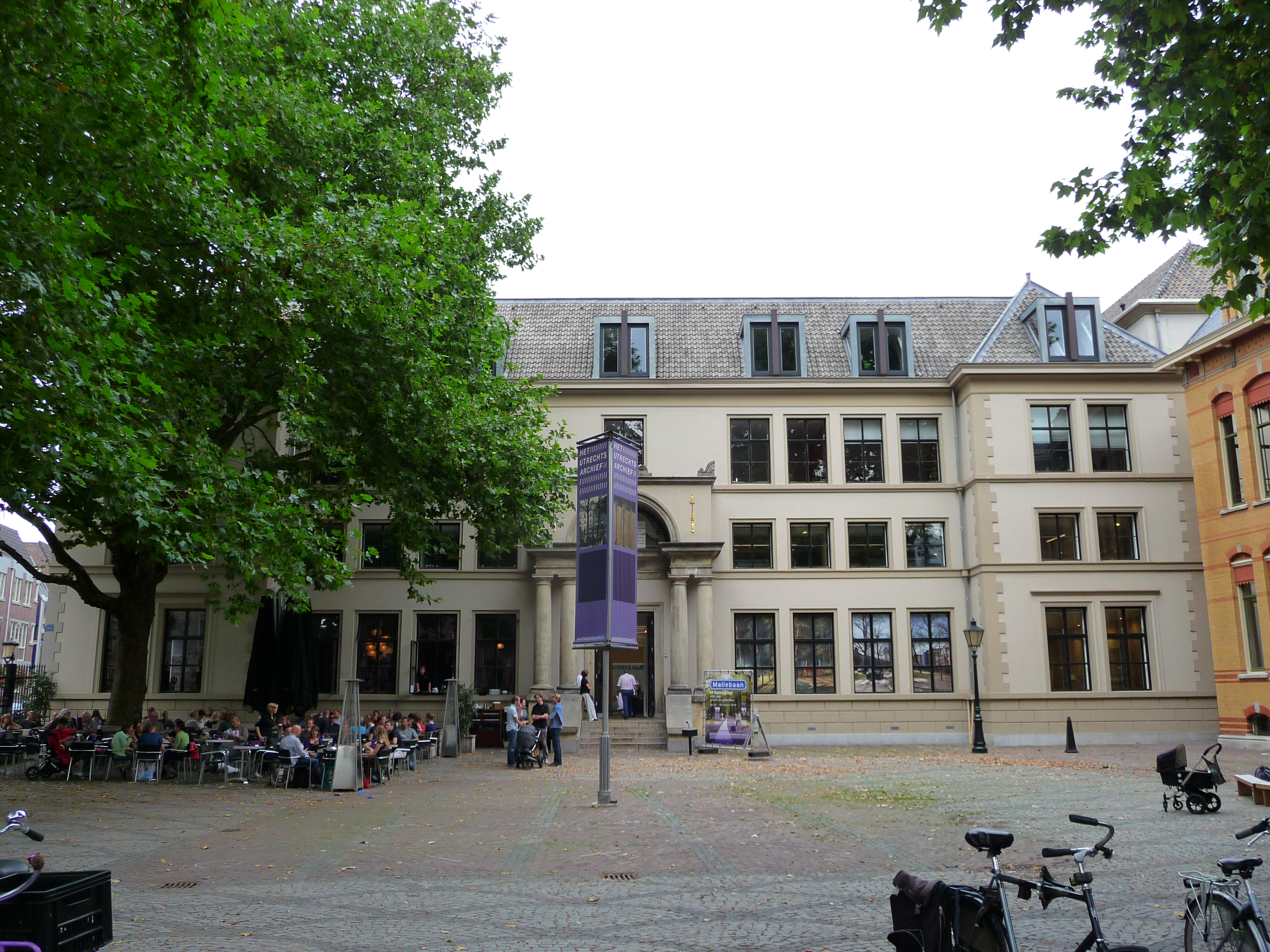
Utrecht Archives
In the Middle Ages, the records of the city of Utrecht lived in a chest, and the chest lived inside one of the city gates - the Catharijnepoort. The gate also stored gunpowder. At some point, somebody made the obvious calculation, and the archive moved. By 1546, the city's documents had found a building at the Stadhuisbrug called Lichtenberg. Today, those same records, along with about 200 kilometers of additional paper, sit inside the former abbey of Saint Paul on Hamburgerstraat - a building older than the documents themselves, with monastic walls and reading rooms where the medieval refectory once stood.
Saint Paul's Abbey, Beneath the Floor
Bishop Bernold founded Saint Paul's Abbey on this site in 1050, one of the oldest and most important monasteries in Utrecht. The 1253 fire destroyed much of the original complex, which was rebuilt and survived until the Iconoclastic Fury and the Reformation emptied the monasteries of the Low Countries. The abbey then became the Court of Utrecht, and the building functioned as a law court until 2000. Fragments of the monastery remain visible inside the modern reading rooms. The hallway on the ground floor preserves a section of the old ambulatory. The auditorium contains stones from the monastic chapter house, refectory, and dormitory. The reading room sits where the medieval library stood. In the basement, cellar walls survive from the eleventh century. Researchers consult genealogical records inches above ground that monks once walked in silence.
Two Hundred Kilometers of Memory
The Utrecht Archives hold the largest and richest documentary collection on the history of the province and city of Utrecht: more than 200 kilometers of paper, over 70,000 publications, around 18,000 postcards, roughly 110 films, more than 6,000 drawings, and almost 5,000 prints. The Image Bank offers around 130,000 digitized photographs from a collection of more than 100,000 originals. The Archive Database contains over 1,249,300 scans of original records. The local newspaper Utrechts Nieuwsblad, from 1893 to 1967, is fully digitized. The archive is one of the few in the Netherlands that holds the national center for ecclesiastical records - centuries of church documents from across the country - alongside the records of the Dutch Railways, headquartered in Utrecht since the railway age began here in 1843.
The Master of the Rolls
In April 1803, the magistrate Petrus van Musschenbroek of Utrecht was named the department's honorary keeper of records. By October he held the post permanently, the city's first official archivist. An 1826 Royal Decree required Dutch provinces and local authorities to inventory their archives, and the position of archivist became a serious professional role. Christiaan Paulus de Vos took charge of the ecclesiastical records that would eventually form the foundation of the Public Record Office in Utrecht. His successor, Gerrit Dedel, used the unofficial title Master of the Rolls - a flourish borrowed from English judicial tradition, applied to a Dutch document keeper. The current Utrecht Archives, founded in 1998, came from the merger of the Public Record Office and the city's Communal Archive and Photo Service, now jointly run by the Dutch Ministry of Education, Culture and Science and the municipality of Utrecht.
A Neoclassical Face on a Medieval Building
In the nineteenth century, the architect Christiaan Kramm wrapped the old monastic complex in a new neoclassical facade, moving the entrance to the center and raising the ground floor to match. By 1900, the building was already too small for its court duties. The architect Willem Metzelaar designed an adjacent Cantonal Court on Hamburgerstraat. In the 1950s and 1960s, more dramatic reconstruction added the current floors, staircases, and doorposts. The court moved out in 2000 to a new building at the Catharijnesingel, the section now called the Court Hotel was remodeled, and in June 2008 the Utrecht Archives took up residence in the building that had served as monastery, law court, and now record office across nearly a thousand years.
Two Locations, One Mission
The Hamburgerstraat 28 location holds the visitor center, exhibition spaces, and the reading room used for genealogical research and local history - the public face of the archive. The other location, at Alexander Numankade 199-201, holds the depots themselves: the climate-controlled storage where the kilometers of paper rest, alongside a library and a more specialized reading room for studying original records. About 70 employees and a large group of volunteers staff the archive. Researchers chasing family histories, scholars working on the Bishopric of Utrecht, journalists tracking down old photographs of vanished neighborhoods - they all come here. The abbey served the soul, the court served justice, and the archive serves memory, the third in a sequence the building seems to accept without protest.
From the Air
Coordinates 52.0891 N, 5.1228 E. Located on Hamburgerstraat in the historic center of Utrecht, just southwest of the Dom Tower and a short walk from the city's medieval canals. From altitude, identify the dense roof grid of central Utrecht with the cathedral tower as the anchor. Nearby airports: Amsterdam Schiphol (EHAM) sits about 40 km west-northwest; Rotterdam The Hague (EHRD) is about 55 km southwest. Recommended viewing altitude 1,500-2,000 ft for the medieval street pattern; the rooflines around the archive are best seen in raking late-afternoon light.