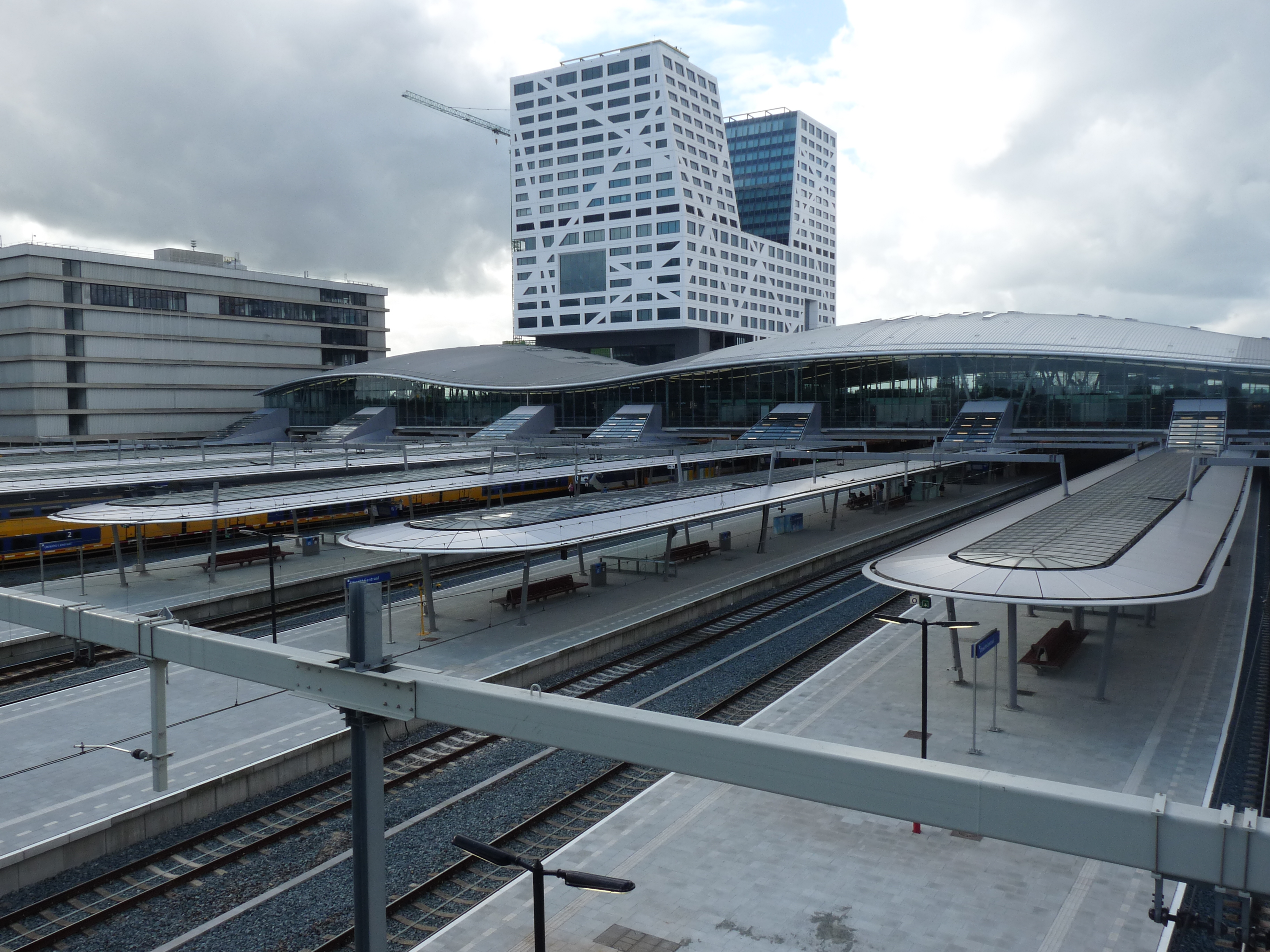
Utrecht Centraal station
Two or three times a year, a snowflake fell on the wrong switch at Utrecht Centraal, and the entire Dutch railway network ground to a halt. As the central hub of the country, with more than a thousand departures a day, the station's complexity had become its weakness: roughly 200 track switches, all of them potential points of failure, in a layout so tangled that one disruption rippled outward in minutes. The solution, when Dutch engineers finally found it, did not come from European rail tradition. It came from Shinagawa Station in Tokyo.
The Largest in the Netherlands
Utrecht Centraal is the largest train station in the Netherlands by every measure that matters. The railway has sixteen platform tracks, twelve of them through tracks. Roughly 207,360 embarking and disembarking passengers move through it each day, not counting transfers. More than a thousand trains depart daily. The bus stations on either side are also the largest and busiest in the country, and the bicycle parking facility on the east side is the largest in the world. The station opened on 18 December 1843, when the Nederlandsche Rhijnspoorweg-Maatschappij ran the first train onto Utrecht soil. The 1865 station building survived fire, renovation, and a long industrial life before the wrecking crews finally took it down in the 1970s.
Swallowed by a Shopping Mall
On 17 December 1973, Europe's largest enclosed shopping mall opened on top of the station. Hoog Catharijne wrapped around the platforms with such totality that for almost forty years Utrecht Centraal had no entrance of its own. The passageways of the mall simply continued into the station hall. Passengers stepped off Intercity trains and into department stores without knowing where one ended and the other began. The station hall was enlarged in 1989, tripling its original size. A new platform appeared in 1995. None of it solved the underlying problem: a station designed for a smaller country, swallowed by a shopping mall, trying to serve as the nervous system of Dutch rail.
Learning From Shinagawa
Between 2011 and 2016, the Dutch government finally committed 270 million euros to remodel the track layout, and the engineers at ProRail went looking for a working model. They found it at Shinagawa Station in Tokyo. The Japanese principle was disciplined: separate the traffic flows physically, give each its own dedicated tracks, optimize for speed and headways, and add switches only where strictly necessary for traffic management. Every additional switch had to justify itself through a cost-benefit analysis weighing financial cost against delay minutes. The result, applied at Utrecht, was a layout with roughly 60 switches replacing the previous 200. Train speeds for both passenger and freight services rose from 40 to 80 km per hour through the station. Capacity doubled. The station now has the bandwidth to grow to eight trains per hour on every corridor, enough to last until 2040.
The New Hall and Its Three Curves
Above the new tracks, Benthem Crouwel Architekten designed a curved roof that hangs over the station like three connected waves. The largest curve covers the railway hall. Two smaller curves cover the bus and tram stations on either side. The whole structure, opened gradually through 2016, brought every form of transit under one roof - trains, buses, trams, bicycles, and pedestrians flowing through a single concourse. The station finally separated itself from the Hoog Catharijne shopping mall, regaining its own front door for the first time in four decades. A scale model of the new Utrecht Centraal is on display at Madurodam, the miniature Holland that has captured the country's landmarks since 1952.
Trams Above and Below
Light rail arrived at Utrecht Centraal in 1983 with the SUNIJ line running to Nieuwegein and IJsselstein. For decades the tram stop sat on the east side. Construction work shifted it to Jaarbeursplein on the west in 2013. In December 2019, a new Centrumzijde terminal opened beneath the main hall, and the Uithoflijn began running tram route 22 out to the university science park. For a few years passengers transferring between the two lines had to walk 500 meters between stops. In July 2022, through-passenger service finally linked the lines, eliminating the transfer. Trams now travel directly between Nieuwegein and the Uithof district by way of the station - one more connection in a hub that, since the Shinagawa lesson, finally lets the country keep moving when one small thing goes wrong.
From the Air
Coordinates 52.0893 N, 5.1100 E. The station occupies the western edge of central Utrecht, just outside the medieval canal ring. From altitude, identify the distinctive three-curve roof of the new hall and the long parallel platforms running roughly north-south. Nearby airports: Amsterdam Schiphol (EHAM) lies about 40 km west-northwest; Rotterdam The Hague (EHRD) is about 55 km southwest. Recommended viewing altitude 1,500-2,500 ft for the station roof structure; the curves are most legible from directly above or from a steep north-south approach.