Utsalady, Washington
By 1855, lumber from Utsalady was reaching the shipyards at Brest, France. By 1860, it was arriving in Shanghai. A community of fewer than 150 people, perched on the north shore of Camano Island in Puget Sound, was supplying timber to two of the world's busiest ports before most Americans had heard of the place. Utsalady's story is a compressed version of the Pacific Northwest timber economy -- explosive growth fueled by old-growth forests and deepwater access, followed by a long, quiet decline as the trees and the markets moved on.
The People of Doksk Ad
The Kikiallus people inhabited this stretch of Camano Island's north shore long before European settlers arrived. They were part of the larger Coast Salish world, speakers of Lushootseed who maintained longhouses here and along the Skagit River on nearby Fir Island. The Lushootseed name for the place -- something like the sound that English speakers rendered as Utsalady -- has survived the centuries better than the Kikiallus themselves. The name the people used for their home, Doksk Ad, has largely faded from common use. What the Kikiallus found here, the settlers also found: sheltered water, timber that seemed limitless, and a shoreline deep enough to load sailing ships directly from the mill.
Timber and Telegraph
The first European-descended settlers arrived in 1853. Within two years, Utsalady had a working sawmill and an export trade. The numbers from the 1870 census paint a portrait of a frontier boomtown in miniature: 54 houses, 147 residents, a blacksmith shop, a telegraph office, a saloon, a shipyard, and a school. By 1872, the community had added a Masonic hall. A granary followed in 1874. And by 1883, sailing ships were hauling away 74,000 board feet of timber every day -- an enormous volume for a settlement smaller than a modern city block. The shipyard was not just repairing vessels; it was building them, feeding the same maritime commerce that carried Utsalady's lumber across the Pacific.
What the Ladies Aid Preserved
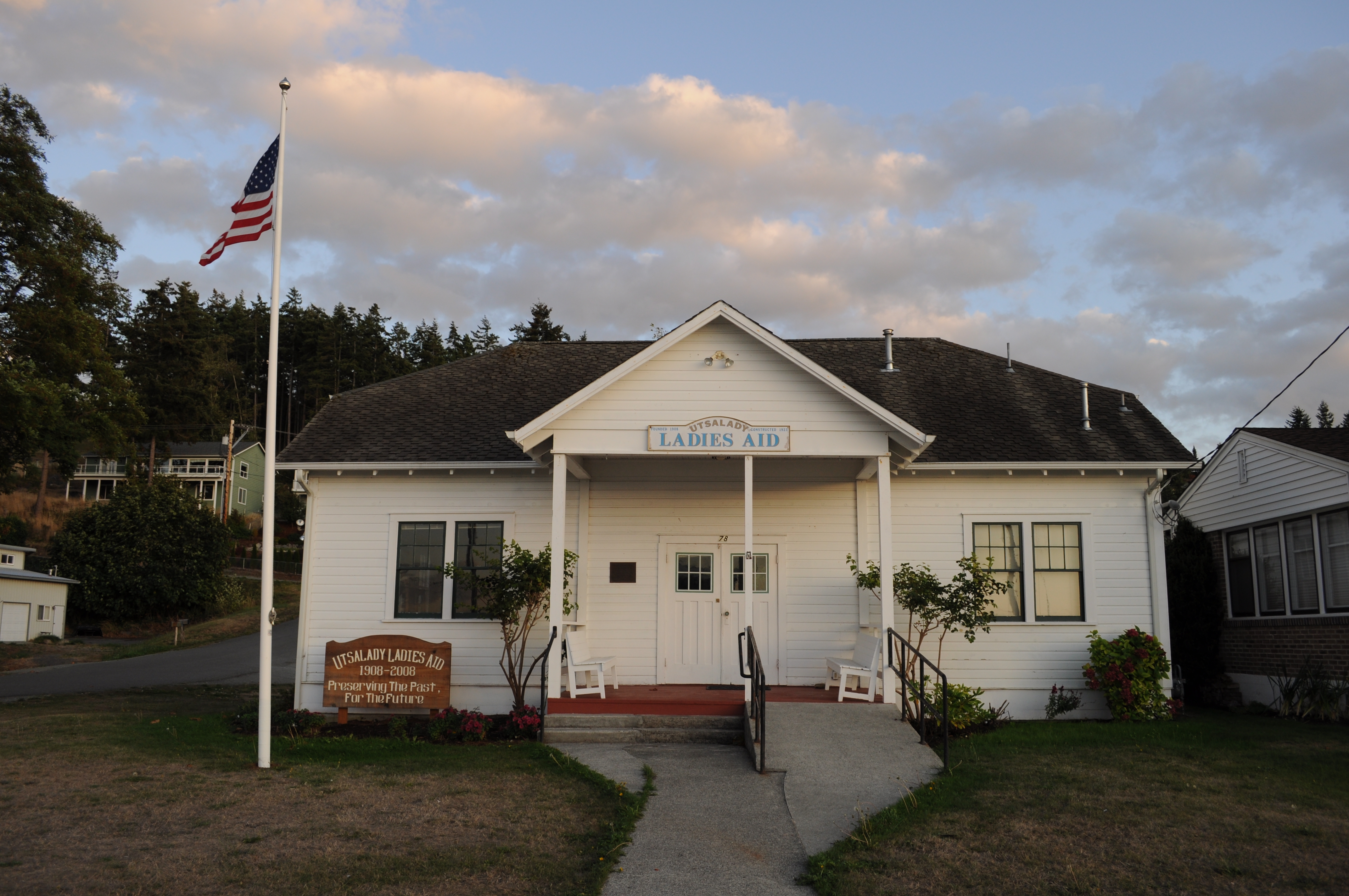
The Utsalady Ladies Aid was founded in 1908, and its 1923 meeting hall still stands on the north shore of Camano Island, listed on both the National Register of Historic Places and the Washington State Heritage Register. The organization was still active as recently as 2008, making it one of the longest-running community groups in Island County. The building itself is a modest, wood-framed structure that would be easy to drive past without noticing -- which is precisely its significance. It represents the social infrastructure that sustained small communities after the economic booms faded. When the timber ran thin and the shipyard closed and the population drifted away, the Ladies Aid kept meeting. Today Utsalady is an unincorporated community within the Camano census-designated place, with an elementary school connected to the Stanwood school system and a shoreline that looks much as it did when 74,000 board feet left the harbor every day -- minus the sailing ships.
From the Air
Located at 48.25N, 122.48W on the north shore of Camano Island, facing Skagit Bay. The community is a scattered settlement along the waterfront, not a dense town center. Look for the shoreline between Utsalady Point and the northeastern tip of Camano Island. Nearest airports: KBVS (Skagit Regional) approximately 10 nm northeast, KPAE (Paine Field) approximately 28 nm south. Recommended viewing altitude 1,500-2,500 ft AGL. The contrast between Camano's forested interior and the cleared shoreline settlement is visible from moderate altitude.