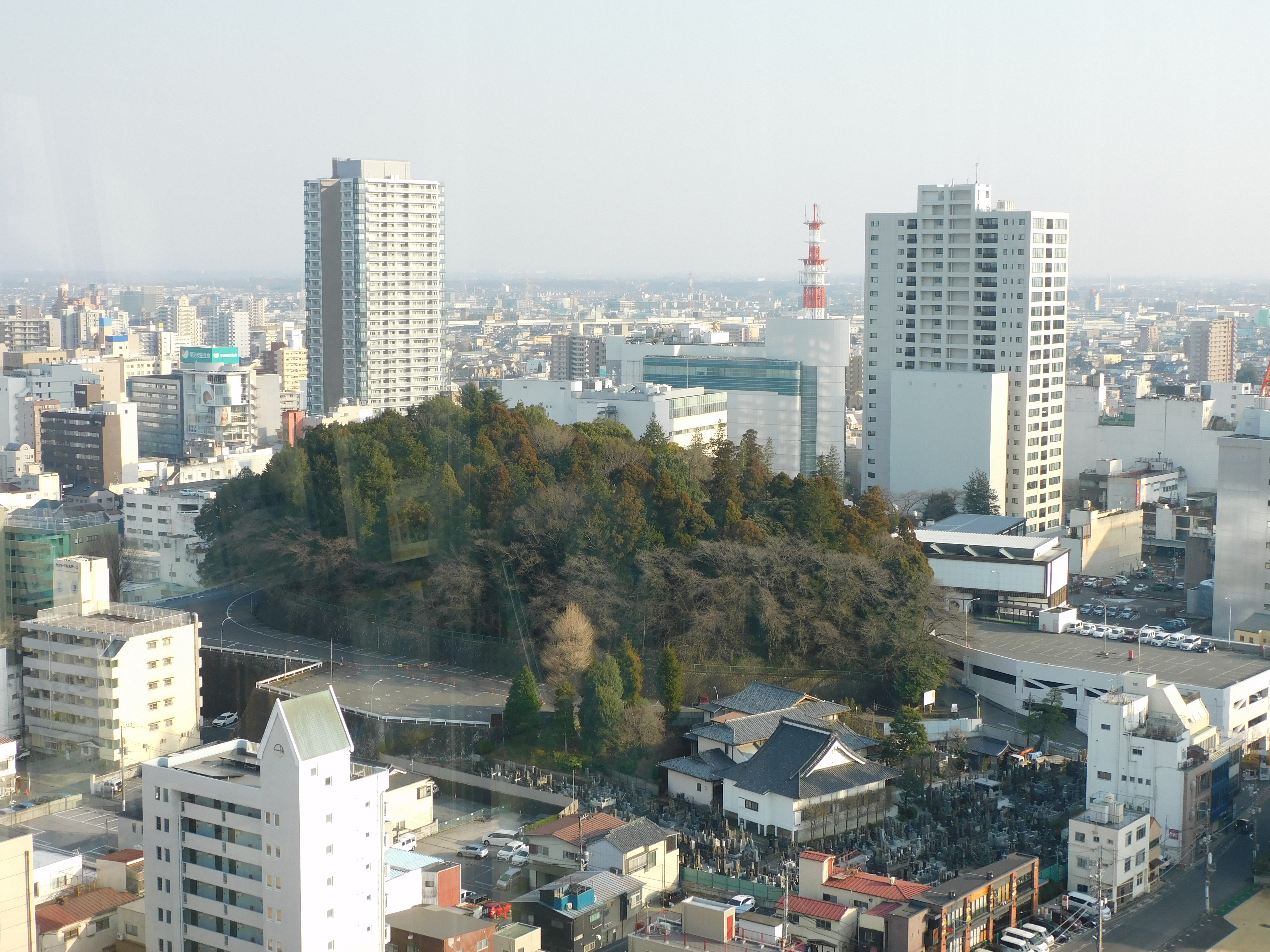
Utsunomiya Futarayama Shrine
Fujiwara Hidesato needed a miracle. The rebel Taira no Masakado had declared himself the new emperor and was tearing through the provinces with an army no one could stop. Hidesato climbed the hill called Usugamine in the heart of Shimotsuke Province, entered the shrine of Futarayama, and prayed. According to tradition, the shrine granted him a magic sword. He carried it into battle during the Johei-Tengyo Rebellion and cut Masakado down. The shrine on this hilltop had already been old when Hidesato arrived. It would still be standing when Japan's last samurai rode past it a thousand years later.
A Prince's Dream, a Province's Soul
The shrine traces its origins to the 5th century, when Emperor Nintoku divided the ancient province of Keno at the Kinugawa River into two halves -- Kamitsukeno and Shimotsukeno, later known as Kozuke and Shimotsuke. He appointed a nobleman named Narawake-no-kimi as regional governor of Shimotsukeno, and this governor built a shrine to honor his great-grandfather, Prince Toyokiirihiko. According to the Nihon Shoki, the prince had been dispatched to the east by his father Emperor Sujin after a prophetic dream involving Mount Miwa, a spear, and a sword pointed toward the sunrise. When Toyokiirihiko journeyed to his new territory, he carried with him a bunrei -- a divided spirit -- of the deity Omononushi from the ancient Omiwa Shrine. That sacred presence took root on this hill and has remained for over fifteen centuries.
The Hilltop That Named a City
The shrine sits at the summit of Mount Myojin, also called Usugamine, which rises just 135 meters but commands the center of the Kanto Plain. The place name Utsunomiya itself derives from the name of this shrine -- the city grew up around the sacred precinct, not the other way around. The Utsunomiya clan, a branch of the powerful Fujiwara family who dominated the region for five centuries from the late Heian period onward, were originally the shrine's own kannushi -- hereditary priests. Their transition from spiritual guardians to feudal warlords mirrors the broader story of medieval Japan, where religious authority and military power merged at the hilltop fortresses of the Kanto.
Swords and Prayers
Because Prince Toyokiirihiko was celebrated for his martial prowess, the Futarayama Shrine became the place where warriors prayed. The list reads like a roster of Japanese military legend. After Fujiwara Hidesato's victory over Masakado, the Heike Monogatari records that the archer Nasu no Yoichi prayed here before his famous feat at the Battle of Yashima, where he struck a fan mounted on a rocking boat from horseback. Minamoto no Yoriyoshi and Minamoto no Yoshiie both sought the shrine's blessing, as did Minamoto no Yoritomo, the founder of Japan's first shogunate. Even Tokugawa Ieyasu, the man who unified Japan, made donations and ordered renovations. Only two Futarasan shrines in all of Japan have an ancient origin documented in the early Heian-period Engishiki -- this one and the famous one in nearby Nikko.
Burned and Reborn
The shrine once followed the tradition of cyclical rebuilding, reconstructed fresh every 20 years. But fire had other plans. The Late Hojo clan's invasion of Utsunomiya in 1585 burned it down. Fires in 1773 and 1832 destroyed it again. Then came the Boshin War of 1868, when pro-Tokugawa forces stormed Utsunomiya Castle just next door, and the shrine burned once more in the crossfire. The current structure dates to 1877, rebuilt as a temporary shrine by the new Meiji government -- a 'temporary' building that has now lasted nearly 150 years. Among its cultural treasures is a star-shaped iron helmet from the Nanbokucho period, assembled from 38 separate iron plates with studs hammered through from behind, and a pair of cast-iron guardian dogs from the Kamakura period.
At the Heart of the Plain
Today the shrine presides over central Utsunomiya, a ten-minute walk from Tobu-Utsunomiya Station. Its main festival falls on October 21 each year. The torii gate, the honden sanctuary, the kagura dance stage, and the formal gate all stand on the modest hilltop where fifteen centuries of Japanese history converged -- where priests became warlords, where warriors sought divine swords, and where a city took its name from the sacred ground beneath its streets.
From the Air
Located at 36.5625N, 139.886E on the summit of Mount Myojin (Usugamine, 135m elevation) in the center of Utsunomiya city, Tochigi Prefecture. The shrine hilltop is immediately adjacent to the Utsunomiya Castle park site to the south. Nearest airport: Utsunomiya Air Field (RJTU), a JGSDF facility approximately 10 km north. Narita International Airport (RJAA) lies roughly 120 km to the south. From altitude, look for the wooded hilltop rising from the city grid near the castle park. Nikko's mountain shrines are visible to the northwest on clear days. Best viewed at 2,000-4,000 ft AGL to see the hilltop shrine complex in relation to the surrounding city.