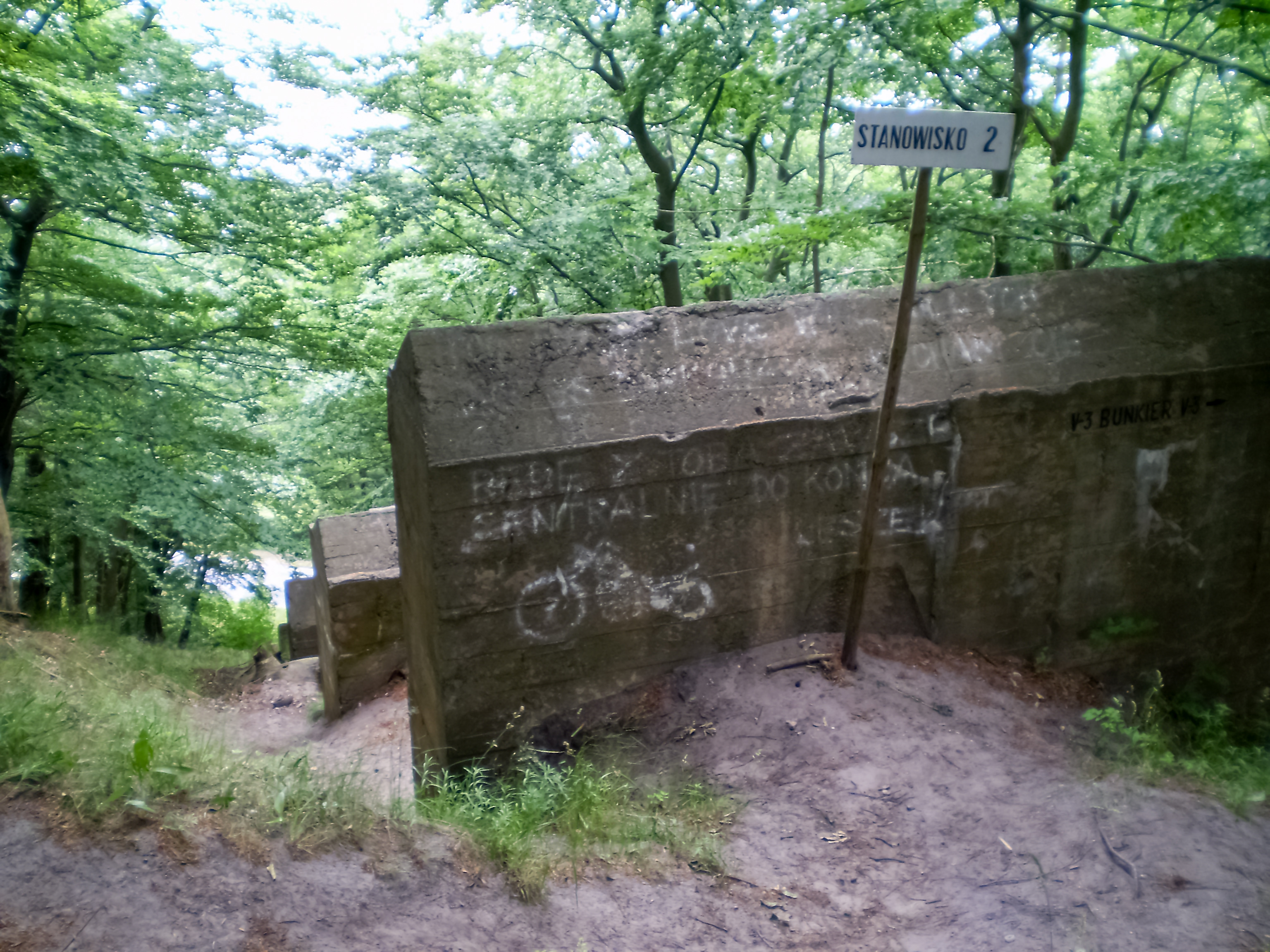
V-3 cannon
The Germans called it Tausendfussler, the millipede, because its 130-metre barrel sprouted angled side chambers like a chain of legs. The official codename was Hochdruckpumpe, High Pressure Pump, the bland phrase chosen to hide the truth. To the SS, it was a Vergeltungswaffe, a vengeance weapon. To one of the engineers, it was Fleissiges Lieschen, Busy Lizzie. To the people of Luxembourg, it was the noise on a clear winter morning in January 1945 that meant another shell had arrived from a forest fifty kilometres away.
An Idea from 1857
The basic principle is older than the Civil War. In 1857, an American inventor named Azel Storrs Lyman patented an Improvement in Accelerating Fire-Arms based on a simple insight: in a conventional gun, all the pressure peaks at the breech and then drops as the shell flies down the barrel. A heavier breech means a heavier gun. Lyman and his collaborator James Richard Haskell wondered what would happen if smaller propellant charges fired in sequence at intervals along the barrel, each one adding velocity as the shell passed. Smoother acceleration. Lower peak pressure. Longer effective range without a monstrous breech. They built a prototype, tested it at the Frankford Arsenal in Philadelphia in 1880, and watched it perform worse than a conventional Armstrong gun. The flash from the first charge leaked past the projectile and lit the others early. They gave up. A French engineer named Louis-Guillaume Perreaux, who is also remembered as a pioneer of the motorcycle, patented a similar gun in 1864 and showed it at the 1878 Paris World Exhibition. Nothing came of that either.
The Engineer at Wetzlar
Eighty years later, when German troops overran France in June 1940, they found archived French Army plans for a long-range multi-charge gun. The plans landed on the desk of August Conders, chief engineer of the Roechling steelworks in Wetzlar. Conders had developed the Roechling shell. He thought he could solve what Lyman and Haskell could not: he proposed electrically activated charges that fired only after the projectile had passed. He built a 20-millimetre prototype using machinery already on hand for Flak 38 anti-aircraft barrels. Then he built a full-calibre gun at the Hillersleben proving ground near Magdeburg. By the end of 1943 he was in trouble. The shells tumbled in flight. The muzzle velocity was just over 1,000 metres per second, far short of what he had promised. The Heereswaffenamt took the project over in March 1944 and gave Conders three problems to solve at once: projectile design, obturation (sealing the gases behind the shell), and ignition of the secondary charges. Six firms, including Krupp and Skoda, were asked to submit shell designs.
Misdroy and Mimoyecques
While Conders fought the physics, two giant deployments went forward. In northern France, near Mimoyecques in the Pas-de-Calais, Organisation Todt began boring two parallel underground complexes, each meant to hold five stacked clusters of five gun tubes for a total of fifty barrels. The plan was simplified to twenty-five barrels in a single complex when the western site was abandoned to bombing. On the Baltic, a single full-length gun with a 150-metre barrel was erected at Misdroy on the island of Wolin, near the Peenemunde rocket centre. Trials at Misdroy in May 1944 reached 88 kilometres. On 4 July 1944 a shell flew 93 kilometres, and the gun burst on the next round. Mimoyecques was already being plastered by Allied bombs and would be destroyed by 617 Squadron's Tallboy bombs two days later. The full V-3 system never fired at London.
Lampaden: Two Half-Barrels in a Ravine
What did fire was a smaller cousin. By autumn 1944 the SS, under Hans Kammler, ordered Conders' team to build two shortened half-barrel V-3 guns, each about 50 metres long with twelve side chambers instead of the original 32. These were dragged to a wooded ravine of the Ruwer River at Lampaden, 13 kilometres southeast of Trier, and mounted at a 34-degree slope facing west. Concrete blockhouses sat between them. Their target, designated Number 305, was the recently liberated city of Luxembourg, 43 kilometres away. The first tube fired five warm-up rounds and five high-explosive shells on 30 December 1944, with Kammler himself watching. The muzzle velocity was about 935 metres per second. A 95-kilogram finned shell with a discarding sabot carried roughly seven kilograms of explosive.
The Luxembourg Casualties
From 30 December 1944 to 22 February 1945, the Lampaden guns fired 183 rounds at Luxembourg City. Forty-four were confirmed hits on the urban area, with 142 striking the city overall. Ten people were killed. Thirty-five were wounded. These are small numbers, statistically. They are also a real ten people: civilians in a small, freshly freed city, killed by an experimental weapon fired from a forest by Captain Patzig's artillery battalion. The bombardment ended when US Army units advanced to within three kilometres of Lampaden. A second battery was being prepared at Buhl in Alsace, aimed at Belfort to support the Operation Nordwind offensive; one gun was erected but the offensive collapsed before it fired. All four HDP guns were eventually abandoned at the Roechling works in Wetzlar.
The Supergun That Never Was
Hitler had wanted barrages on Paris, Antwerp, London. None happened. The reasons were prosaic: the railway network was disintegrating, ammunition was scarce, the projectile design never fully worked. After the war, the principle waited for fresh attempts. In the 1980s, the Canadian artillery scientist Gerald Bull pursued the same multi-charge concept as Project Babylon, a supergun for Saddam Hussein's Iraq, before he was assassinated in Brussels in 1990. In 2015, Cambridge engineer Hugh Hunt built a working scale model of the V-3 with explosives engineer Charlie Adcock, finally proving that the secondary charges were ignited by the gas behind the projectile rather than the projectile itself, settling a technical argument that had outlived both Conders and the city the gun was built to destroy.
From the Air
The full-scale V-3 was built at the Fortress of Mimoyecques (50.854°N, 1.758°E) in the Pas-de-Calais, 165 km from London on a bearing of 299 degrees. Test barrels lie at Misdroy/Miedzyzdroje on the Polish island of Wolin (53.93°N, 14.45°E), and the operational half-barrel guns were sited at Lampaden in the Ruwer valley (49.65°N, 6.81°E), 13 km southeast of Trier, Germany. For the Mimoyecques site itself, see the Fortress of Mimoyecques flight notes. Nearest airport to Mimoyecques: Calais-Dunkerque (LFAC), 20 km north-northeast. Best viewed at 2,500-4,000 feet.