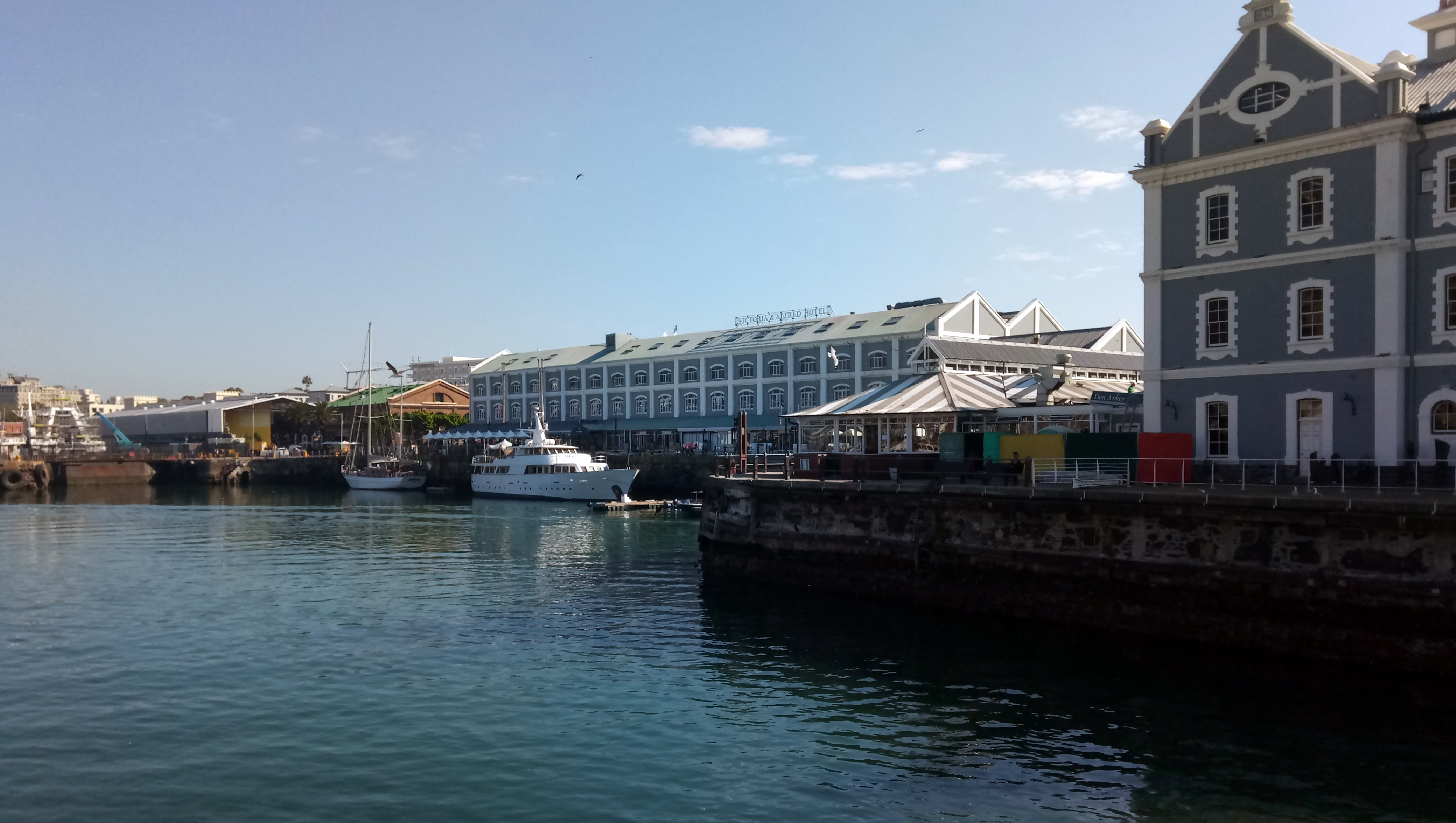
V&A Waterfront
In 1654, two years after arriving at the foot of Table Mountain, Jan van Riebeeck hammered together a small wooden jetty. It was a modest thing, meant to resupply passing ships for the Dutch East India Company. Three and a half centuries later, that jetty's descendants occupy 123 hectares of prime waterfront real estate, and 24 million people pass through every year. The V&A Waterfront is the oldest working harbour in the Southern Hemisphere, a place where container cranes still swing above commercial berths while tourists sip wine at restaurants a stone's throw from the loading docks. It is named for Queen Victoria and her son Prince Alfred, who visited the Cape Colony while serving in the Royal Navy and ordered the construction of a proper harbour. The imperial ambitions of that era built the basins; today's ambitions have built something stranger and more interesting around them.
Two Basins, Two Centuries
The discovery of gold and diamonds in South Africa's interior transformed what had been a modest provisioning stop into one of the busiest ports in the Southern Hemisphere. The Alfred Basin, completed first, could not keep up with the flood of ships hauling ore and fortune seekers. The Victoria Basin followed, and together they were under construction from 1860 to 1920. The heritage buildings from that era still line the quays, their Victorian brickwork and cast-iron detailing now housing craft markets and cocktail bars. In 1938, the massive Duncan Dock was built on 230 hectares of reclaimed land, shifting commercial shipping north and leaving the older basins to slowly quiet. By the 1980s, the Victoria and Alfred docks were underused relics. Then, in November 1988, a subsidiary of Transnet began the redevelopment that would transform them into what stands today: a working harbour wrapped in a neighbourhood.
The Silo District and Its Cathedral of Concrete
The most dramatic reinvention sits at the precinct's southern edge. A cluster of 42 concrete grain cylinders, once used to store maize for export, stood derelict for years before architect Thomas Heatherwick carved them into the Zeitz Museum of Contemporary Art Africa. Using concrete-cutting techniques, his team excavated cathedral-like galleries from the densely packed tubes, capping the remaining shafts with strengthened glass to flood the interior with light. The museum opened in September 2017, becoming the largest institution dedicated to contemporary African art on the continent. Above it, the ultra-luxury Silo Hotel occupies the upper floors, its pillowed glass windows bulging outward with views of Table Mountain. The Silo District now includes galleries, restaurants, and the headquarters of Allan Gray Investment Management, turning what was once an industrial afterthought into the precinct's cultural anchor.
Districts Within a District
The Waterfront sprawls across six distinct areas, each with its own character. The Clocktower District takes its name from an 1882 clock tower that once guided ships into the harbour; today it houses the Nelson Mandela Gateway, the ferry terminal for boats to Robben Island. Granger Bay opens to the Atlantic, with the Oranjezicht City Farm Market bringing Cape Town's urban farming movement to boardwalks that look out over breaking surf. The Canal District connects the Waterfront to the city centre, its R1.1 billion expansion adding new residential and commercial space along man-made waterways. Portswood Ridge climbs toward the Atlantic Seaboard, where the UCT Graduate School of Business occupies the old Breakwater Prison. And at the South Arm, commercial fishing vessels still berth alongside tugboats, a reminder that for all its polish, this remains a place where people work the sea.
Nobel Square and Living Memory
Near the entrance to the Clocktower District, four bronze figures stand at Nobel Square, representing South Africa's Nobel Peace Prize laureates: Albert Luthuli, Desmond Tutu, F.W. de Klerk, and Nelson Mandela. Their presence anchors the Waterfront's connection to the broader story of South Africa's struggle and transformation. Across the water, Robben Island is visible on clear days, the place where Mandela spent 18 of his 27 years of imprisonment. The ferry that carries visitors there departs from the Mandela Gateway just steps away. The Two Oceans Aquarium offers a different kind of encounter, housing marine life from both the Atlantic and Indian Oceans that converge at the Cape. The Chavonnes Battery, an 18th-century fortification uncovered during construction, has been preserved in situ, its stone walls a reminder that layers of history sit just beneath the surface of every square metre here.
Where Table Mountain Meets the Tide
What makes the V&A Waterfront unlike most urban redevelopment projects is its backdrop. Table Mountain rises directly behind the precinct, its flat summit often draped in the famous tablecloth of orographic cloud. Signal Hill flanks the harbour to the west, and on the opposite shore, the lights of the city bowl cascade down to meet the water. Over 23,000 people live and work within the Waterfront's boundaries, making it a genuine neighbourhood rather than a theme park. The 450-plus shops and 80 eateries generate the commercial energy, but it is the collision of working harbour, cultural institutions, mountain scenery, and historical weight that gives the place its particular gravity. Fishing boats head out before dawn. Container ships pass the breakwater. And 24 million visitors a year walk docks that were built to service a colonial refreshment station and now service something altogether harder to define.
From the Air
Located at 33.90S, 18.42E on the Atlantic coast of Cape Town. Table Mountain (1,085 m) dominates the skyline to the south. The harbour basins and distinctive Silo District are clearly visible from altitude. Cape Town International Airport (FACT) is 20 km southeast. Recommended viewing altitude: 3,000-5,000 ft for harbour detail. The V-shaped breakwater and circular clock tower are useful landmarks.