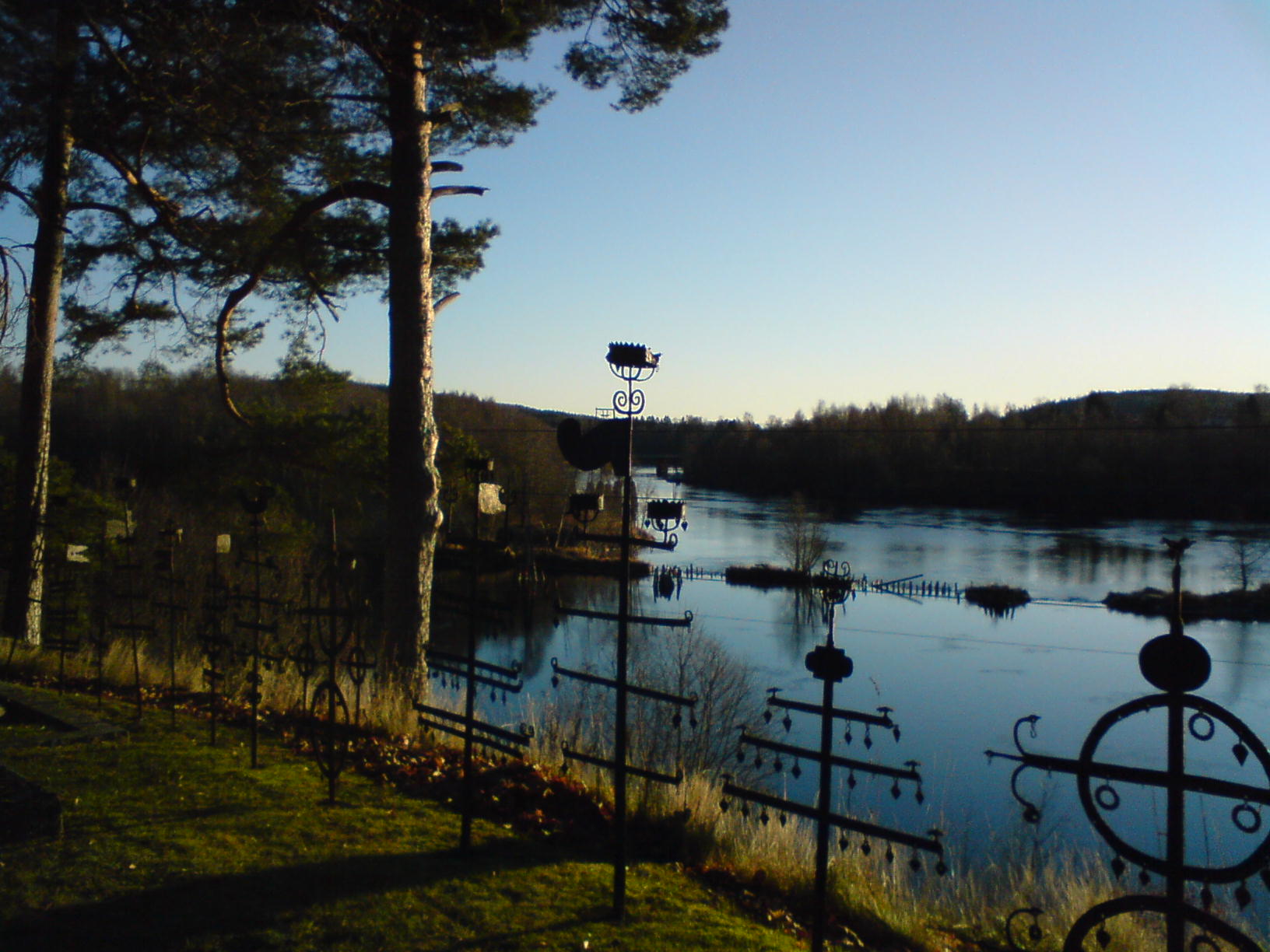
Värmland
Selma Lagerlöf wrote her Nobel Prize-winning novel Gösta Berlings Saga here, drawing on the landscape she knew from childhood at Mårbacka, where the endless forests meet the iron-rich hills of Bergslagen. Värmland occupies a peculiar position in Swedish consciousness: a borderland province wedged between Norway and the heartland, neither fully mountain nor fully lowland, that somehow produced an extraordinary concentration of poets, inventors, and world-class athletes. From the Ericsson brothers who revolutionized naval warfare and telecommunications to four-time Olympic gold medalist Thomas Wassberg skiing through the very forests where Finnish settlers once carved homesteads from the wilderness, Värmland punches far above its weight in the story of Scandinavian achievement.
Where Two Worlds Meet
Värmland's geography explains much of its character. The western reaches climb into the Scandinavian Mountains, where Granberget rises to become the province's highest peak near the village of Höljes. Eastern Värmland belongs to Bergslagen, the ancient mining district where iron ore deposits drew smiths and merchants for centuries. Between these extremes, Lake Vänern, Sweden's largest lake, collects the waters flowing down from countless smaller lakes and streams that give the landscape its signature character. The Klarälven River meanders south through the province, once carrying massive log drives that employed entire communities of river drivers, whose dangerous work floating timber downstream became the stuff of local legend.
The Iron That Built Empires
The mining district around Långban and Nordmark operated continuously from 1711 until 1972, extracting iron ore that fed Sweden's industrial ambitions. The wealth generated by this iron trade created something unexpected: a cultured provincial society where landed gentry supported education, theatre, and the arts. This iron aristocracy produced not only steel but also ideas. John Ericsson, born in Langbanshyttan in 1803, designed the USS Monitor that revolutionized naval warfare during the American Civil War. His brother Nils became Sweden's foremost mechanical engineer. Lars Magnus Ericsson, from the village of Värmskog, founded the telecommunications giant that still bears his name. When the steel revolution rendered local iron processing obsolete in the late 1800s, Värmland's creative legacy remained.
A Province of Poets
The economic crisis that shuttered iron foundries in the 1870s and 1880s paradoxically enriched Swedish literature. Writers like Selma Lagerlöf and Gustaf Fröding, watching their province's traditional economy collapse, turned to capturing its folklore and oral traditions before they vanished. Lagerlöf's Gösta Berlings Saga, set in the 1820s Värmland she reconstructed from family stories, became a neo-romantic masterpiece that earned her the 1909 Nobel Prize in Literature, the first woman so honored. The novel later became a silent film starring a young Greta Garbo. Fröding's poetry, mixing dialect and classical forms, made him one of Sweden's most beloved poets. This tradition of richly textured storytelling continued through Göran Tunström into the modern era.
The Border That Bristled With Guns
Värmland's position on the Norwegian frontier meant it repeatedly became a military staging ground. During the 1814 campaign against Norway, the Värmland Regiment crossed the border and fought at Fredrikstad, Rakkestad, and the bloody Battle of Lier near Kongsvinger. When Nazi Germany invaded Norway in April 1940, approximately 150,000 Swedish troops mobilized to Värmland, a number that swelled to perhaps 250,000 by fall 1943 as Sweden prepared to end German transit rights and feared retaliation. The fortification Skansen Hultet, constructed 1940-1941 in Eda Municipality, bristled with machine gun emplacements, casemates, and tank traps, now preserved as a monument to the tense neutrality Sweden maintained. Some 12,000 military objects from this period still dot the Värmland landscape.
Champions of Snow and Ice
Modern Värmland channels its frontier energy into winter sports. The Torsby Ski Tunnel, inaugurated in 2006 as Sweden's first and then the world's longest indoor ski facility, trains elite athletes year-round. The village of Mattila, a Finnish settlement dating to the 1640s in the Finnskogen forest, now offers 170 kilometers of cross-country trails extending into Norway. Branäs, the province's largest ski resort and Sweden's fourth largest, drops 415 vertical meters. From this snowy crucible emerged Thomas Wassberg, four-time Olympic gold medalist in cross-country skiing, and Stefan Holm, the Forshaga-born high jumper who claimed gold at the 2004 Athens Olympics. Even the province's ice hockey team, Färjestads BK from Karlstad, has won ten Swedish championships since 1975, more than any other club.
From the Air
Located at approximately 59.75N, 13.25E in west-central Sweden, Värmland stretches from Lake Vänern in the south to mountain plateaus along the Norwegian border. The Klarälven River provides a visible navigation line running north-south through the province. Major visual landmarks include the urban area of Karlstad on Vänern's northern shore, the forested highlands of Finnskogen in the northwest, and the ski slopes of Branäs in the north. Nearest major airports include Karlstad Airport (ESOK) and Oslo Gardermoen (ENGM) across the Norwegian border.