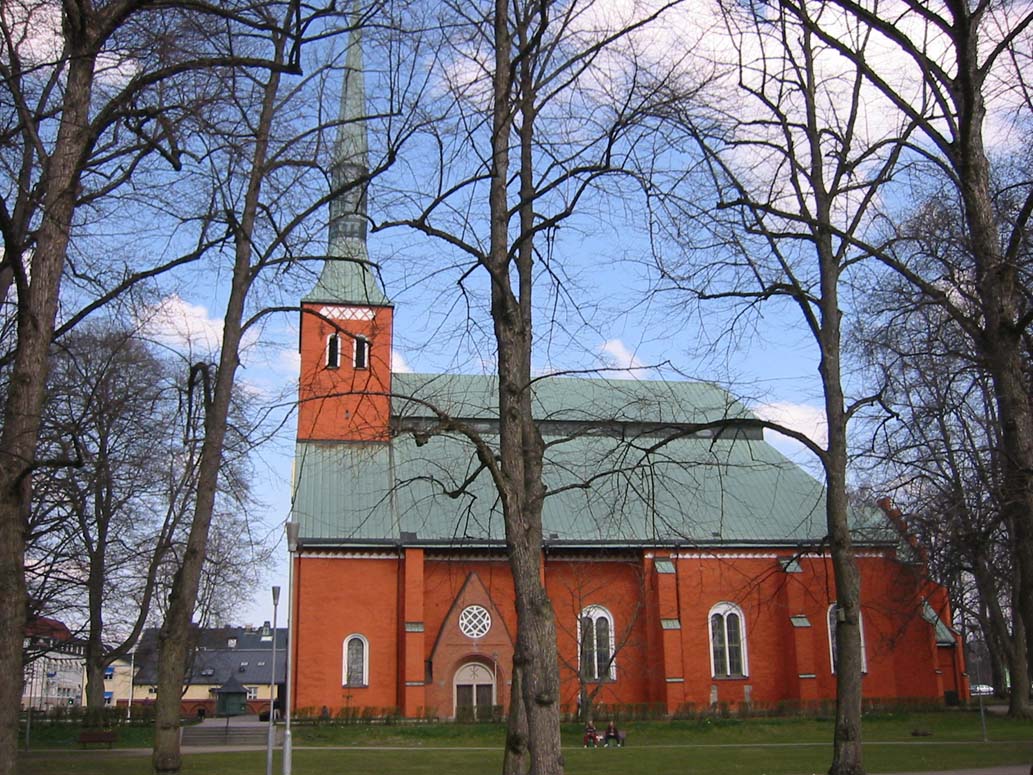
Vaxjo Cathedral
Somewhere beneath the white-painted nave of Vaxjo Cathedral lies a stone marker adorned with a stylized "S" and three crosses. According to legend, this marks the burial place of Saint Sigfrid, the English missionary who chose this marketplace in the Swedish forest as ground zero for Scandinavia's Christianization. The 11th-century coins unearthed here and the preserved runestone propped against the choir wall suggest the legend carries more than a grain of truth. A millennium of worship, warfare, fire, and artistic reinvention has passed over this spot, yet the cathedral remains the spiritual heart of Vaxjo.
A Missionary's Foundation
Saint Sigfrid arrived from England with a mission: convert the pagan Swedes. The legend says he built his first wooden church here in the 11th century, on a site that had served as a marketplace since pre-Christian times. By the 1160s, as the Diocese of Vaxjo was formally established, craftsmen began constructing a stone church around the old wooden structure, allowing services to continue while massive new walls rose. The architectural influence came from Lund Cathedral to the south, and the builders incorporated Sigfrid's relics into the new structure. Throughout the Middle Ages, the cathedral was dedicated jointly to Sigfrid and John the Baptist, a testament to its founder's enduring importance.
Fire, War, and Royal Repentance
The cathedral's tower bears witness to Sweden's turbulent medieval history. In 1276 or 1277, during a bitter conflict between King Valdemar and his brother Magnus, the tower was used as an improvised fortification and suffered severe damage in the fighting. A repentant Valdemar later provided funds for reconstruction. Danish troops plundered and burned the building in 1570 during the Northern Seven Years' War, then returned in 1612 to use it as quarters, destroying pews and burning the archives. Lightning struck a spire in 1740, igniting a devastating fire that destroyed the medieval roof and vaults. Each catastrophe prompted rebuilding, each rebuilding altered the cathedral's face, until by the 1950s architect Kurt von Schmalensee was called in for a comprehensive restoration that gave the building its current appearance.
Where Light Meets Stone
Step inside today and the white-painted interior glows with an unexpected luminosity. The hall church design places the nave and aisles at equal height, creating a unified space supported by thirteen vaults, seven of which date to medieval times. But it is the glass art that defines contemporary Vaxjo Cathedral. The current altarpiece, installed in 2002, is a striking work by glass artist Bertil Vallien. The baptismal font is also made of glass, as are the decorated entrance doors and the chantry chapel's screen. Even the candle holders incorporate glass elements. This might seem jarring in a medieval church, but Vaxjo has always been a place where old and new coexist. Gothic Revival chandeliers, possibly donated by the famous opera singer Christina Nilsson, hang near 20th-century wooden sculptures of Saints Peter and Paul.
Voices of the Bells
A carillon of 27 bells was installed in the tower in 1962, adding a voice to the cathedral that rings out over the surrounding countryside. Five additional church bells complete the ensemble. Below, three church organs span the centuries: the largest has a facade dating to the 1770s though its mechanism was renovated in 2002, while two smaller instruments from 1984 and 2001 serve the north and south aisles. The cathedral continues its dual role as the seat of the Bishop of Vaxjo within the Church of Sweden and as an active parish church, hosting regular services and concerts. Its listing in the Swedish National Heritage Board's database ensures that this layered history of fire, faith, and artistic transformation will be protected for generations to come.
From the Air
Located at 56.8775N, 14.8119E in the city of Vaxjo, Smaland region of southern Sweden. The cathedral's distinctive red exterior with white stone trim and twin spires makes it visible from the air. Vaxjo-Kronoberg Airport (ESMX) lies approximately 7nm northwest. Best viewed at 2,000-3,000 feet AGL. The surrounding lake-dotted landscape of Smaland provides excellent VFR conditions in summer months.