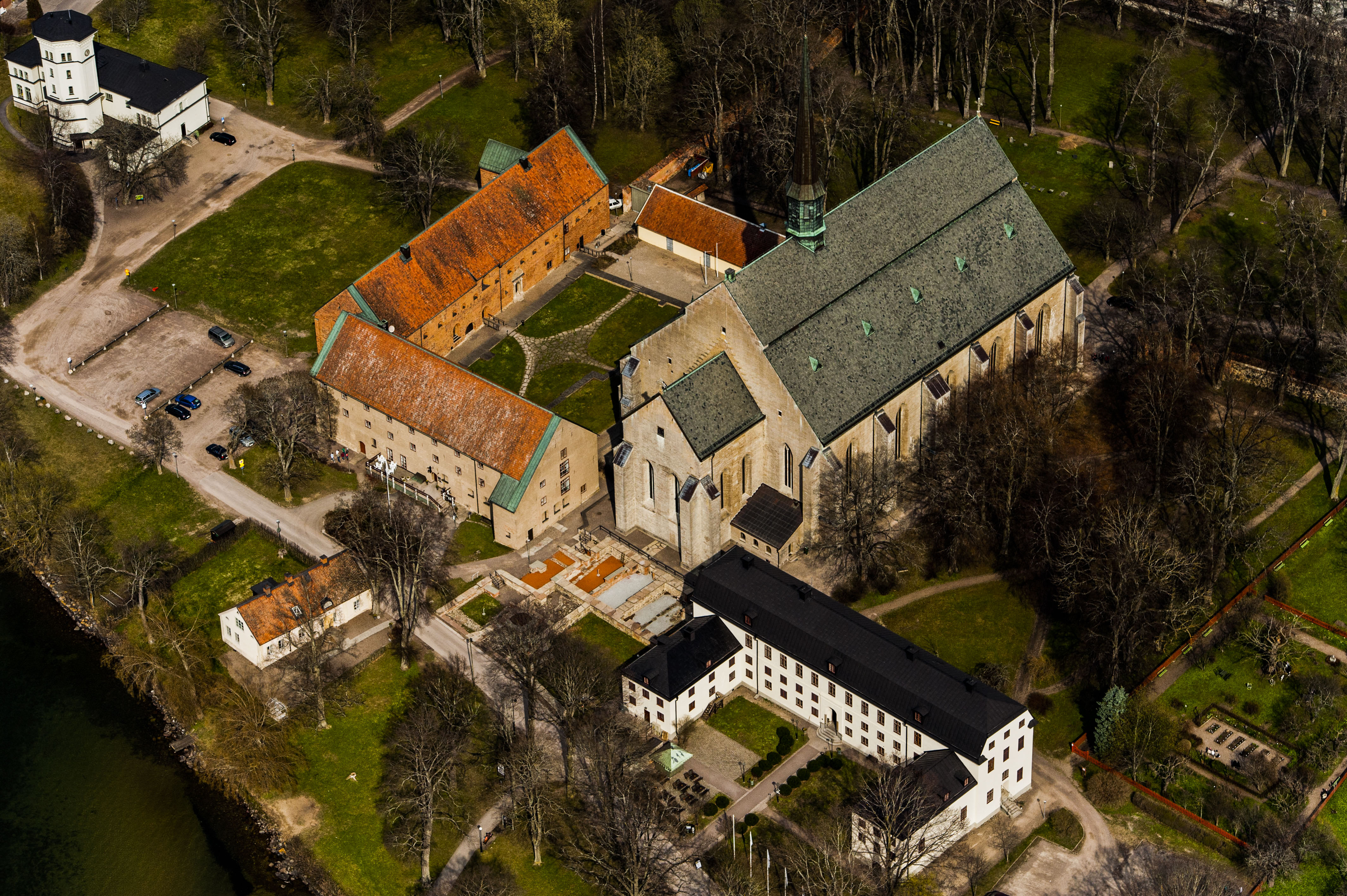
Vadstena Abbey
The nuns plugged their ears during the Protestant sermon. It was May 1540, and the women of Vadstena Abbey refused to surrender their faith without a fight. For nearly two centuries, this monastery on the shores of Lake Vattern had been the spiritual heart of Sweden, the motherhouse of an international religious order, and a center of learning that produced some of the earliest Swedish literature. The Reformation would eventually silence the abbey's prayers, but the defiance of those nuns captures the fierce devotion that Saint Bridget kindled when she founded this place in 1346.
A Saint's Vision Takes Form
Bridget of Sweden was no ordinary mystic. A noblewoman, mother of eight children, and confidante of royalty, she convinced King Magnus IV and Queen Blanche to donate ten farms in Ostergotland for her revolutionary vision: a double monastery where 60 nuns and 25 monks would live and worship together under the authority of an abbess. This was radical medieval feminism sanctioned by Pope Urban V himself. When Bridget died in Rome in 1373, her daughter Catherine brought her relics home to Vadstena, arriving to find only a handful of novices. She became their abbess, though she would not live to see her mother canonized in 1391. The translation of Bridget's remains to the abbey church in 1394 transformed Vadstena into a pilgrimage destination, drawing the faithful and the wealthy from across Europe.
Crown Jewel of Medieval Sweden
The abbey became far more than a religious house. In 1400, Duke Eric of Pomerania was crowned King of Denmark, Norway, and Sweden within its walls by Queen Margaret herself. Two queens rest in its church: Philippa of England and Catherine of Bjurum. The Bridgettine nuns produced translations of the Bible and saints' legends into Swedish, creating foundational works of Scandinavian literature. Their manuscripts survive in the Royal Library of Stockholm, including two in Bridget's own handwriting. The abbey ran a hospital and retirement home, supported controversial Beguine communities, and became Sweden's greatest landowner. Its international influence stretched from the Baltic to England, where four nuns and a monk from Vadstena established the famed Syon Abbey in 1415.
Surviving the Storm
The Swedish Reformation of 1527 should have ended Vadstena. Monasteries across the country were dissolved, novices banned, assets seized. Yet Vadstena's royal connections and international prestige earned it an exemption. The monks could leave to become doctors, pastors, or teachers; the nuns had no such options. Most stayed. The abbey's population dwindled as the Catholic Mass was banned, valuables confiscated, and Danish soldiers looted during the Northern Seven Years' War. But a remarkable revival came under King John III, whose Catholic queen Catherine Jagellon forged secret connections with Rome. The Papal Legate reformed the abbey in 1580; a seminary for Catholic priests opened in 1592. It could not last. In 1595, Protestant Duke Charles ordered the final dissolution. The last abbess and her remaining nuns sailed to Danzig, carrying centuries of devotion into exile.
Many Lives After Prayer
The empty buildings found strange new purposes. A home for veterans occupied the nuns' wing for 140 years. A hospital for venereal diseases operated from 1795 to 1909. The sacred spaces became a prison, then an asylum. But in 1956, workers discovered substantial remains of a thirteenth-century royal palace hidden within the walls, leading to careful restoration. Today, the Vadstena Monastery Museum preserves these layers of history. The abbey church, known as the Blue Church, still stands, visited by both Lutheran and Roman Catholic pilgrims who come to venerate Bridget's relics in their red casket. Medieval sculptures of saints watch over the space that has witnessed crownings, burials, and eight centuries of prayer.
Return of the Bridgettines
The story did not end in exile. In 1935, Bridgettine sisters returned to Vadstena under Elisabeth Hasselblad, who would herself be canonized in 2016. The modern Abbey of Mary's Peace, established in 1963 and raised to autonomous status in 1991, continues the tradition that Bridget began. Eight nuns maintain the rhythm of prayer that was interrupted for four centuries. Their community traces an unbroken spiritual lineage to the Netherlands, one of the few original Bridgettine houses that survived the Reformation. The town that grew up around the medieval abbey still centers on this sacred precinct, where the Blue Church anchors a landscape shaped by faith, power, and remarkable resilience.
From the Air
Vadstena Abbey sits on the eastern shore of Lake Vattern at 58.45N, 14.89E. The medieval church complex is clearly visible from the air, distinguished by its blue-painted exterior. Lake Vattern, Sweden's second-largest lake, provides excellent visual reference. Approach from the west for dramatic views across the water. Nearest airports: Linkoping City Airport (ESSL, 35km east), Jonkoping Airport (ESGJ, 75km south). Best viewed at 2,000-3,000 feet for detail of the abbey complex and its relationship to Vadstena Castle nearby.