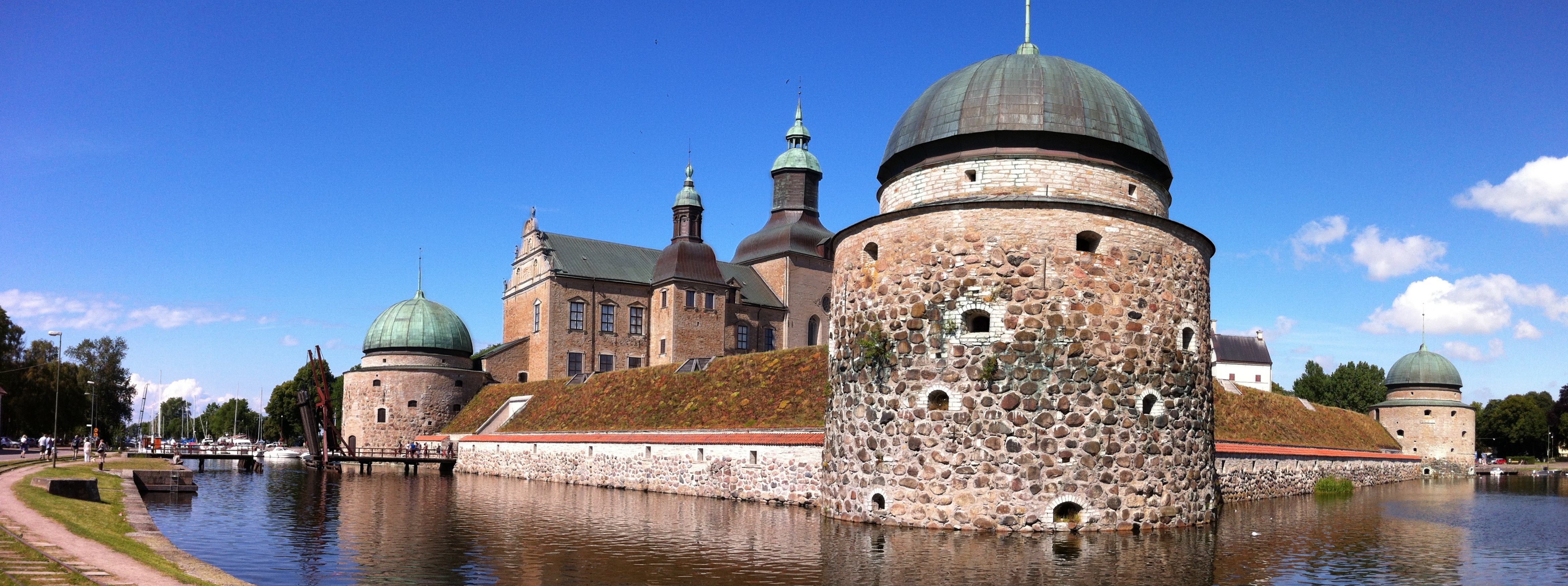
Vadstena Castle
The wedding hall was not finished in time for the wedding. On August 22, 1552, King Gustav I married his third wife, Catherine Stenbock, at Vadstena, but the grand banqueting room that would bear the name Wedding Hall was still under construction. It captures something essential about this castle: begun as a military fortress in 1545, it spent 75 years being transformed into a Renaissance palace, only to be abandoned by the royal family in 1716 and converted into a grain storage barn. Today Vadstena Castle stands as one of Sweden's best-preserved examples of Renaissance architecture, a monument to Vasa ambition that outlasted the dynasty's interest in it.
Fortress Against the South
Gustav I had enemies, and they would approach Stockholm from the south. In 1545, he began construction of a fortress at Vadstena on the shore of Lake Vattern to block that route. The original fortification was pure military architecture: three stone buildings facing the lake, three ramparts each 31 meters wide, a moat, and four circular cannon turrets bristling with artillery. The original ramparts were demolished in the 19th century, but the present ramparts, inaugurated in 1999, restore the castle's defensive silhouette. Those early stone buildings would eventually become the ground floor of something far grander than Gustav had planned.
A Duke's Troubled Residence
The transformation from fortress to palace began in the 1550s when Prince Magnus became Duke of Ostergotland. Magnus carried a burden his brothers did not share: mental illness that made him the only son of Gustav I who would never become king. He lived at Vadstena as the castle grew around him, watching construction crews convert military stonework into habitable chambers. Magnus died in 1595 and was buried in the church of nearby Vadstena Abbey, the ancient monastery his father had tried but failed to fully suppress. His ornate sarcophagus remains visible in the abbey church today, a reminder that the castle and the monastery shared this town and its complicated religious history.
Every Vasa King's Mark
When construction finally finished in 1620, every king of the House of Vasa had contributed to Vadstena Castle. Gustav I built the fortress core. His sons expanded and refined it. The result was a Renaissance palace of remarkable coherence, with classical proportions, elegant chambers, and the Wedding Hall that Gustav had rushed to complete for his third marriage. The castle's chapel occupies the main tower, looking out across Lake Vattern. Circular turrets guard the moat. A suspension bridge leads to the main gate. The basement still houses a 17th-century cannon, a reminder of the building's origins as a fortress designed for war.
From Palace to Granary
Vadstena Castle served as a royal residence for nearly a century after completion, but by 1716, the Swedish crown had lost interest. The dynasty that built it had ended. New monarchs had newer palaces. Vadstena became a storage barn for grain, its Renaissance chambers filled with the harvest. The transformation seems almost absurd: one of Sweden's finest palaces reduced to agricultural utility. Yet this neglect may have preserved it. Unlike castles that were continuously modernized, Vadstena remained frozen in its 17th-century form, waiting for an age that would appreciate what the grain bins contained.
Sweden's Smallest Opera House
Since 1899, Vadstena Castle has housed the Provincial Archives, preserving documents in chambers once meant for kings. A Castle Museum displays 16th and 17th-century furniture, portraits, and paintings that speak to the Vasa era. But the castle's most unexpected resident is the International Vadstena Academy, Sweden's smallest opera house. The Academy commissions new operas and revives forgotten works discovered in archival scores, bringing music back to a building that once hosted royal entertainments. During summer, the courtyard fills with audiences for classical and popular concerts. The fortress that Gustav I built to repel invaders now welcomes visitors seeking art, history, and the peculiar atmosphere of a palace that forgot it was important.
From the Air
Vadstena Castle sits on the eastern shore of Lake Vattern at 58.45N, 14.88E, adjacent to Vadstena Abbey. The four circular turrets and moat are distinctive from the air. The castle forms a clear rectangular structure with the lake immediately to the west. Fly a circuit to capture both the castle and the nearby abbey for context. Nearest airports: Linkoping City Airport (ESSL, 35km east), Jonkoping Airport (ESGJ, 75km south). Best viewed at 1,500-2,500 feet for architectural detail. Morning light from the east illuminates the facade facing the town.