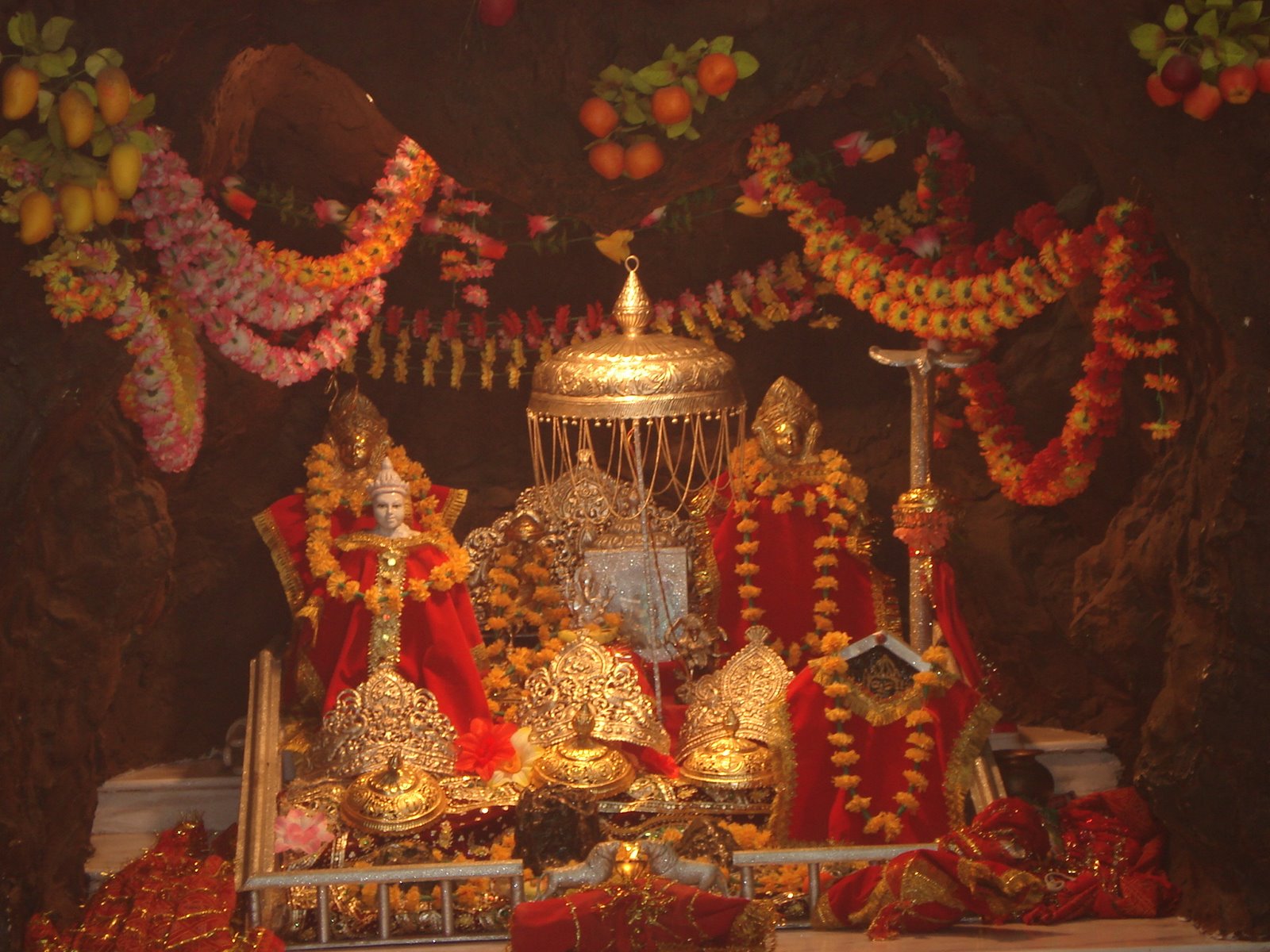
Vaishno Devi Temple
The path begins before dawn. From the town of Katra in Jammu and Kashmir, pilgrims set out on a 13-kilometer trek up the Trikuta mountain, climbing to 5,200 feet through switchbacks and staircases cut into the hillside. At the top, the trail narrows into a cave. One by one, they crouch and squeeze through a low passage where icy water from the Charan Ganga stream runs across the stone floor, soaking their feet and clothes. What waits inside are three rock formations -- the Pindis -- smooth and ancient, representing the triple manifestation of the goddess Vaishno Devi: Mahakali, Mahalakshmi, and Mahasarasvati. A geological study estimated the cave's age at nearly a million years. The pilgrims have been coming in these numbers for less than fifty.
From Obscurity to Nine Million
The temple's meteoric rise is one of modern India's most remarkable pilgrimage stories. In 1971, scholar Inderjit Bhardwaj surveyed Devi shrines across the Siwalik mountains and did not single out Vaishno Devi as particularly important. An expansion in 1976, designed to accommodate up to 5,000 visitors daily, changed everything. By 1981, annual pilgrims had reached 900,000. A decade later, the figure exceeded three million, making it the most popular Devi temple in the region. By 2007, some 7.5 million people were making the climb each year, and the Shrine Board had to cap monthly visitor numbers to manage congestion and security. In 2023, the board reported 9.52 million pilgrims. The temple is sacred to both Hindus and Sikhs, and prominent visitors have included Swami Vivekananda. Over two decades ending in 2020, the shrine received more than 1,800 kilograms of gold, 4,700 kilograms of silver, and an estimated $16 million in annual cash donations.
Legends Older Than Memory
The Trikuta hill appears in the Rigveda. The Mahabharata describes Arjuna worshipping the goddess Durga before the Kurukshetra War on the advice of Lord Krishna, and the text's reference to a temple 'on the slope of the mountain in Jambhu' is widely interpreted as a reference to present-day Jammu. Another legend tells of Vaishno Devi encountering Lord Rama during his exile in the Trikuta Hills. She wished to marry him, but Rama, bound by his vow to Sita, declined -- promising instead to return as Kalki, the tenth incarnation of Vishnu. He directed her to meditate in the cave of Trikuta, blessing devotees until that future age. The story of Bhairon Nath gives the cave its dramatic character: a tantric practitioner pursued the goddess into the hills, and she beheaded him with her trishul at the cave's threshold. His severed head flew to a hilltop now called Bhairon Ghati, while his body became a 14-foot stone slab at the cave entrance. Pilgrims must visit the Bhairon Nath temple after the main cave to complete the yatra.
The Crawl Through Stone
Scholar Diana Eck describes the pilgrimage as a ritual of rebirth. The cave passage is deliberately narrow -- pilgrims squeeze through one at a time, crawling on hands and knees through rock that the goddess is said to have split with her trident while fleeing Bhairon Nath. The icy Charan Ganga flows through the cave, springing from the feet of the Pindis themselves, and wading through its purifying current is the last act before reaching the sanctum. Eck writes that the crawl 'has all the symbolism of gestation and birth,' a transformation enacted in stone and water. The first major stop on the ascent is Ardh Kunwari, a cave where the goddess reportedly meditated for nine months before breaking through the back wall to escape her pursuer. Five stone structures on a neighboring mountain are believed to represent the five Pandavas, who tradition holds were the first to build temples at this site in gratitude for the goddess's blessings.
Governance and the Mountain's Future
The temple's administration reflects its importance to the state. Maharaja Gulab Singh placed it under the Dharmarth Trust in 1846, and his descendants managed it as hereditary trustees through Indian independence. In 1986, Governor Jagmohan passed legislation transferring control from the trust and its hereditary priests to the Shri Mata Vaishno Devi Shrine Board, a nine-member body appointed by the government. The board manages everything from trail maintenance and crowd control to the Navaratri festival, a nine-night celebration of the goddess's victory over evil, and Diwali, which draws especially large crowds each autumn. The challenge is perpetual: how to accommodate the faith of nearly ten million annual visitors on a mountain trail that ends in a cave barely wide enough for a single person. That tension between the intimate and the overwhelming is, perhaps, the point.
From the Air
Located at 33.03°N, 74.95°E on Trikuta mountain at 5,200 feet elevation in the Trikuta Hills of Jammu and Kashmir. The temple cave itself is not visible from the air, but the town of Katra at the mountain's base and the pilgrim trail infrastructure are identifiable. Nearest airport is Jammu Airport (VIJU), approximately 43 km to the south. The Siwalik foothills and the Trikuta ridgeline are the key visual landmarks. Recommended viewing altitude: 8,000-12,000 feet AGL to see the full mountain context.