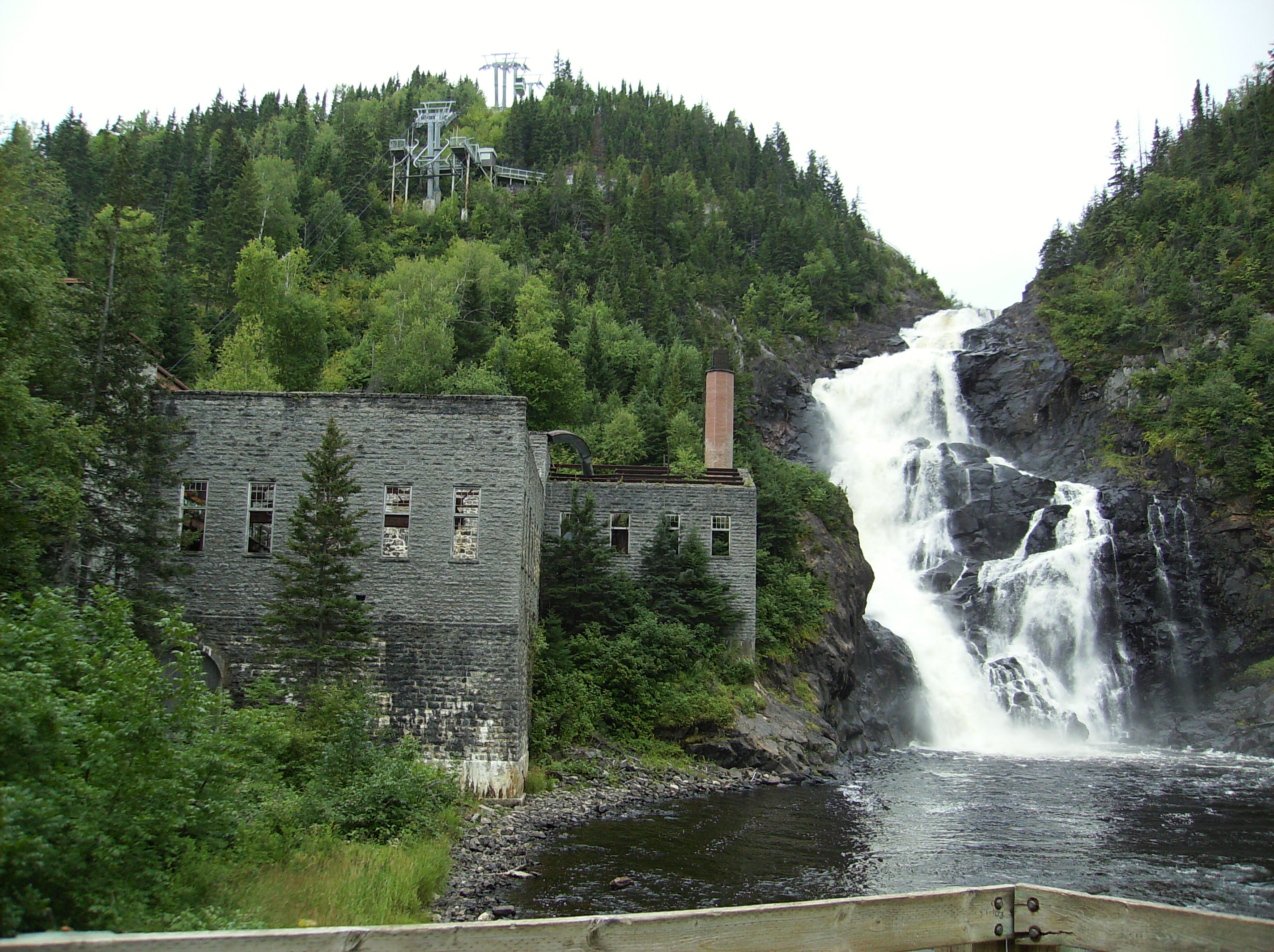
Val-Jalbert
The schoolhouse desks still face the blackboard. The general store shelves still line the walls. In Val-Jalbert, a ghost town tucked into the forests of Quebec's Saguenay-Lac-Saint-Jean region, the twentieth century stopped in 1927 and never started again. Over 70 original buildings stand along streets that once housed 950 people -- workers, families, nuns, a priest -- all of them employed by or dependent on a pulp mill that thundered at the base of the 72-meter Ouiatchouan Falls. When the mill went silent, the town died within two years. No gradual decline, no last holdouts clinging to hope. The company ordered the homes boarded up, and the people walked away. What they left behind is now considered the best-preserved ghost town in Canada, a place where you can step through the door of a 1920s worker's cottage and feel the century collapse around you.
Damase Jalbert's Gamble
In 1901, an entrepreneur named Damase Jalbert from the nearby village of Lac-Bouchette looked at the Ouiatchouan Falls and saw something more than scenery. He saw power. Two waterfalls on the Ouiatchouan River -- one of them taller than Niagara Falls at 72 meters -- could generate the energy needed to run a pulp mill, and the global appetite for newsprint in Britain and the United States was surging. Jalbert founded the Ouiatchouan Pulp Company and built his mill at the base of the falls. The village that sprang up around it was first called Saint-Georges-de-Ouiatchouan, after the river. Jalbert did not live to see it thrive -- he died in April 1904, just three years after founding the operation. American investors bought the company, and by the time the Chicoutimi Pulp Company acquired it in 1909, the village was growing into something remarkable: a fully planned company town in the Quebec wilderness.
A Model Town in the Forest
Val-Jalbert -- renamed in 1913 to honor its founder -- was no rough lumber camp. The Ouiatchouan Falls Paper Company and later the Chicoutimi Pulp Company laid out a proper community with four distinct types of worker dwellings. Uptown sat the residential quarter; downhill, the mill and its business operations. The company installed electricity, a sewer system, water works, and telephone service -- amenities that made Val-Jalbert the envy of surrounding communities in the remote Lac-Saint-Jean region. By the mid-1920s, the village had reached its peak population of 950 residents. There was a convent school, staffed by nuns from Chicoutimi who had arrived in 1915. There was a general store, a butcher shop, a church. The town hummed with the sound of the mill and the roar of the falls, and the workers who lived there had every reason to believe it would last.
The Silence of 1927
It did not last. A crisis in the pulp industry began squeezing the mill in 1924, and by the mid-1920s demand for non-transformed mechanical pulp was collapsing. Workers began losing their jobs and seeking employment in Chambord, Roberval, and other nearby communities. On August 13, 1927, the Quebec Pulp and Paper Mills Ltd. -- which had owned the plant for only a year -- shut the mill for good. Many unemployed workers refused to leave, hoping the market would recover. They waited through 1928 and into 1929, but no reversal came. The company ordered every home boarded up. On September 15, 1929, the local priest, Joseph-Edmond Tremblay, and the teaching nuns from Chicoutimi packed their belongings and left Val-Jalbert for the last time. The Spanish flu had already ravaged the small population years earlier. Now the streets were simply empty. The falls kept roaring. Nobody was listening.
Ghosts and Guardians
Val-Jalbert became a provincial park in 1960, and the preserved village was eventually designated a National Historic Site by Parks Canada. Roughly 30 houses have been restored, along with the mill, the general store, the butcher shop, the convent school, and a guest house. The site is now the second most visited tourist attraction in the Lac-Saint-Jean region. Most visitors come for the falls -- a glass observation platform offers a vertiginous view into the heart of the cascade. But the ghost town itself is what lingers. Walking streets where children once played, peering into classrooms where desks still face forward, standing in the shell of the mill where machinery once shook the floor -- Val-Jalbert makes the passage of time feel physical. A controversial 2012 proposal to build an 18.3-megawatt hydroelectric dam upstream of the falls drew fierce opposition from residents, environmentalists, and the Innu community of Masteuiatsh, whose ancestral territory includes the river. The falls that powered Damase Jalbert's dream remain, for now, undammed and undiminished.
From the Air
Located at 48.44N, 72.16W on the banks of the Ouiatchouan River in the Saguenay-Lac-Saint-Jean region of Quebec, between the municipalities of Chambord and Roberval on the southwest shore of Lac Saint-Jean. The 72-meter Ouiatchouan Falls are visible from altitude as a white thread cutting through the forested river valley. The abandoned village grid is discernible below the treeline as a pattern of cleared lots and roads adjacent to the falls. Lac Saint-Jean, one of Quebec's largest lakes, spreads to the northeast. Nearest airport: Roberval Airport (CYRJ), approximately 10 km to the northwest. Quebec City Jean Lesage International (CYQB) is approximately 250 km to the south. Best viewed at 2,000-4,000 feet to pick out individual buildings in the ghost town and the falls, or at higher altitude to see the relationship between the village, the river, and Lac Saint-Jean.