Valerian Palace: The Emperor's Gilded Cage
In 260 AD, something happened that had never happened before in seven centuries of Roman history: a sitting emperor was captured alive on the battlefield. Valerian, ruler of the Roman Empire, knelt before Shapur I, king of the Sasanian Empire, after the catastrophic Battle of Edessa. What followed was stranger than the defeat itself. Shapur did not execute his prisoner. He did not ransom him. Instead, he built Valerian a palace. In Bishapur, his royal capital in the mountains of Fars Province, Shapur ordered the construction of an elegant residence just 150 meters from his own government buildings. The Roman emperor would live out his remaining years here, surrounded by carved stone and painted stucco, watched but not starved, housed but never free.
Defeat at Edessa
The Battle of Edessa was one of Rome's most humiliating defeats. Valerian had marched east to confront the Sasanian threat, bringing an army weakened by plague. The details remain debated, but the outcome is certain: Valerian was taken prisoner, and the Roman army was shattered. Sasanian rock reliefs carved into the gorge walls at Tang-e Chogan near Bishapur depict the scene with unmistakable pride. Valerian kneels before the mounted Shapur, a visual humiliation that Shapur commissioned to be carved in stone for eternity. The captured emperor became proof of Sasanian supremacy, a living trophy installed in a purpose-built residence within sight of his captor's throne.
An Octagon of Stone
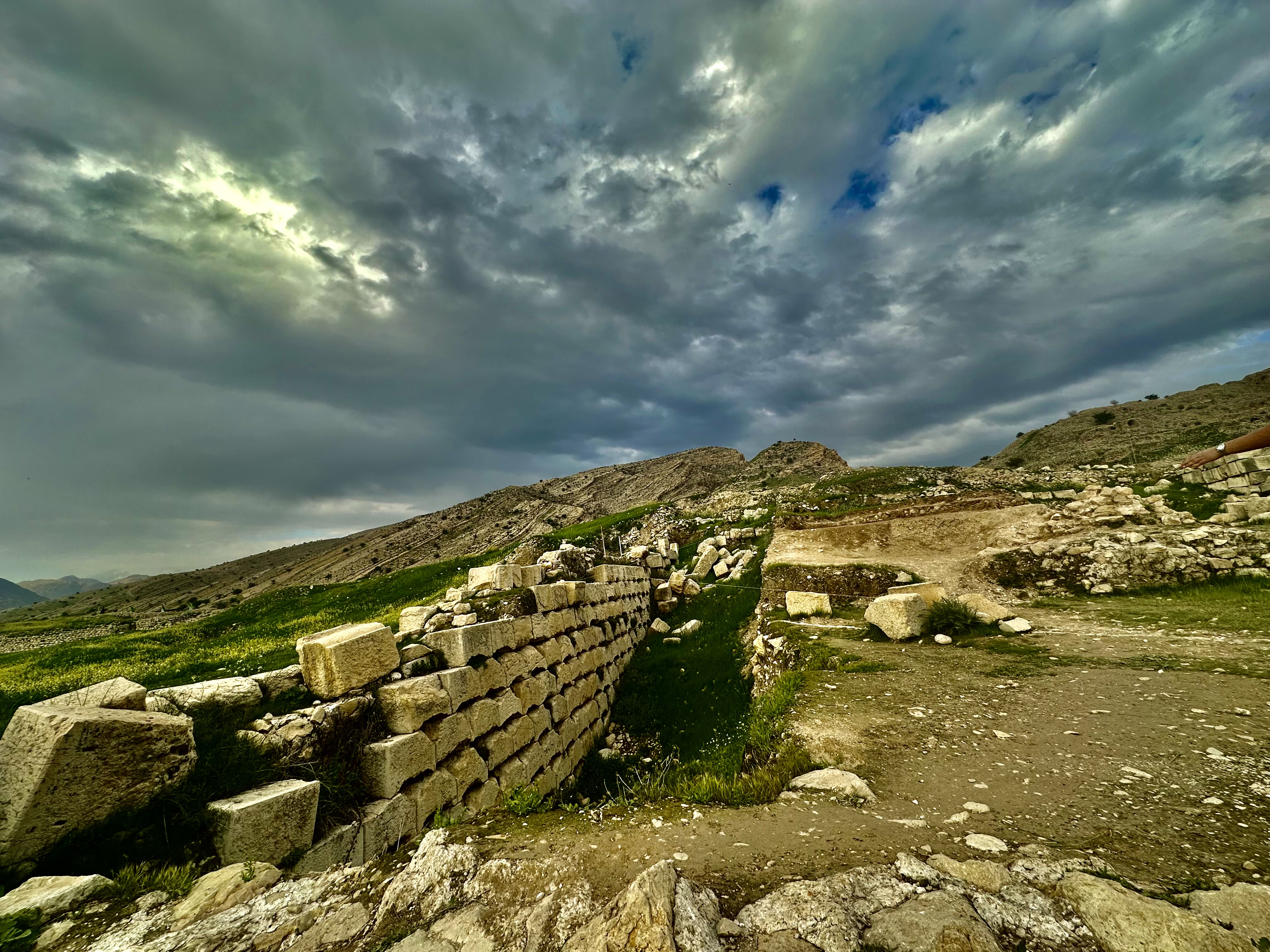
Valerian Palace was built in 266 AD in the Sasanian architectural style, entirely of solid, patterned stone. The structure is octagonal, an unusual shape that opened onto a central courtyard through four corridors. Its entrance facade echoes the interior of the nearby Temple of Anahita, suggesting the same builders and the same ambition. The interior walls are made of carved and patterned stones; the exterior was whitewashed with plaster. Reliefs and stuccoes decorated every surface. Some of these ornamental fragments survive today in the Bishapur Museum, their intricacy a reminder that this was no dungeon. It was a palace in the fullest architectural sense, designed to impress and to confine in equal measure.
A Prisoner's Lifetime
Valerian was kept under surveillance in this palace for the rest of his life. No rescue came from Rome. No ransom was negotiated. The emperor who had ruled the eastern half of the Roman Empire died in captivity in a Persian mountain city, far from the marble halls of the Palatine Hill. Ancient sources differ on the details of his treatment, with some Persian accounts claiming he was treated with dignity and others suggesting cruelty. What the architecture tells us is that Shapur invested significant resources in housing his prisoner. The palace sits on the northern side of the royal citadel, close to the ceremonial hall and the great fire temple, placing Valerian within the daily orbit of Sasanian court life.
Layers of Excavation
French archaeologist Roman Ghirshman first explored the palace during excavations at Bishapur between 1935 and 1937. Iranian archaeologist Ali Akbar Sarfaraz continued the work from 1968 to 1974, excavating extensively throughout the royal citadel. In 1995, Mosayeb Amiri led a dedicated excavation focused on fully uncovering the palace structure. The site was among Iran's earliest registered national monuments, and it is now part of the Bishapur complex recognized on the UNESCO World Heritage List. In 2025, cultural heritage officials announced a new season of excavations focusing specifically on Valerian Palace, suggesting that the octagonal structure still has secrets to yield. Each generation of archaeologists has peeled back another layer of Shapur's royal compound.
Power Written in Stone
Valerian Palace is more than architecture. It is a political statement preserved in carved limestone. Building a palace for a defeated emperor rather than throwing him into a pit was an act of calculated propaganda. Shapur demonstrated that the Sasanian Empire could not only defeat Rome but could afford to house its leader in luxury. The rock reliefs at Tang-e Chogan reinforce the message from a different medium: carved into living rock, they show Valerian's submission as permanent fact. The palace and the reliefs work together across the centuries, one in three dimensions and the other in two, both declaring the same thing. Rome's power had limits. Persia's did not.
From the Air
Located at 29.78N, 51.58E in the Zagros foothills of Fars Province, Iran. Valerian Palace sits within the royal citadel of Bishapur, approximately 15 km west of modern Kazerun, along the Shapur River valley. The ruins cluster in the northeastern part of the ancient city, adjacent to the Temple of Anahita and ceremonial hall. The nearest major airport is Shiraz International Airport (OISS), approximately 120 km to the southeast. The Tang-e Chogan gorge with its Sasanian rock reliefs is visible nearby. The terrain is mountainous Zagros range landscape with narrow valleys.