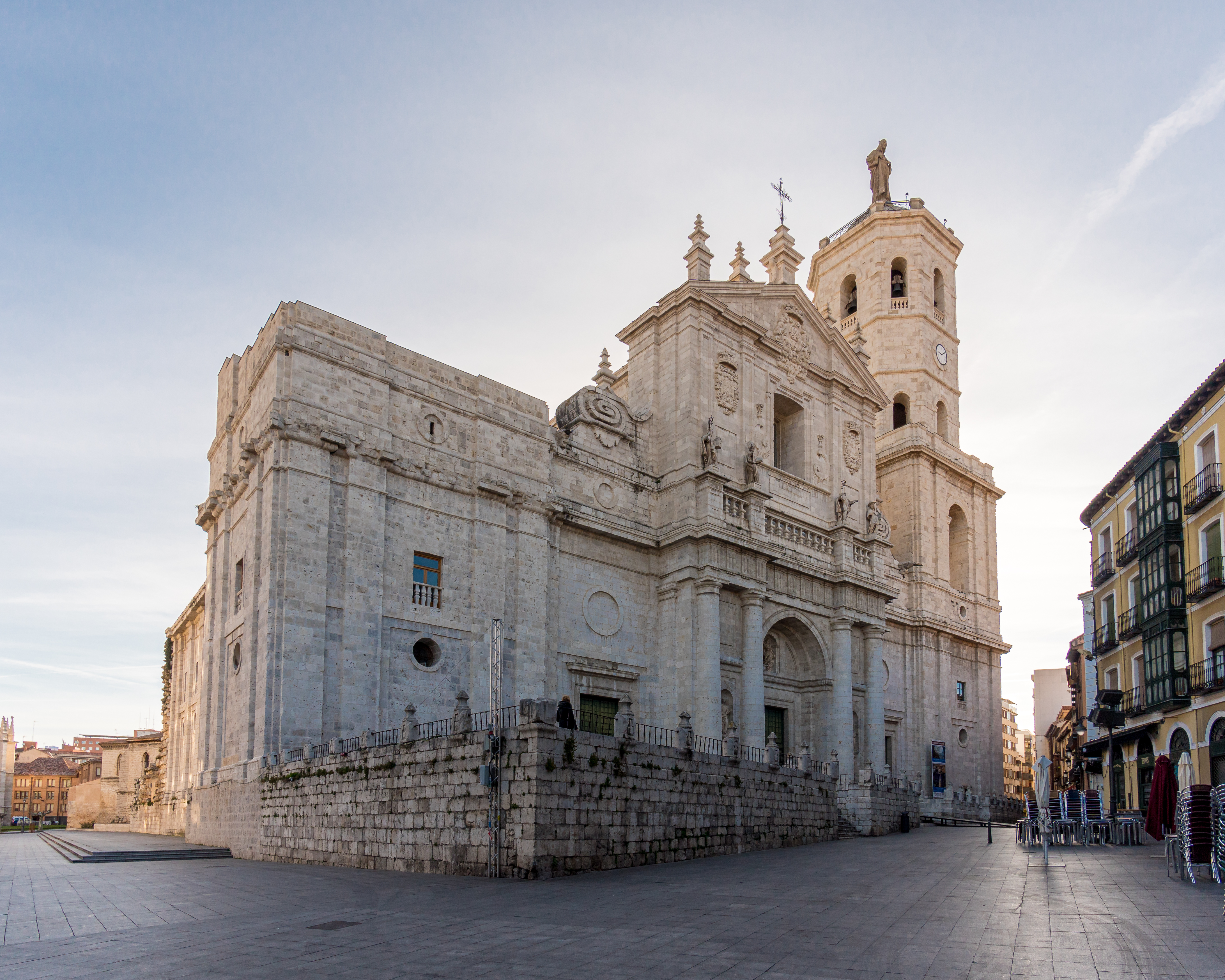
Valladolid Cathedral
Only 40 to 45 percent of Valladolid Cathedral was ever built. That fact, which might seem like failure, is what makes it extraordinary. Designed by Juan de Herrera -- the same architect who created the austere grandeur of El Escorial -- the cathedral was meant to be the largest in Europe, a structure befitting a city that was, at the time, the de facto capital of Spain. Then Philip II moved the court to Madrid, the money dried up, and the building simply stopped. What stands today is a fragment of a dream, and it is stunning precisely because you can see both what was achieved and what was lost.
A Capital Without a Cathedral
Before the sixteenth century, Valladolid had no cathedral at all. The city was not a bishopric, and its principal church was a late Gothic collegiate structure begun in the 1400s. But when Valladolid became the seat of a newly established episcopal see, the Town Council decided the city deserved something grander -- a Renaissance cathedral that would announce its status to the world. With King Philip II and his court in residence, the project had every reason to be ambitious. Herrera's plans called for a vast rectangular structure with three aisles, a transept, two facade towers, and a series of chapels between buttresses. It would have dwarfed every church on the continent.
The Money Runs Out
By the 1560s, Madrid had become Spain's new capital, and Valladolid's fortunes dimmed. Construction funds were severely trimmed. Herrera's disciples -- principally Diego de Praves and later his son -- carried on through the first half of the seventeenth century, but they could only build half the intended structure. The building stops at the transept; beyond it, open air fills the space where the rest of the nave should have been. Only one tower was completed, and even that does not follow Herrera's original plans. An error during construction left the portal arch slightly pointed rather than perfectly rounded, a small imperfection that somehow suits a building defined by the gap between intention and reality.
Centuries of Additions and Losses
In the eighteenth century, Alberto Churriguera added an upper section to the principal facade, imitating El Escorial's style, and topped the balustrade with statues of Saints Ambrose, Augustine, Gregory, and Jerome. A second tower rose beside the vestry -- only to be damaged by the shockwaves of the 1755 Lisbon earthquake. It collapsed entirely in 1841 and was eventually rebuilt in a different location, crowned with a statue of the Sacred Heart. Inside, the cathedral accumulated treasures that belie its incomplete exterior. A sixteenth-century altarpiece by the sculptor Juan de Juni was transferred from the nearby church of Santa Maria La Antigua in 1922. Choir stalls dating to 1617, originally from the convent of San Pablo, line the nave. A pipe organ built in 1904 by Aquilino Amezua fills the space above the main door, its 36 stops voiced in the Romantic style.
The Beauty of the Unfinished
Valladolid Cathedral was declared a site of Cultural Interest in 1931, a recognition that its incompleteness is part of its significance. A wooden model from the 1780s, still preserved inside the building, shows what Herrera envisioned -- a church of breathtaking symmetry and scale. Standing in the actual nave, you can hold both realities at once: the soaring vaults overhead and the absent walls that should continue beyond. The cathedral also houses a musical archive of 6,000 works and eight chapels containing Baroque altarpieces, Neoclassical paintings, and the tomb of Count Ansurez, the city's medieval founder. Today, during Holy Week, hooded members of religious brotherhoods process through the streets past the cathedral's facade, a living tradition flowing around a building that has been waiting five centuries for someone to finish it.
From the Air
Located at 41.65N, 4.72W in the heart of Valladolid. The cathedral is visible from the air as a large stone structure near the Plaza Mayor. Nearest airport is Valladolid (LEVD), about 10 km northwest. The single surviving tower is distinguishable from surrounding buildings at altitudes below 5,000 ft AGL. The city sits on the Castilian meseta at approximately 690 m elevation.