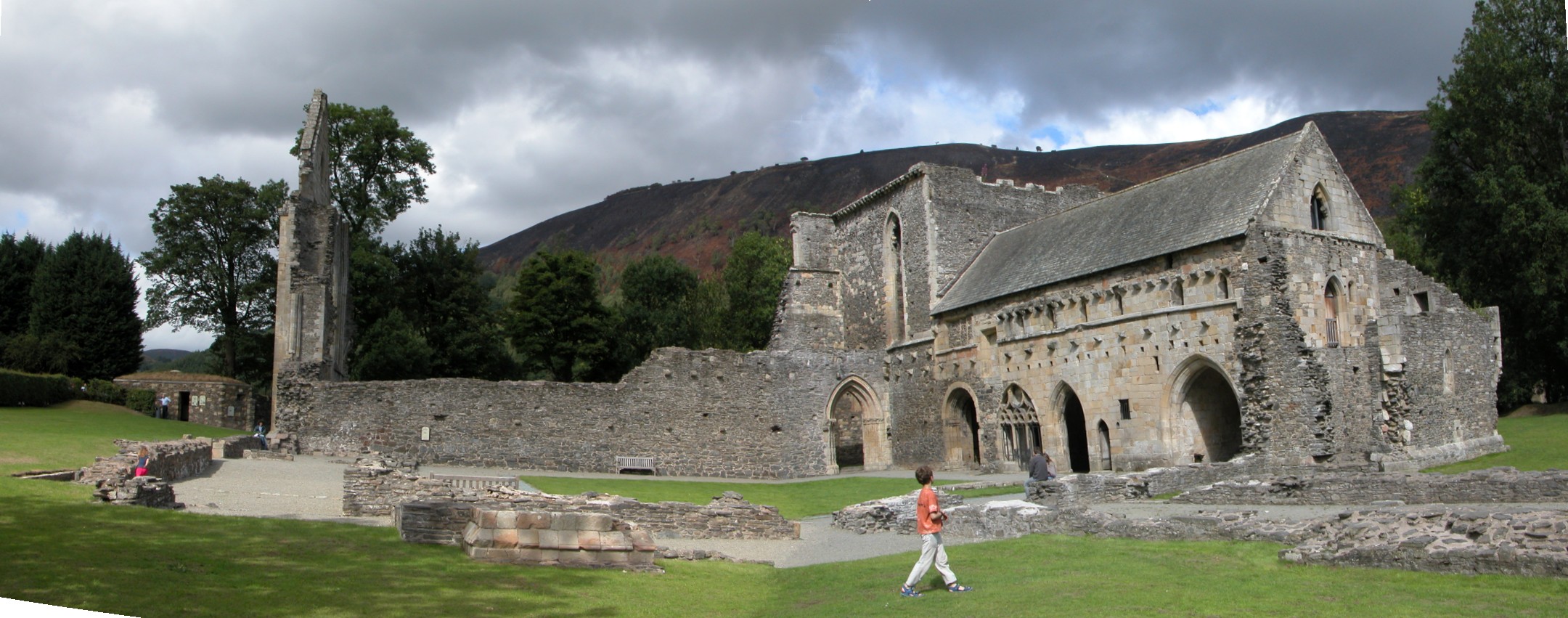
Valle Crucis Abbey
The name means Valley of the Cross, but the cross came first. Four centuries before the abbey was built, Cyngen ap Cadell, King of Powys, erected the Pillar of Eliseg nearby in memory of his great-grandfather Elisedd ap Gwylog. When Madog ap Gruffydd Maelor, Prince of Powys Fadog, chose this valley for his Cistercian monastery in 1201, he was building in the shadow of that older monument, layering Christian devotion over an already sacred landscape. The pillar still stands. So do large parts of the abbey, which is more than many Welsh monasteries can claim.
Twelve Monks from Strata Marcella
Valle Crucis was the last Cistercian monastery to be established in Wales, founded as a colony of twelve monks from Strata Marcella, an older abbey in Powys. The Cistercians favored remote, well-watered valleys, and the site near Llantysilio in Denbighshire fit their requirements precisely. A temporary wooden structure came first, replaced over time with stone buildings of roughly faced rubble. The abbey sat at the spiritual heart of Powys Fadog, while the hilltop fortress of Castell Dinas Bran served as the principality's political stronghold. Madog, who founded the monastery, was buried within its walls upon his death in 1236. Not long after, a serious fire damaged the church and south range, requiring substantial reconstruction.
Stone, Light, and Water
The abbey's layout followed the standard Cistercian plan: a cruciform church running east to west, with outbuildings enclosing a square courtyard. The west end front wall survives, including the masonry of a rose window that once filled the nave with colored light. The east range -- housing the chapter house, sacristy, dormitory, and abbot's lodgings -- remains largely intact, unusual for a monastic ruin and a testament to the quality of the original construction. The site also preserves the only remaining monastic fishpond in Wales, though it was reshaped into a reflecting pool in the eighteenth century, blurring the line between medieval utility and Romantic aesthetics.
Dissolution and Afterlives
Henry VIII dissolved Valle Crucis in 1537, deeming it insufficiently prosperous compared to the wealthier English abbeys. The buildings were given on a twenty-one-year lease to Sir William Puckering, and after his death the property passed through several families via marriage and inheritance. By the late sixteenth century, the eastern range had been converted into a manor house -- a practical repurposing that probably saved it from total collapse. The estate was sequestered by Parliament in 1651, and by the late eighteenth century what remained was re-roofed and used as a farm. The abbey's font was removed and placed in the gardens of Plas Newydd in Llangollen by the Ladies of Llangollen, the celebrated couple whose unconventional household attracted visitors from across Europe.
Scott's Restoration
George Gilbert Scott, the tireless Victorian restorer of medieval churches, turned his attention to Valle Crucis in 1870, stabilizing the west end wall and beginning the process of preservation that continues under Cadw, the Welsh government's heritage agency. Excavations undertaken in the latter half of the nineteenth century uncovered the extent of the original complex and revealed archaeological evidence of the thirteenth-century fire. Unusually for a monastic ruin, visitors can still access parts of the first floor, walking through the dormitory and the abbot's lodgings with their stone walls open to the sky.
The Valley Today
Valle Crucis received 5,690 visitors in 2018, a modest number that reflects its relatively remote location in the Dee Valley near Llangollen. The abbey is surrounded on three sides by a caravan park whose caravans press up against the outer walls of the ruin -- a juxtaposition that is either charming or jarring depending on your temperament. The Pillar of Eliseg still stands in a field nearby, connecting the ninth century to the thirteenth and both to the present. In 2015, the American metal band Obsequiae used an image of the abbey on the cover of their album Aria of Vernal Tombs, proving that a Welsh Cistercian ruin can find admirers in unexpected places.
From the Air
Valle Crucis Abbey is located at 52.9887N, 3.1865W, in the Dee Valley approximately 2 miles northwest of Llangollen in Denbighshire. From the air, look for the ruins in a green valley with the town of Llangollen and its bridge to the southeast. Castell Dinas Bran, the ruined hilltop castle, is visible on the ridge above Llangollen. The Pillar of Eliseg stands in a field near the abbey. Nearest airports: Hawarden/Chester (EGNR), Welshpool (EGCW). Recommended altitude: 2,000-3,000 ft AGL for the valley context.