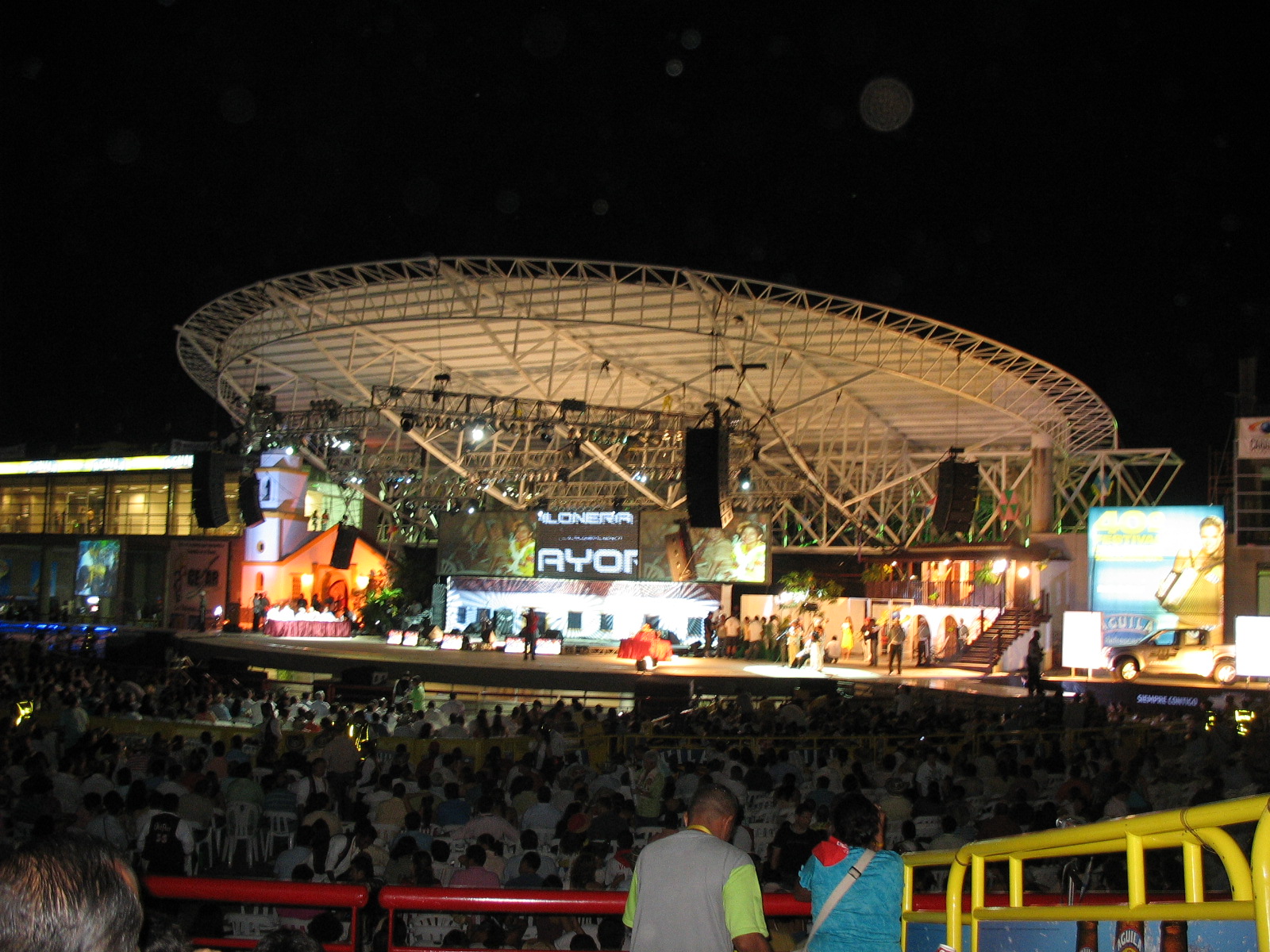
Vallenato Legend Festival
In the piqueria, two singers face each other and improvise verses designed to outwit, outcharm, and verbally demolish their opponent. The crowd roars. The accordion drives the rhythm. No one has written anything down. This is the Vallenato Legend Festival, held every April in Valledupar, a city nestled in the valley between the Sierra Nevada de Santa Marta and the Serrania del Perija in northeastern Colombia. Since 1968, this festival has been the beating heart of vallenato -- a musical genre that UNESCO placed on its list of Intangible Cultural Heritage in Need of Urgent Safeguarding in 2015.
Three Founders, One Vision
The festival began as a conversation between three people who understood that vallenato was slipping away. Rafael Escalona, one of the genre's most celebrated composers, saw traditional forms being diluted by commercial pressures. Alfonso Lopez Michelsen, then governor of the Cesar Department and a future president of Colombia (1974–1978), saw cultural preservation as political and economic opportunity. Consuelo Araujo, a journalist, writer, and future Minister of Culture, saw both and pushed hardest for action. Together they launched the first Festival de la Leyenda Vallenata in 1968, tying it to the religious feast of the Virgin of the Rosary. What began as a local effort to keep a tradition alive has grown into one of the most important musical events in Latin America, drawing thousands of national and international visitors each April.
The Sounds of Contest
At its core, the festival is a competition. Accordion players are judged on their mastery of four rhythms -- paseo, son, puya, and merengue -- each demanding different technical skills and emotional registers. Categories range from professional to amateur to youth, ensuring the pipeline of talent runs deep. The piqueria pits lyricists against each other in real-time verbal duels, where cleverness counts more than volume and a well-placed rhyme can win a round. The highest honor is La Pilonera Mayor, a statuette awarded to composers and performers whose life's work has shaped the genre. Only six musicians have received it, including Escalona himself and the blind composer Leandro Diaz, whose songs he never saw written down but whose melodies entire regions know by heart.
Roots in Three Continents
Vallenato emerged in the nineteenth century among cattle ranchers and farmers on Colombia's Atlantic coast, blending sung poetry with instrumental accompaniment drawn from three traditions. The accordion arrived with European traders. The caja vallenata, a small drum, carries African rhythmic patterns. The guacharaca, a ridged gourd scraped with a stick, traces its origins to indigenous communities. The result is a genre that sounds unmistakably Colombian but carries the DNA of three continents. Its traditional purpose was storytelling -- news, gossip, love declarations, and social commentary delivered through song as musicians traveled from village to village. The festival preserves that oral tradition even as modern vallenato increasingly moves into recording studios and commercial production.
Dancing the Piloneras
The festival opens with the Piloneras Parade, a traditional dance rescued from extinction in 1994. Rooted in the culture of Magdalena River communities, the dance centers on a large wooden mortar and pestle used to crush corn into flour. Men and women dance around the corn-smashing in a courtship ritual, moving from house to house to receive liquor in exchange for their performance. The festival formalized this into a competition among groups of piloneros, with categories for children, youth, and adults. Beyond the official program, families affiliated with the festival throw open parrandas -- parties that spill from houses into streets, fueled by vallenato music and the particular energy of a city that considers this week the most important on its calendar.
From the Air
Located at 10.48N, 73.24W in Valledupar, Cesar Department, Colombia. The city sits in a wide valley between the Sierra Nevada de Santa Marta to the west and the Serrania del Perija to the east -- both mountain ranges are prominent visual landmarks from altitude. Nearest airport: Alfonso Lopez Pumarejo Airport (SKVP), located just south of the city center. The festival takes place in April across multiple venues in the city center.