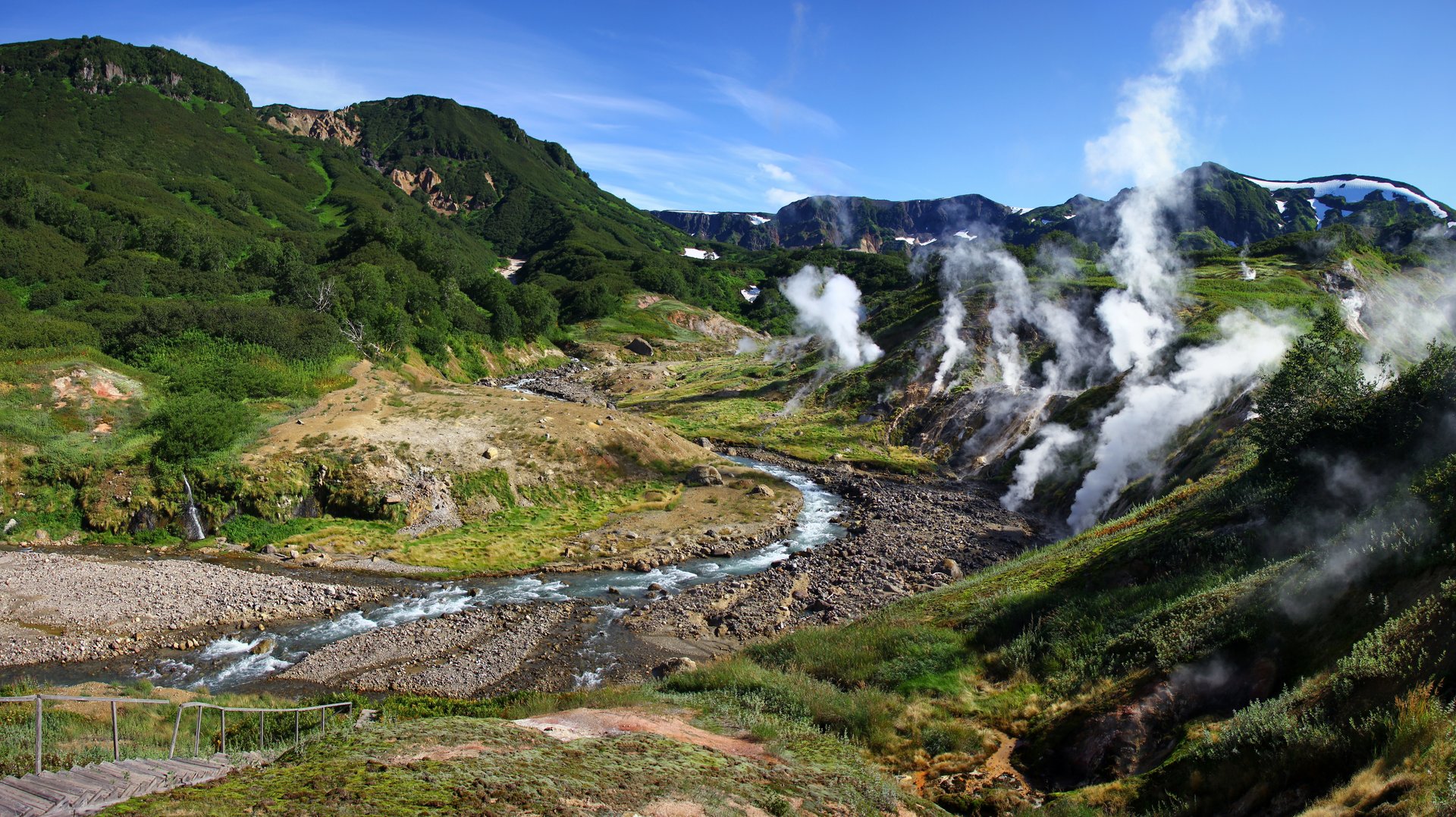
Valley of Geysers
Tatyana Ustinova was not looking for geysers. In 1941, the young scientist was surveying rivers on Kamchatka's remote eastern coast when a column of boiling water erupted from the bank of the Geysernaya River, drenching her and her guide. What she had stumbled upon, in a 6-kilometer basin accessible only by helicopter, was the second-largest concentration of geysers on Earth. Approximately ninety geysers and hundreds of hot springs crowd the valley floor, fed by geothermal waters flowing from Kikhpinych, a young stratovolcano looming above. For decades, this steaming canyon remained one of the planet's best-kept geological secrets.
Steam from Below
The Valley of Geysers sits on the left bank of the Geysernaya River, which cuts ever deeper into volcanic rock as it descends toward the Pacific. Geothermal energy from Kikhpinych heats groundwater to extraordinary temperatures beneath the caldera floor, driving columns of superheated water skyward at irregular intervals. The most powerful, named Velikan -- the Giant -- launches jets as high as 40 meters. Over thirty geysers have been named, each with its own rhythm and character: some pulse every few minutes, others build pressure for hours before erupting in a single violent burst. The valley is part of the Kronotsky Nature Reserve and belongs to the UNESCO World Heritage Site "Volcanoes of Kamchatka," a designation that reflects both its scientific value and its fragility.
A Secret Emerges
Ustinova published her discovery fourteen years after making it, and even then the valley drew little attention. Systematic surveys did not begin until the mid-1970s, and an automatic monitoring system was not installed until 1990. Through the Cold War decades, few outsiders knew the valley existed. That changed in the 1980s, when Soviet authorities began promoting it as a premier destination in the Russian Far East. Foreign tourists were finally permitted in 1991, though reaching the valley required -- and still requires -- a helicopter flight over some of the most rugged terrain in Asia. About 3,000 visitors make the trip each year, paying steep fees for a single day among the geysers.
The Day the Valley Drowned
On June 3, 2007, the earth moved. A massive mudflow swept down the valley, burying two-thirds of the geyser field under meters of debris. The World Wildlife Fund called it tragic for humankind, the loss of one of the great natural wonders. Russia's environmental officials declared the consequences irreversible. By coincidence, a documentary crew filming Wild Russia captured footage of the valley both before and after the catastrophe, preserving a record of what had been. Initial despair was premature, however. Within days, water levels began to recede, exposing features that had seemed permanently lost. Velikan, the Giant, had survived -- unbowed and still erupting.
Resurrection
Nature proved more resilient than anyone dared hope. Heavy rainfall in 2013 triggered a new landslide that destroyed the natural dam created by the 2007 disaster, draining the lake that had formed over the buried springs. As water subsided, geysers that had been silent for six years sputtered back to life, one after another, steam rising from the valley floor like signals of recovery. The revival was not complete -- the valley's topography had been permanently altered, and some features were gone forever. But the fundamental geothermal system that powers the geysers remained intact beneath the surface, a reminder that the forces driving this landscape operate on timescales far longer than any single catastrophe.
Fire and Ice at the Edge of the World
The Valley of Geysers remains one of the most difficult places on Earth to visit. No roads lead here. The helicopter ride from Petropavlovsk-Kamchatsky crosses snowcapped volcanic ridges and river valleys where brown bears fish for salmon in absolute solitude. On clear days, the valley announces itself as a thin veil of steam rising from a deep green gash in the mountainside. From the air, the scale is deceptive -- what looks like a gentle mist is in fact water superheated to hundreds of degrees, erupting with enough force to scald anything in its path. Boardwalks thread between the geysers for the few thousand visitors who make the journey each year, offering a close encounter with a landscape that was nearly lost and, against all expectations, came back.
From the Air
Located at 54.43N, 160.14E on the eastern coast of the Kamchatka Peninsula. Approach from the west over volcanic ridgelines. The valley is a narrow 6 km basin visible as a steam plume in clear weather. Nearest significant airfield is Petropavlovsk-Kamchatsky (UHPP), approximately 180 km southwest. Expect turbulence over mountainous terrain and variable visibility due to volcanic steam and weather. Recommended viewing altitude 3,000-5,000 ft AGL to see geyser activity.