Valley of the Golden Mummies
A donkey stumbled. That is how the story begins. In 1996, a guard at the Temple of Alexander near Bahariya Oasis was riding his donkey across the desert when the animal's hoof broke through the sand into a cavity below. The guard peered into the hole and saw the glint of gold. He had just opened the door to one of the largest burial sites ever discovered in Egypt, a necropolis holding an estimated ten thousand mummies dating back two thousand years.
Gold in the Western Desert
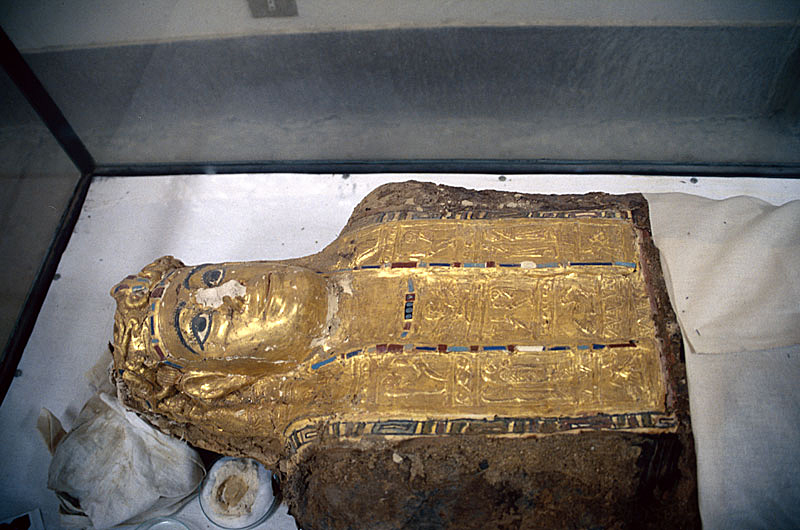
Archaeologist Zahi Hawass and his Egyptian team began excavation almost immediately, and over several seasons they recovered approximately 250 mummies from what became known as the Valley of the Golden Mummies. The site lies at Bahariya Oasis, a depression in Egypt's Western Desert about 370 kilometers southwest of Cairo, where springs have sustained human settlement for millennia. What distinguished these burials from the royal tombs of the Nile Valley was not their grandeur but their sheer number, and the wealth they represented. Roughly sixty of the recovered mummies wore gilded masks over their faces and gilded waistcoats across their chests, decorated with scenes of Egyptian gods and goddesses. These were not pharaohs. They were the prosperous citizens of a desert oasis town.
Four Styles of the Dead
The mummies fell into four distinct categories, each reflecting the status and means of the individual. The wealthiest wore the golden masks and ornamental chest plates depicting deities like Anubis, the jackal-headed god of mummification. A second style was wrapped in cartonnage, a layered material of linen and plaster painted with religious scenes. The third group rested inside anthropoid pottery coffins without gilding or cartonnage, while the simplest burials were wrapped in plain linen. Each mummy was buried with personal artifacts: jewelry, bracelets, pottery trays that once held food offerings, wine jars, and Ptolemaic coins. The variety suggests a society with a clear economic hierarchy but one in which even ordinary people could afford some form of elaborate burial.
Wine, Wealth, and the Oasis Economy
How did a remote desert oasis produce such wealth? The answer lay in its vineyards. Bahariya's principal industry during the Greco-Roman period was the production of wine from dates and grapes, a commodity that traveled far beyond the oasis walls. Hawass estimated the population of Bahariya at roughly 30,000 during the Roman period, when Egypt's total population was about seven million. The wine trade connected this isolated community to the broader Mediterranean economy, generating the surplus that paid for gilded burial masks and skilled artisans. Workshops flourished across the oasis, and craftspeople who prepared the dead were among the most important professionals in the community. As Hawass observed, "it would seem that workshops were everywhere and artisans were one of the main professions in Baharyia" during this prosperous era.
The Scales of the Afterlife
The burial practices at Bahariya reflected a mummification tradition that had evolved over three thousand years. During this period, embalmers placed reed sticks along each side of the body before wrapping it in linen, a technique that produced more stable mummies than those of the earlier Pharaonic period. Preparation began in a workshop called the Wabt, where the god Anubis was believed to watch over every step. The theology of death shaped every detail. According to Egyptian belief, the heart of the deceased was weighed on a scale against the feather of Maat, goddess of truth. If the scale balanced, Horus would lead the soul to meet Osiris and Isis in the fields of paradise. If it did not, the monstrous Ammit waited to devour the unworthy. For the people buried at Bahariya, the gilded masks and painted gods were not decoration. They were insurance for the longest journey anyone would ever take.
Ten Thousand Still Waiting
The 250 mummies recovered represent only a fraction of what lies beneath the sand. Hawass estimated the total at more than ten thousand, making the Valley of the Golden Mummies one of the largest burial sites in Egypt. Much of the necropolis remains unexcavated, its contents preserved by the dry desert climate that has kept gilded masks bright and linen wrappings intact for two millennia. The site transformed understanding of Roman-era Egypt, demonstrating that wealth and sophisticated burial customs extended far beyond the Nile Valley into communities that conventional history had overlooked. Bahariya Oasis, a green interruption in hundreds of kilometers of sand, guarded its dead quietly for twenty centuries until a donkey put its foot wrong.
From the Air
Located at 28.33N, 28.83E in Egypt's Western Desert at Bahariya Oasis, approximately 370 km southwest of Cairo. The oasis is a large green depression visible against the surrounding desert terrain. The nearest significant airport is Cairo International (HECA), about 370 km to the northeast. The oasis itself has a small airstrip. Best viewed at 5,000-10,000 ft AGL where the contrast between green oasis and surrounding desert is most dramatic. The Black Desert and White Desert are visible to the south.