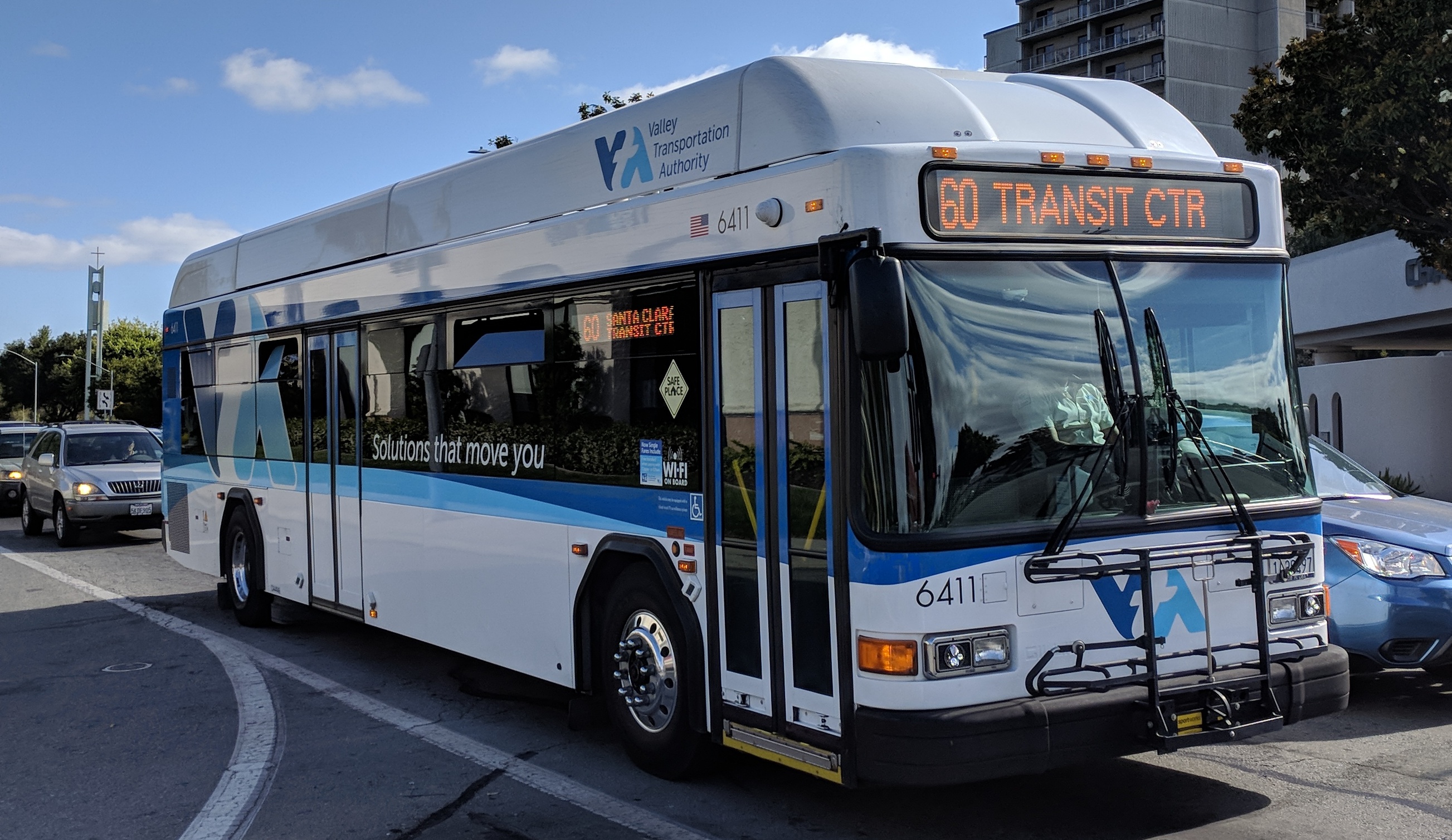
Valley Transportation Authority
Between December 1977 and April 1978, six buses in Santa Clara County caught fire. Critics called them "rolling propane bombs." The Santa Clara County Transit District, barely a decade old and already struggling to replace three bankrupt private bus companies, had to scrap its entire propane fleet and start over with diesel. It was the kind of crisis that could have killed a young transit agency. Instead, it became the first chapter in a story of relentless reinvention -- one that would eventually produce the Valley Transportation Authority, Silicon Valley's answer to the question of how you move a million people through a place that was designed around the car.
Three Bus Companies Walk into Bankruptcy
In 1969, Santa Clara County's public transit consisted of three private bus companies -- Peninsula Transit, San Jose City Lines, and Peerless Stages -- all of them hemorrhaging money. The California Legislature passed the Santa Clara County Transit District Act that year, allowing county voters to decide whether to create a public transit agency. They said yes, but the state offered no funding. The new district would have to finance itself through bonds and, eventually, voter-approved taxes. On March 6, 1976, Santa Clara County voters passed Measure A, a half-cent sales tax to support the fledgling system. By 1977, the district had built its primary maintenance facility at Cerone Yard and ordered 102 diesel buses to replace the propane fleet that kept catching fire. Three additional bus yards followed by 1979. The transit district was learning the hard way that public transportation is not a business you can run on optimism.
Light Rail and the Supreme Court
The transit district broke ground on a light rail system in 1986, and revenue service began along the Guadalupe line on December 11, 1987. The agency marked the occasion by overhauling its visual identity, swapping the old blue-and-orange color scheme for blue and burgundy to match the Tuscan red of the new light rail stations. Expansion continued in sections until 1991, when the starter system reached Santa Teresa in South San Jose. But the district's most consequential legacy from this era was not a train. In December 1978, the agency had approved an affirmative action plan to diversify its workforce. A legal challenge followed, winding through the courts for nearly a decade until the U.S. Supreme Court upheld the plan's gender component in a landmark 6-3 decision, Johnson v. Transportation Agency, on March 25, 1987. A county transit district in San Jose had set nationwide legal precedent.
Reinvention, Recession, and BART
On January 1, 1995, the transit district merged with the county's Congestion Management Agency to become the Santa Clara Valley Transportation Authority. By December 1996, it had adopted the shorter name everyone would actually use: VTA. The rebrand coincided with an ambitious push for funding. Voters approved a 30-year sales tax extension in 2000 to finance the Silicon Valley BART extension, which would bring Bay Area Rapid Transit from Fremont into the heart of San Jose. The measure passed with 70 percent of the vote. Then the dot-com bubble burst, and VTA found itself cutting service and raising fares just as it was promising a subway tunnel through downtown. A series of fare increases between 1998 and 2005 tested riders' patience, but the agency adapted, redesigning routes to match actual demand. By 2008, ridership was climbing again. On June 13, 2020, VTA opened the first phase of the BART extension to Berryessa/North San Jose, fulfilling -- partially -- a promise two decades in the making.
Tragedy at the Rail Yard
On May 26, 2021, a VTA employee opened fire at the Guadalupe rail yard in San Jose. Nine coworkers were killed before the gunman took his own life, making it the deadliest mass shooting in San Francisco Bay Area history. The attack struck at the heart of the agency -- not at a distant facility, but at the maintenance yard where workers began and ended their shifts, the kind of place where people knew each other's names and coffee orders. The shooting prompted a wave of grief that extended far beyond the transit workforce. These were the people who kept the buses running and the light rail moving, and they had been killed in the place where they went to do that work. The community's response -- vigils, memorials, calls for workplace safety reform -- reflected the recognition that public servants are not abstractions. They are neighbors.
The Holly Trolley and What Comes Next
For all its bureaucratic complexity, VTA has a whimsical side. Every winter, a vintage trolley called the Holly Trolley runs between Diridon and Civic Center stations, a joint project with the California Trolley and Railroad Corporation that has been delighting riders since December 2012. It is a small gesture -- a seasonal novelty on tracks built for commuters -- but it captures something about what transit can be when it remembers that moving people is also about connecting them to moments of unexpected pleasure. The agency's future is considerably more ambitious than a holiday trolley. The second phase of the BART extension will bring a five-mile subway tunnel through downtown San Jose, and plans for a connector between Diridon Station and San Jose International Airport are under study. In March 2025, VTA experienced its first-ever operator strike, with 1,500 workers walking off the job for sixteen days before a court injunction ended the work stoppage. The agency keeps building, keeps arguing, keeps moving.
From the Air
VTA's headquarters are located at 37.353N, 121.965W on North First Street in San Jose, near the River Oaks light rail station. The light rail system is visible from the air as a network of tracks threading through Santa Clara County's urban core. Key landmarks include the Guadalupe rail yard (site of the 2021 shooting), the Cerone bus maintenance facility, and San Jose Diridon Station where Caltrain, BART, and VTA light rail converge. Nearest airports: San Jose International (KSJC, 2nm N), Moffett Federal Airfield (KNUQ, 6nm NW), Reid-Hillview (KRHV, 6nm SE). Best viewed at 3,000-5,000 feet AGL to trace the light rail lines across the valley floor.