ValuJet Flight 592: The Crash That Changed Aviation Safety
Cardboard boxes marked "empty" sat in the forward cargo hold of a 27-year-old DC-9 taxiing at Miami International Airport on the afternoon of May 11, 1996. Inside those boxes were 144 chemical oxygen generators - devices that produce breathable oxygen through an intense chemical reaction reaching temperatures above 450 degrees Fahrenheit. They were not empty. They were not deactivated. And within minutes of takeoff, they would ignite a fire so fierce that it would bring ValuJet Flight 592 down into the sawgrass and black water of the Florida Everglades, killing all 110 people on board in the deadliest plane crash in Florida history.
Ten Minutes of Terror
Flight 592 departed Miami International Airport at 2:04 p.m., bound for Atlanta with 105 passengers and 5 crew members aboard the McDonnell Douglas DC-9-32, registration N904VJ. The aircraft was the 496th DC-9 built at the Long Beach plant, first flown on April 18, 1969, and had served Delta Air Lines for over two decades before being sold to ValuJet in 1993. Six minutes after takeoff, smoke filled the cabin. Passengers screamed. The cockpit crew radioed Miami tower requesting an immediate return. Captain Candalyn Kubeck and First Officer Richard Hazen fought to control the aircraft as systems failed. At 2:13 p.m., nine minutes after takeoff, the DC-9 plunged nose-first into the Everglades at over 500 miles per hour. There were no survivors.
A Swamp Holds Its Dead
The crash site was a nightmare for recovery teams. The Everglades swallowed the aircraft whole - the DC-9 drove itself into a deep-water swamp with a floor of solid limestone, leaving no large pieces of fuselage above the surface. The nearest road was more than a quarter mile away. Searchers waded through sawgrass and muck, dodging alligators and risking bacterial infection from every cut. Recovery took weeks. The violence of the impact, immersion in swamp water, and scavenging by wildlife meant very few intact human remains were found. About 68 of the 110 victims were identified, some from jawbones alone, at least one from a single tooth. Captain Kubeck's remains were never recovered. Toxicology testing proved impossible given the conditions.
The Oxygen Generators That Should Never Have Flown
The NTSB's 15-month investigation traced the fire to chemical oxygen generators loaded as cargo in the hold beneath the passenger cabin. SabreTech, a maintenance contractor working on ValuJet aircraft, had removed the expired generators during maintenance but failed to install the required safety caps on their firing pins. Workers then packed them in cardboard boxes, some labeled "empty." Federal regulations explicitly prohibited transporting hazardous materials in passenger aircraft cargo holds. The generators, once activated by heat or impact, produced oxygen through an exothermic reaction - creating both extreme heat and the very element fire needs to grow. The cargo hold had no smoke detectors and no fire suppression system. A decade earlier, the NTSB had recommended that all class D cargo holds be fitted with both. The FAA had declined.
The Airline That Cut Too Deep
ValuJet Airlines, founded in 1992, had built its business on aggressive cost-cutting. Its fleet consisted of used aircraft purchased from other carriers. Training for workers and maintenance contractors was minimal. By 1995, the airline's safety record was poor enough that the U.S. military refused to let its personnel fly ValuJet, and some FAA officials had quietly pushed to ground the airline entirely. After the crash, ValuJet's fleet was grounded for months. When operations resumed, passengers stayed away. In 1997, ValuJet acquired AirTran Airways, but the damage to the ValuJet name was irreparable - executives adopted the AirTran brand instead. The name ValuJet vanished, but the lessons of Flight 592 reshaped American aviation. The FAA mandated smoke detectors and fire suppression systems in all cargo holds, the very change the NTSB had recommended years before the crash.
What Remains
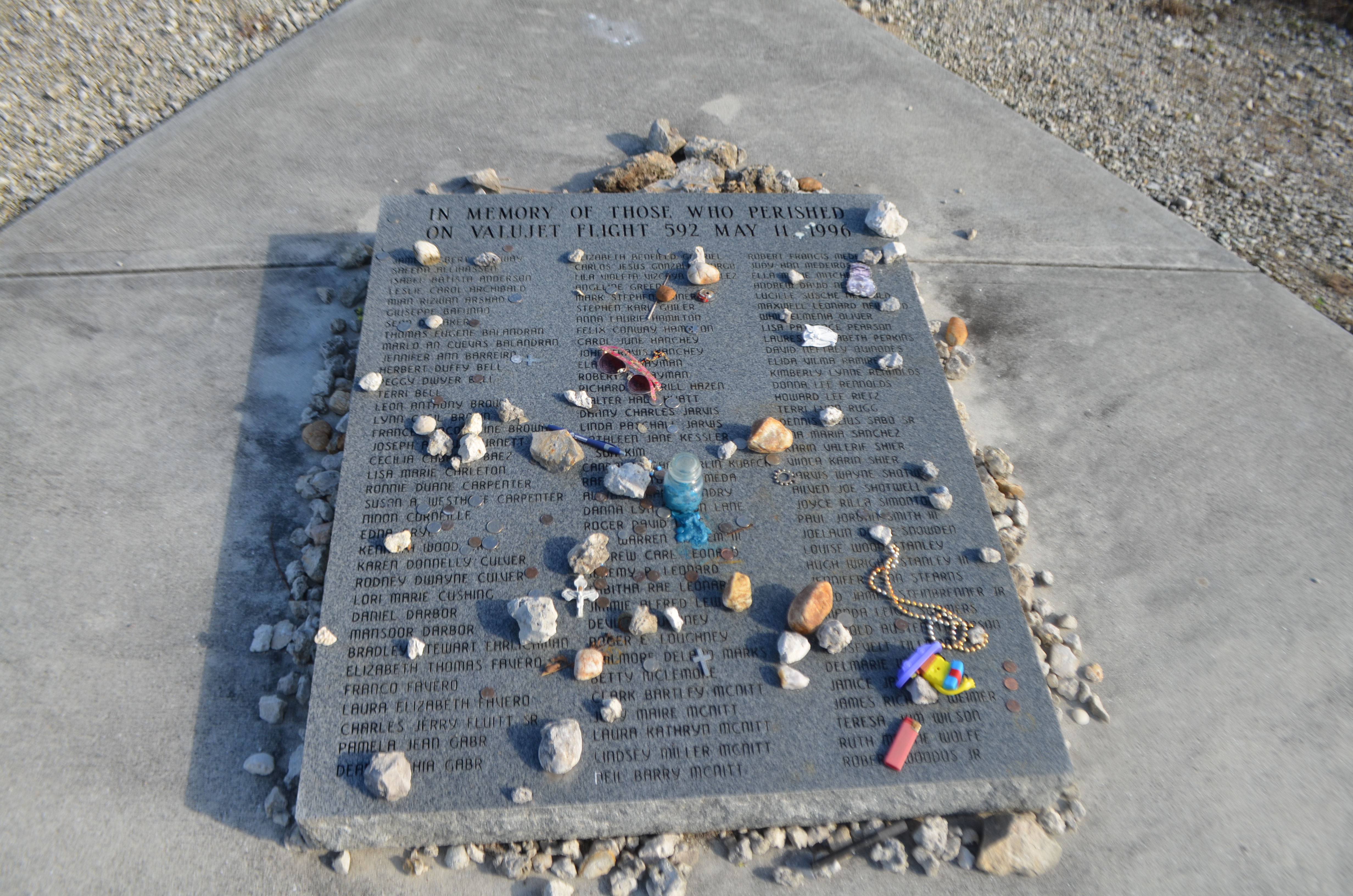
A memorial stands along U.S. Route 41, the Tamiami Trail, near the crash site in the Everglades. Among the 110 who died were San Diego Chargers running back Rodney Culver and songwriter Walter Hyatt. One passenger, DelMarie Walker, was the prime suspect in a Georgia murder case. The mechanic responsible for improperly handling the oxygen generators, Mauro Ociel Valenzuela-Reyes, was indicted but fled the country and remains on the FBI's Most Wanted list. The Everglades have long since closed over the wound - sawgrass grows where the aircraft struck, water covers the wreckage. But the regulatory changes born from Flight 592 continue to protect every passenger who boards a commercial flight in the United States.
From the Air
The crash site lies at approximately 25.92°N, 80.58°W in the Florida Everglades, roughly 10 nautical miles west-northwest of Miami International Airport (KMIA). From altitude, the Everglades appear as an endless expanse of sawgrass and shallow water stretching west from Miami's urban edge. The crash site is not marked from the air but sits in the vast wetland west of the Shark River Slough. The memorial is accessible from U.S. Route 41 (Tamiami Trail). Nearby airports include Miami International (KMIA), Opa-locka Executive (KOPF), and Miami Homestead General Aviation (X51). Best viewed at lower altitudes in clear weather; the stark boundary between Miami's development and the Everglades wilderness is visible from any altitude.