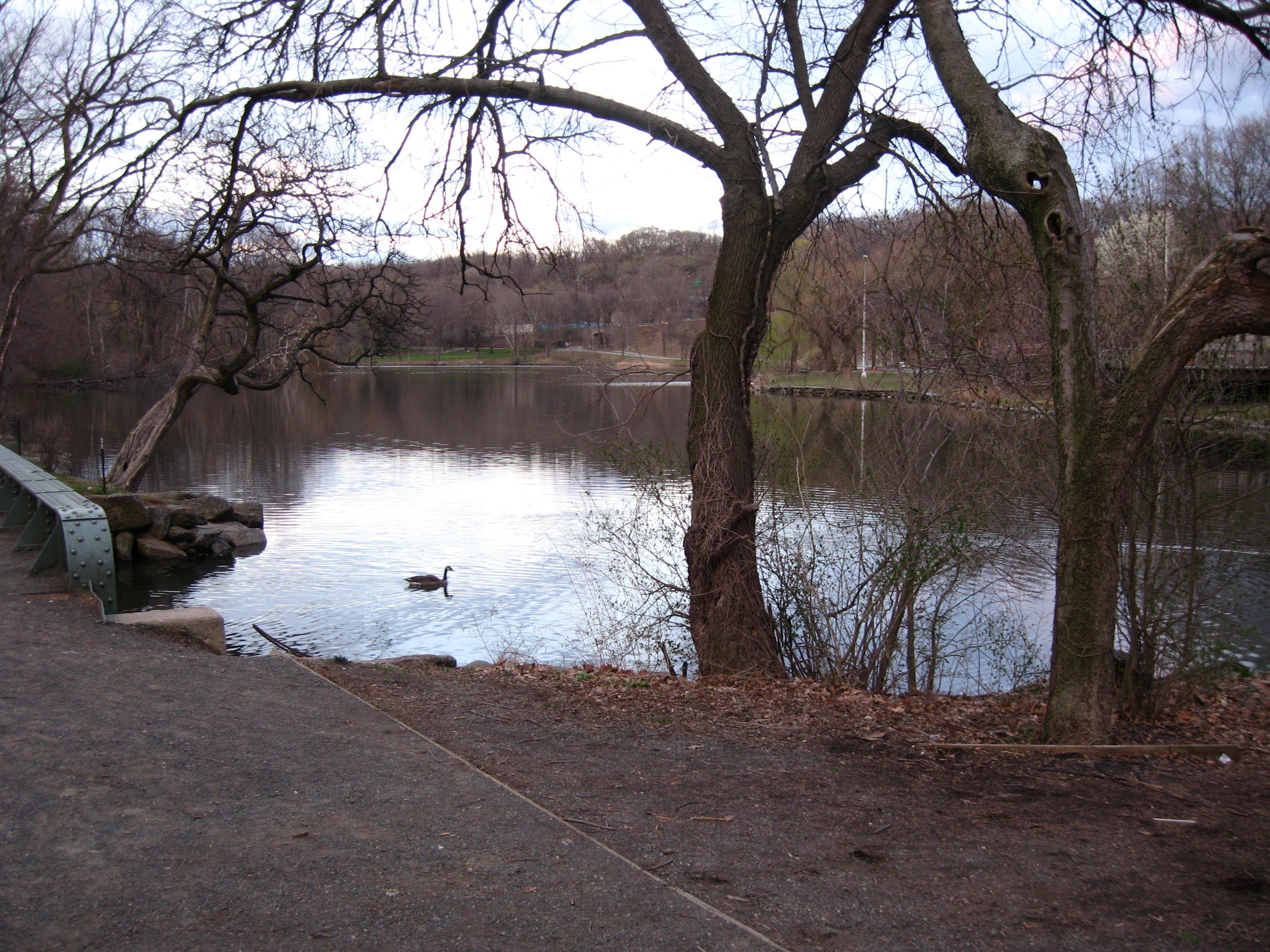
Van Cortlandt Park
In the 1970s, golfers at Van Cortlandt Park carried nightsticks in their bags. They played in groups the size of football teams to deter robbers, wore long-sleeved shirts against mosquito clouds, and dropped their balls a club-length away from abandoned cars lodged in the fairway. Flagsticks had been reduced to broken bamboo poles stuck in the ground. The park's lake was so choked with sediment that a small boat could not float on it. That this same place -- all 1,146 acres of it -- is also the site of the nation's oldest public golf course, a forest that has stood since the last ice age, and the mansion where Washington planned his march to Yorktown says everything about the complicated life of New York City's third-largest park.
Before the Van Cortlandts
The forest here has been growing for 17,000 years, since the Wisconsin glacier retreated and left behind outcrops of Fordham gneiss and Inwood marble. The Wiechquaskeck, a Wappinger people, settled the area around the fourteenth or fifteenth century and established a village they called Keskeskick -- roughly, "sharp grass or sedge marsh" in the Unami language. They fished Tibbetts Brook, Spuyten Duyvil Creek, and the Hudson River, and farmed the flat ground that is now the Parade Ground. In 1646, Dutch settler Adriaen van der Donck bought the land from the Dutch West India Company and named it Colen Donck. He also paid the local chief Tacharew as a gesture of respect. Van der Donck built a house between what is now Van Cortlandt Lake and Broadway, and farmed the parade ground. He died in 1655, and the property eventually passed through the Philipse family to Jacobus Van Cortlandt, who dammed Tibbetts Brook in 1699 to create the lake and power his sawmill.
The Country's First Public Links
When the Van Cortlandt family's land became a public park in 1888, the city wasted little time putting it to use. The nine-hole Van Cortlandt Golf Course opened on July 6, 1895 -- the first public golf course in the United States. The original 2,561-yard layout had eight relatively easy holes and one monster: the ninth, spanning two stone walls and two small brooks, was considered among the hardest holes in the country. Four years later, the city hired Tom Bendelow, known as the "Johnny Appleseed of Golf," to expand it to eighteen holes. The course would endure decades of hard use, neglect, and revival, but its claim as the country's oldest public course has never been challenged. Frederick Law Olmsted, who had surveyed the Bronx in 1876, compared the Van Cortlandt estate's beauty to Central Park and recommended the city purchase it. It took a gubernatorial signature -- Grover Cleveland's, on the New Parks Act of 1884 -- to make that vision real.
Moses Cuts the Park in Six
Robert Moses became New York City Parks Commissioner in 1934, and during his twenty-six-year tenure he reshaped Van Cortlandt Park more than anyone before or since. His ambitions were contradictory: he built playgrounds, paved dirt roads, installed lights, and added baseball, soccer, and cricket fields. He landscaped the areas near subway stations to attract visitors from other neighborhoods. But he also drove the Henry Hudson Parkway and Mosholu Parkway straight through the park, fragmenting it into six disconnected pieces. The construction required dredging and landscaping Tibbetts Brook in 1938, destroying the last remaining freshwater marsh in New York State. The Major Deegan Expressway followed in the 1950s, bisecting what the parkways had already divided. Moses's vision of a "rural oasis" was undermined by his own highways. The roads brought pollution, siltation, and ecological disruption that would take decades to address.
Ruin and Renewal
The 1975 fiscal crisis pushed the park into its darkest period. Pollution from upstream storm sewers and highway runoff killed the fish in Van Cortlandt Lake -- by the late 1970s, only catfish could survive in its waters. The Colonial and Shakespeare Gardens, which had once boasted 250,000 flowers, had already been demolished in the 1930s due to poor drainage. Homeless squatters built shelters in the park. Jogging tracks and bridle paths eroded into impassable ruts. Gradual improvements began in the late 1980s, and in 2015, the city completed a $3.2 billion water filtration plant buried 160 feet below the Mosholu Golf Course. A master plan published in 2014 envisions the park's future through 2034, calling for the restoration of Tibbetts Brook, new pedestrian bridges, playgrounds, and athletic facilities. The Van Cortlandt Golf Course was renovated in 2016. The park endures, carrying its 17,000 years of forest and its complicated twentieth-century wounds into whatever comes next.
From the Air
Located at 40.898°N, 73.884°W in the northwestern Bronx. From the air, the park's 1,146 acres are unmistakable -- a vast green swath bisected by the visible lines of the Henry Hudson Parkway and Mosholu Parkway, with the Major Deegan Expressway running along its eastern edge. Van Cortlandt Lake is visible near the park's center, and the large flat Parade Ground is prominent at the southwest corner. The golf course occupies the park's northern reaches. Nearest airport: LaGuardia (KLGA), approximately 9 nm south-southeast; Teterboro (KTEB) approximately 8 nm west. Best viewed at 3,000-5,000 ft AGL to appreciate the park's full extent and its fragmentation by highways.