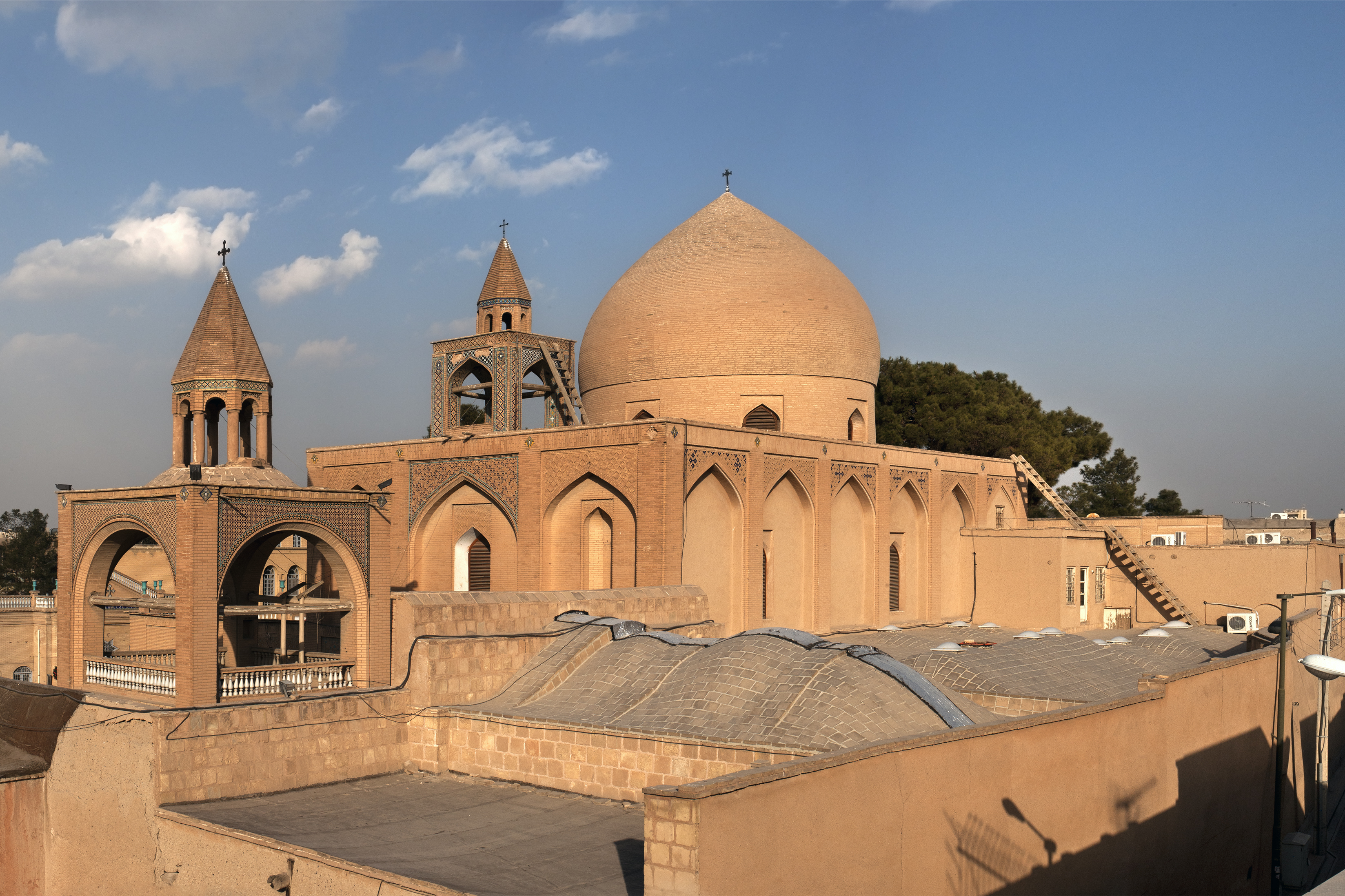
Vank Cathedral
The word "vank" means monastery in Armenian, but the Holy Savior Cathedral in Isfahan's New Julfa district is something more complicated than that simple translation suggests. It is a Christian church with a dome that could be mistaken for a mosque. Its interior walls blend European oil paintings with Persian floral tilework. And it was built by people who did not choose to be there. In 1604–1605, Shah Abbas I forcibly relocated hundreds of thousands of Armenians from their homeland to his new capital during the Ottoman-Safavid War, burning the lands behind them so the Ottomans would inherit nothing. The cathedral these deportees raised on the far side of the Zayandeh River became both a declaration of faith and an argument for survival.
Exile Across the River
Shah Abbas I was not a simple villain in the Armenian story. He was a calculating one. Moving his capital from Qazvin to Isfahan in 1598, he recognized that Armenian merchants controlled some of the most lucrative trade networks between Europe and Asia. Relocating them to a suburb across the Zayandeh River gave him access to their commercial expertise while keeping them close enough to control. The scorched-earth deportation from Armenia during the war with the Ottomans served a dual military purpose: it denied resources to the advancing Ottoman army and delivered skilled artisans, merchants, and laborers to his growing capital. Abbas issued an edict in 1606 establishing New Julfa, named after the Armenian city of Julfa that his army had destroyed. He granted the community a degree of autonomy unusual in the Safavid Empire, including the right to practice Christianity and govern their own affairs. Subsequent edicts by Abbas and his successors explicitly prohibited persecution of Armenians or interference with their property. These protections were strategic, not generous. The Armenians made Isfahan rich.
Two Traditions Under One Dome
Construction of the cathedral began in 1606, almost immediately after the first Armenian arrivals. What rose from the ground over the following decades was unlike anything in either Persian or Armenian architectural tradition. The exterior is deliberately understated, its dome and brickwork resembling the Islamic architecture of the surrounding city. Step inside, and the walls erupt with frescoes depicting biblical scenes, rendered in a style that draws on both Armenian manuscript illumination and the European paintings that Armenian merchants brought back from their travels. Persian floral motifs interweave with images of the Last Judgment. The result is a building shaped by the cultures that intersected in New Julfa: Armenian, Persian, and European, layered onto each other without any one tradition dominating. European missionaries, mercenaries, and travelers passed through the suburb regularly, and their influence can be traced chronologically in the cathedral's evolving decorative program.
Ink, Metal, and Memory
The cathedral complex houses a library containing over 700 handwritten books in Armenian and medieval European languages. Across the courtyard stands a museum whose collection traces the full arc of the Armenian experience in Isfahan. The 1606 edict of Abbas the Great sits alongside edicts from his successors forbidding anti-Armenian persecution. A historic printing press occupies one gallery, representing the first book ever printed in Iran. Safavid-era costumes and tapestries share space with European paintings that Armenian merchants carried home along the Silk Road. Vestments, chalices, and monstrances speak to centuries of unbroken worship. But the museum does not confine itself to celebration. An extensive display of photographs, maps, and translated Turkish documents chronicles the 1915 Armenian Genocide. In the courtyard itself, a memorial stands in one corner, connecting the community that built this cathedral to the broader Armenian story of survival and loss.
A Community That Outlasted Its Patron
What makes Vank Cathedral remarkable is not just its beauty but its persistence. The Safavid dynasty that brought the Armenians to Isfahan collapsed in 1722 when Afghan forces besieged the city. The political upheavals that followed could easily have scattered or destroyed the New Julfa community. They did not. The cathedral endured through the fall of the Safavids, the brief Afghan interregnum, the rise of Nader Shah, and every subsequent change of government. The Armenian quarter retained its identity across the river from Isfahan's Islamic core, century after century. The cathedral's architectural influence spread outward, shaping the design and decoration of Orthodox churches throughout the region. Today, New Julfa remains one of the oldest and most significant Armenian communities outside of Armenia itself, and the Vank Cathedral stands as its anchor. A tile plaque inscribed in Armenian greets visitors at the entrance. Graves with Armenian inscriptions line the exterior wall. The building announces, in every detail, exactly who built it and why they are still here.
From the Air
Located at 32.635°N, 51.656°E in the New Julfa district of Isfahan, Iran, on the south bank of the Zayandeh River. The cathedral dome is visible from altitude, situated across the river from the main historic core and Naqsh-e Jahan Square. Nearest major airport is Isfahan Shahid Beheshti International Airport (OIFM), approximately 25 km northeast. The Zayandeh River provides a clear east-west visual reference dividing the Armenian quarter from the rest of the city.