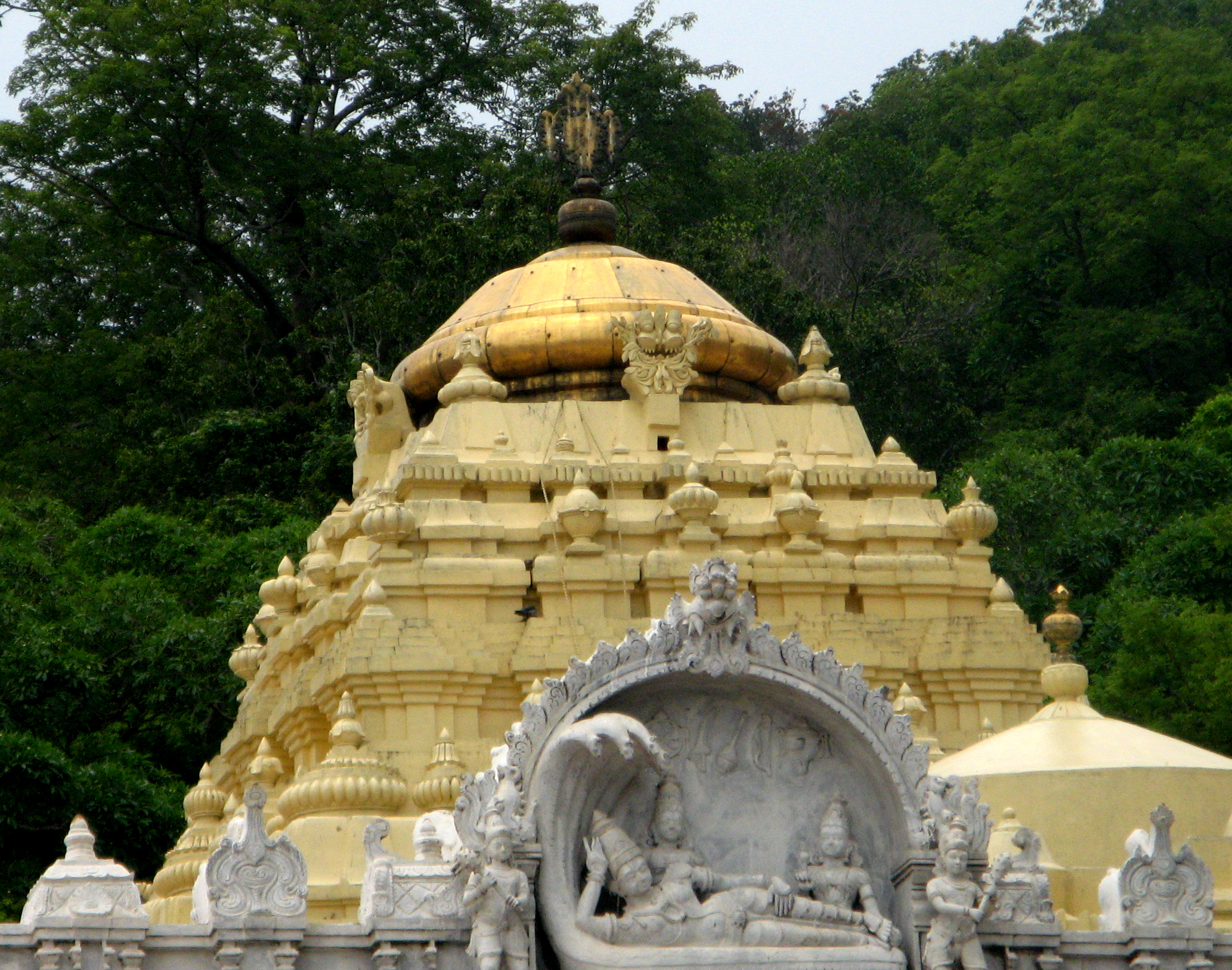
Varaha Lakshmi Narasimha Temple, Simhachalam
For 364 days a year, no one sees the god. The central idol at Simhachalam sits coated in a thick layer of sandalwood paste, its features entirely obscured, resembling nothing so much as a Shiva lingam. Only on the day of Akshaya Tritiya, during the third day of the bright fortnight of the Vaishakha month, do priests scrape away the fragrant coating to reveal the true form beneath: Varaha Narasimha, a fusion of Vishnu's boar and man-lion avatars that exists at no other major temple in India. Pilgrims who time their visit for that single day of revelation call the experience Nijarupadarsanam, the viewing of the real form. Everyone else must take it on faith that the divine is there, hidden under sandalwood, 300 meters above the coastal plain of Visakhapatnam.
The Lion's Hill
Simhachalam means "the hill of the lion," and the name carries a weight that goes beyond geography. The temple complex sits atop a hill in the Eastern Ghats overlooking the Bay of Bengal, its stone walls built in a fortress-like style that blends Kalinga, Chalukya, and Chola architectural traditions. The earliest inscription at the site dates to 1098 CE, during the reign of Chalukya-Chola ruler Kulottunga I. But the temple as it stands today owes most of its form to the Eastern Ganga dynasty king Narasimha Deva I, who rebuilt it in the 13th century. His son Bhanudeva I consecrated the structure in 1268 CE. Three courtyards ringed by five gateways give the complex the layered feel of a medieval citadel, and the carvings on the outer walls draw from sculptural vocabularies spanning centuries and kingdoms.
A Calendar of Fire and Light
The temple's ritual year is dense enough to make a liturgical calendar look sparse. During Dolotsava, priests carry the processional idol down the hill to a garden, sprinkle it with red powder, and place it on a ceremonial swing. At nightfall, a small hut near the temple entrance is set ablaze in the Kamadahana ceremony, symbolizing the annihilation of desire. For Karthika Deepavali, the full moon festival of lights, innumerable oil lamps blanket the temple grounds while twelve earthen containers burn at cardinal and intercardinal points, eight for the directional guardians and four for Brahma, Narasimha, Shesha, and Garuda. An inscription from 1270 CE records that a donor named Chittana Gopala gave fifty cows and two perpetual lamps to keep the tradition alive. During Giripradakshina, devotees fast and then circumambulate the entire hill on foot, covering 30 kilometers before visiting the sanctum.
Verses on Copper and Palm Leaf
Simhachalam's literary footprint is as layered as its architecture. The poet Krishnamacharyulu, considered the first Telugu writer to channel bhakti devotion into prose, composed 400,000 vachanas, devotional prose pieces, on copper plates dedicated to Varaha Narasimha. Only 75 of those copper plates survive, but villagers near Simhachalam still recite the Simhagiri Vachanas on special occasions. His work influenced a lineage of Telugu devotional poets: Annamacharya, Kancherla Gopanna, and the great Tyagaraja all followed in the tradition he established. Centuries later, the Vijayanagara emperor Krishnadevaraya documented his own pilgrimage to Simhachalam in the epic poem Amuktamalyada and erected a victory pillar at the site, an event recorded by the court poets Allasani Peddana and Dhurjati.
Andhra's Second Pilgrimage
Simhachalam ranks as the second-wealthiest temple in Andhra Pradesh after Tirumala, with annual earnings recorded at 60 crore rupees as of 2013. It is one of 32 Narasimha temples in the state that form a pilgrimage network, alongside sites at Ahobilam, Antarvedi, Kadiri, and Mangalagiri. The scholar Diana L. Eck, in her book India: A Sacred Geography, observed that Simhachalam offers something unusual in Hindu worship: the pairing of Narasimha, whose mythology is steeped in ferocious violence, with Varaha, generally regarded as a peaceful deity. That combination softens the fearsome energy into something approachable. Parents who credit the temple with granting them children often name those children after the deity, and the names Simhadrinatha and Simhadri Appanna appear frequently in the villages surrounding the hill.
From the Air
Approaching from the Bay of Bengal, the forested ridge of Simhachalam rises distinctly from the coastal lowlands northeast of Visakhapatnam's urban sprawl. The temple's stone towers and whitewashed gopurams catch the light against the green hillside, visible from altitude as a clearing among the trees. The hill itself is modest by mountain standards, but its isolation from the surrounding terrain makes it a reliable visual landmark. Below and to the south, the port city of Visakhapatnam stretches along the coast, its harbor cranes and naval installations providing further orientation. The temple stands roughly 16 kilometers north of the city center, close enough to be spotted on approach to Visakhapatnam Airport.
From the Air
Located at 17.77°N, 83.25°E on a hilltop approximately 300 meters above sea level. Nearest airport is Visakhapatnam (VOVZ/VTZ), roughly 16 km to the south. The forested hill with whitewashed temple structures is visible as a distinct clearing when approaching from the Bay of Bengal. The Visakhapatnam naval base (INS Dega) and port facilities provide additional orientation landmarks.