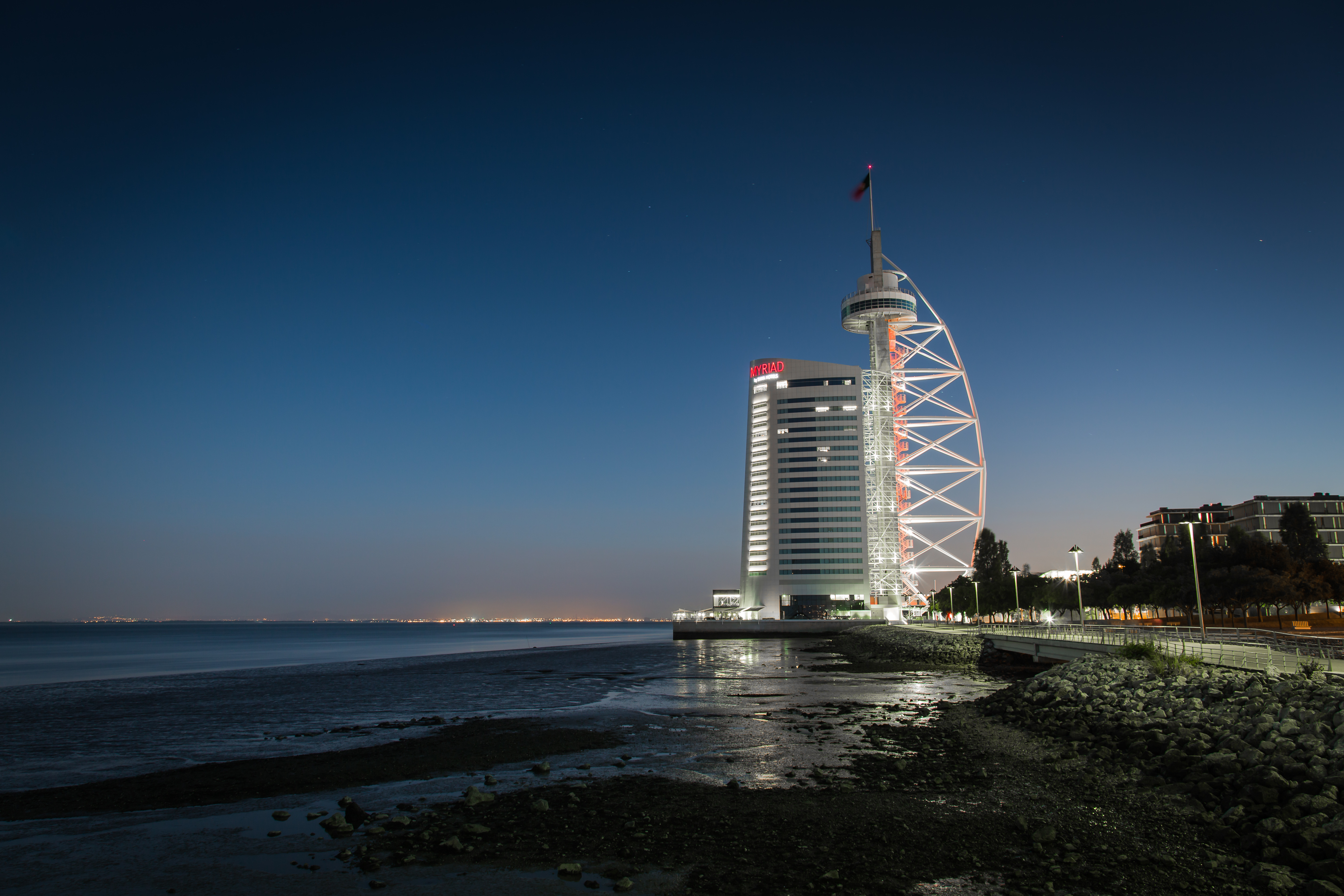
Vasco da Gama Tower
In 2006, the French urban climber Alain Robert scaled a 160-meter tower on the bank of the Tagus River in Lisbon, sponsored by a Portuguese mobile phone company. The stunt captured something essential about the Vasco da Gama Tower: it is a building that invites spectacle. Designed to evoke the sail of a caravel, the ship that carried Portuguese explorers across uncharted oceans, the tower is the tallest structure in Lisbon and the most visible legacy of Expo '98, the World's Fair that transformed a derelict industrial waterfront into the modern Parque das Nacoes district.
Built for a World's Fair
The tower was completed in 1998 as the centerpiece of Expo '98, a World's Fair themed around "The Oceans, a Heritage for the Future." The choice of theme was deliberate: 1998 marked the 500th anniversary of Vasco da Gama's voyage to India, the maritime achievement that launched the Portuguese Empire. At the tower's base, a three-story building served as the European Union Pavilion during the fair. When the Expo closed, plans to convert the base into commercial office space failed to attract tenants. The building sat largely empty, hosting occasional one-off events, including the world premiere of the redesigned Mini car in 2001. Both the observation deck and the restaurant closed in October 2004, and for several years the tower stood as a monument to the familiar post-exposition problem: what to do with the fair when the fair is over.
A Sail on the Tagus
The architects, Leonor Janeiro, Nick Jacobs, and the firm Skidmore, Owings and Merrill, drew their design from Portugal's nautical heritage. The tower's vertical mast rises from a base that enters the river like the bow of a ship, supported by pillars that form a terrace above the water. A metallic tubular structure curves away from the mast like a sail filling with wind, and at 120 meters, a platform forms the crow's nest, housing what was originally a revolving restaurant and viewing area. The engineering firm Martifer assembled the structure, which manages to be both monumental and graceful, its lattice framework allowing the Tagus winds to pass through rather than push against it.
Reinvention at the Top
The solution to the tower's post-Expo emptiness arrived in stages. Portuguese architect Nuno Leonidas designed a 20-floor, 178-room luxury hotel to replace the original base building. Demolition began in July 2007, and the five-star Myriad hotel opened in 2012, wrapping around the base of the tower in a sleek, contemporary form that contrasts with the lattice structure above. Then, in 2018, Michelin-starred chef Martin Berasategui opened the panoramic restaurant Fifty Seconds in the space that had been the observation deck. The name refers to the elevator ride to the top. Within a year, the restaurant earned its own Michelin star, transforming a closed-off platform into one of Lisbon's most coveted dining experiences, with the Tagus River, the Vasco da Gama Bridge, and the city spread out below.
From the Air
Located at 38.775N, 9.091W in the Parque das Nacoes district on the north bank of the Tagus River in eastern Lisbon. At 160 meters, the tower is the tallest structure in Lisbon and highly visible from the air. The nearby Vasco da Gama Bridge, one of Europe's longest, extends across the Tagus to the southeast. Nearest airport is Lisbon/Humberto Delgado (LPPT), 10 km west. Best viewed at 3,000-6,000 ft AGL.