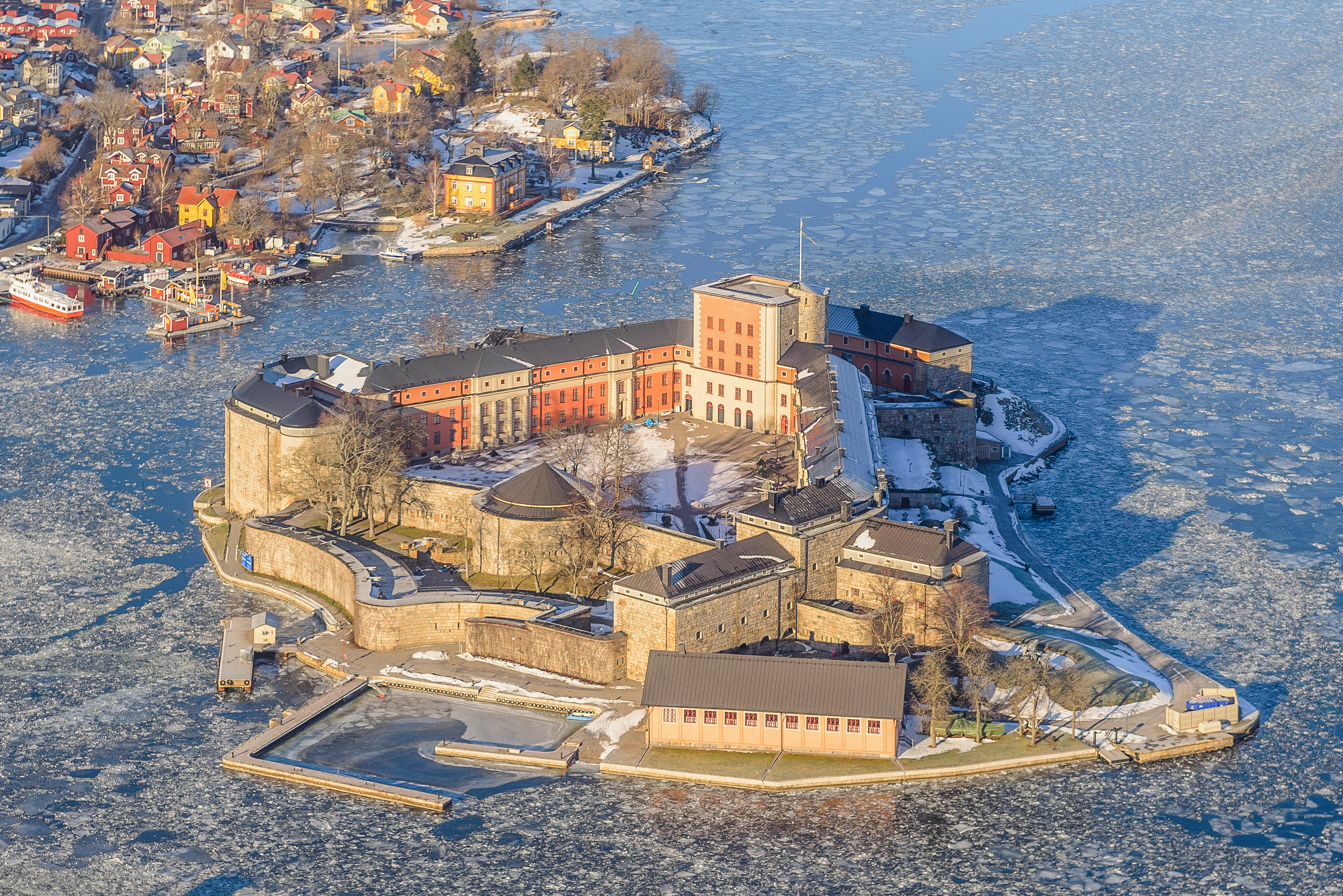
Vaxholm Fortress
The story goes that Helmuth von Moltke, the legendary Prussian field marshal famous for his iron demeanor, smiled only twice in his entire life. The first time was when someone told him his mother-in-law had died. The second was when he saw Vaxholm Fortress. By the late 1800s, Sweden's once-formidable guardian of Stockholm had become a military joke—but that punchline obscures three centuries of strategic importance and the remarkable engineering that made this island fortress the Baltic's most effective chokepoint.
Gustav Vasa's Granite Gamble
In 1548, King Gustav Vasa faced a problem that had vexed Swedish rulers for generations: Stockholm lay exposed to naval attack from the east. The Baltic Sea offered enemies a direct highway to the capital. Gustav's solution was elegant in its simplicity. The islet of Vaxholmen sat squarely in the Kodjupet strait, one of only two navigable passages into Stockholm from the open sea. Control that rock, and you controlled access to the kingdom. The king ordered the alternative route artificially shallowed, funneling all deep-draft shipping past his new wooden blockhouse. Any hostile fleet would have to sail directly under Swedish guns—or turn back.
Stone, Steel, and Russian Galleys
Gustav's wooden fort served its purpose, but his grandson Johan III recognized the need for something more permanent. During his reign from 1569 to 1592, the blockhouse was replaced with a stone tower that would form the core of the fortress for centuries. The defenses proved themselves twice in dramatic fashion. In 1612, Danish warships tested Vaxholm and were repulsed. Over a century later, in 1719, Admiral Apraksin's Russian fleet attempted to bypass the fortress entirely by finding an alternate route through the archipelago—the famous Battle of Stäket—rather than challenge Vaxholm directly. The fortress never fell to assault. The current structure, dating from 1833 to 1863, was built partly by Russian prisoners of war, adding an ironic twist to its history. French military theory inspired its design, particularly the ideas of engineers Marc René de Montalembert and Lazare Carnot.
Made Obsolete by Progress
Technology ultimately achieved what enemy fleets could not. By the latter half of the 1800s, ships had grown too large for the narrow, twisting Kodjupet strait. In 1879, the Swedish government simply dredged out the Oxdjupet strait—the very passage Gustav Vasa had blocked 330 years earlier—and redirected the main shipping lane away from Vaxholm entirely. The fortress that had guarded Stockholm for three centuries became strategically irrelevant overnight. Von Moltke's alleged comment captured the mood: a fortification that protected nothing was merely picturesque. The garrison shrank, and military planners turned their attention elsewhere.
From Ramparts to Pippi
Vaxholm's second act proved more colorful than its first. In 1970, filmmakers arrived to shoot scenes for "Pippi in the South Seas," transforming the stone fortress into a pirate stronghold for Sweden's beloved literary heroine. The fortress museum had already opened in 1964, finding a new purpose as a keeper of military history rather than a maker of it. Today, visitors arrive aboard the Kastellet, an electrically powered cable ferry that crosses the narrow channel from Vaxholm town. The fortress fills the entire islet of Vaxholmen—there is no shore to speak of, just walls rising from the water. From the car ferry plying between Vaxholm and Rindö island, the scene looks much as it did when Swedish cannoneers scanned the horizon for enemy sails.
Guardian of the Archipelago
The Stockholm archipelago spreads across 24,000 islands, but Vaxholm Fortress stands alone as the human attempt to impose order on this watery labyrinth. The fortress represents a uniquely Swedish approach to defense: rather than building massive land fortifications, control the water. The strategy reflected geography—Stockholm's approaches are a maze of channels, shoals, and islands where a well-placed battery could neutralize a fleet. Walking the ramparts today, visitors can trace sight lines that haven't changed in 400 years. The shipping channel may have moved, but the stone walls remain, a monument to the centuries when Sweden was a Baltic superpower and this small island held the key to its capital.
From the Air
Located at 59.40°N, 18.36°E on the island of Vaxholmen in the Stockholm archipelago. The fortress is unmistakable from the air—a compact stone fortification filling an entire small island. The town of Vaxholm lies immediately to the west across a narrow channel. Look for the Kastellet ferry making its short crossing. Rindö island lies to the east; the car ferry route between Vaxholm and Rindö provides excellent fortress views. Nearest airports are Stockholm Arlanda (ESSA) approximately 35 km northwest and Stockholm Bromma (ESSB) about 20 km southwest. Optimal viewing altitude is 1,500-2,500 feet to appreciate the fortress's relationship to the surrounding waterways and the town of Vaxholm.