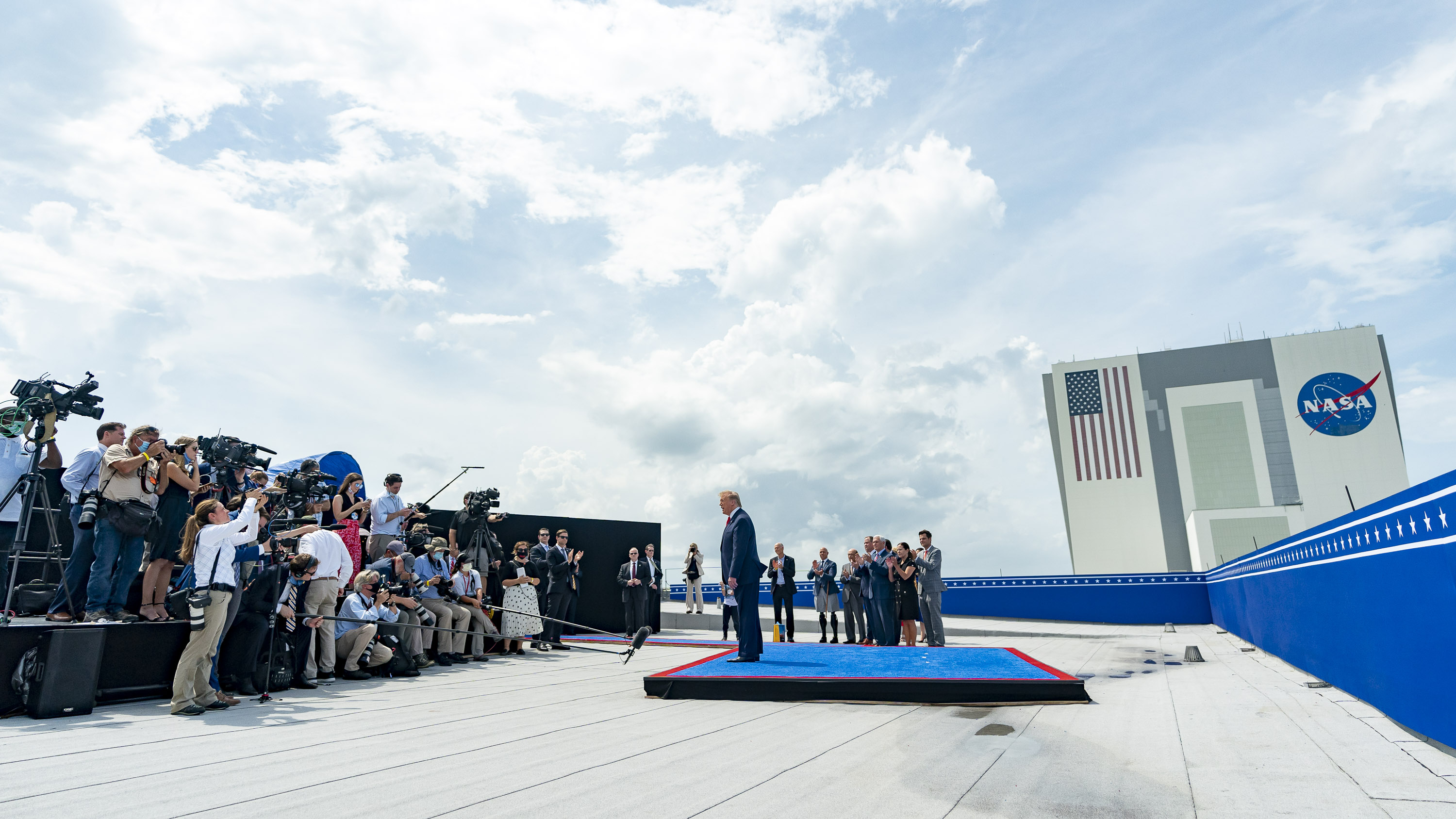
Vehicle Assembly Building
The building is so large that it creates its own weather. Before NASA installed a sophisticated air handling system, moisture rising from Florida's humid air would condense near the 525-foot ceiling of the Vehicle Assembly Building and form rain clouds inside the structure. That anecdote captures the VAB perfectly: a building so far beyond normal human scale that the atmosphere itself gets confused. Standing on Merritt Island at Kennedy Space Center's Launch Complex 39, the VAB is the tallest building in the United States outside an urban area, the eighth-largest building in the world by volume, and the place where every Saturn V, every Space Shuttle, and the Space Launch System's Artemis rockets have been stacked and prepared for their journey to the pad.
Built for the Moon
In 1963, NASA contracted Urbahn Architects to design a building capable of vertical assembly of the Saturn V -- the 363-foot rocket that would carry astronauts to the Moon. Construction began on August 2, 1963, with the driving of the first steel foundation piles. By the time workers finished in 1966, they had driven 4,225 pilings down to bedrock, poured a foundation of concrete, and erected a steel frame that soared 525 feet into the coastal Florida sky. The building was originally called the Vertical Assembly Building, but NASA renamed it the Vehicle Assembly Building on February 3, 1965, anticipating that it would serve programs far beyond Apollo. That foresight proved correct. The VAB was designed with room for six assembly bays, though only four were built and just three were ever connected to the crawlerway that leads to the launch pads. Bay 2, on the building's west side, saw limited use during the Saturn era and eventually became a storage area.
Inside the Cathedral
The north end of the VAB contains four high bays -- immense vertical chambers where rockets are stacked piece by piece on mobile launcher platforms. Components enter through the south side, which houses eight low bays for storage and pre-assembly. A transfer aisle runs the full length of the building, allowing hardware to move between bays. Adjustable platforms at multiple levels give technicians access to every part of a rocket, from the engines at the base to the spacecraft at the top. During the Shuttle era, orbiters were mated to their external fuel tanks and solid rocket boosters inside these bays, then the complete assembly -- vehicle, boosters, and mobile launcher platform -- was carried to Launch Complex 39A or 39B by a crawler-transporter, a machine the size of a baseball diamond that moves at one mile per hour. The entire operation, from vertical stacking to rollout, embodied an industrial process unlike anything else on Earth.
Stars, Stripes, and Storm Damage
The American flag painted on the VAB's eastern face was the largest flag in the world when it was added in 1976 as part of the United States Bicentennial celebration. Each star on the flag spans six feet. The blue field is the size of a regulation basketball court. A Bicentennial star logo was painted alongside it and later replaced by the NASA "meatball" insignia in 1998 for NASA's 40th anniversary. But Florida's hurricane season has tested the building's exterior relentlessly. In 2004, Hurricane Frances tore 850 aluminum panels from the facade, opening roughly 40,000 square feet of gaps in the walls. Hurricane Jeanne struck three weeks later and ripped off 25 more. Hurricane Charley, earlier that same season, caused $700,000 in damage. Some of these panels are engineered "punch-outs" -- designed to detach during extreme pressure differentials to protect the building's structural integrity, a deliberate sacrifice of skin to save skeleton.
From Saturn to Artemis
The VAB has reinvented itself for every generation of American spaceflight. After the last Saturn V launched Skylab in 1973, the building was adapted for the Space Shuttle program, which used it from 1981 until the Shuttle's retirement in 2011. When the Constellation program was cancelled in 2010, the building briefly opened for public tours -- one of the few times ordinary visitors could stand on the floor of a high bay and look straight up at 525 feet of empty air. Those tours ended in 2014 when renovations began for the Space Launch System. NASA's FY2013 budget allocated $143.7 million for modernizing the VAB and surrounding facilities for the Artemis program. On March 17, 2022, the first SLS rocket rolled out of the VAB on its mobile launcher platform, bound for Launch Complex 39B. On November 16, 2022, Artemis I launched successfully, returning the VAB to its original purpose: preparing vehicles for deep space. Designated a National Historic Civil Engineering Landmark in 2020, the VAB remains what it has always been -- the place where America's boldest machines stand up before they leave the ground.
From the Air
The Vehicle Assembly Building is located at Launch Complex 39, Kennedy Space Center, Merritt Island, Florida, at approximately 28.586N, 80.651W. At 525 feet tall with a distinctive cubic profile bearing a massive American flag and NASA insignia, the VAB is one of the most recognizable landmarks on Florida's Atlantic coast and is clearly visible from altitude and from considerable distance. The Crawlerway extends southeast from the VAB to Launch Pads 39A and 39B. Nearest airports: NASA Shuttle Landing Facility (KTTS) immediately adjacent to the north, Space Coast Regional / Titusville (KTIX) 8nm northwest, Merritt Island Airport (KCOI) 10nm south, Melbourne Orlando International (KMLB) 25nm south. Approach from the east at 3,000-5,000 feet for a dramatic view of the entire launch complex with the VAB as the visual anchor.