Veliky Ustyug
The name explains itself, once you know. Ustyug means "Mouth of the Yug" -- Ustye Yuga -- marking the spot where the Yug River flows into the Sukhona to create the Northern Dvina, one of Russia's great Arctic-bound waterways. The "Veliky" -- Great -- was bestowed by a tsar in recognition of the city's commercial and historical weight. For centuries, Veliky Ustyug sat at the crossroads of the routes that opened the Komi-Perm lands, the Urals, and Siberia to Russian exploration and trade. Today it sits at a different kind of crossroads: a town of extraordinary 18th-century architecture that most Russians know as the home of Ded Moroz, the country's Santa Claus.
Gateway to the Unknown
Veliky Ustyug's location made it inevitable as an outpost of expansion. The Sukhona-Vychegda system provided an east-west corridor while the Yug-Northern Dvina offered a north-south route, and the town sat exactly where they intersected. From here, Russian explorers and merchants pushed into the Komi-Perm territories, crossed the Urals, and penetrated Siberia. The city was home and birthplace to many of these figures, men whose names are now attached to rivers, mountains, and towns across eastern Russia. This strategic importance also drew conflict: Veliky Ustyug was contested between the Novgorod Republic and the Vladimir-Suzdal Principality, the only Northern Dvina town that belonged to the latter. First mentioned in chronicles in 1207, the city accumulated wealth, churches, and civic ambition that far exceeded what its remote location might suggest.
Spires Above the Confluence
What survived in Veliky Ustyug is remarkable, and what survived is largely sacred. The city possesses one of the richest collections of Northern Baroque ecclesiastical architecture in Russia -- a style characterized by ornate facades, elaborate bell towers, and interiors heavy with gilded iconostases. The Cathedral of St. John the Righteous, the Church of the Ascension (now housing the Old Russian Art Museum), and the Church of St. Nicholas (home to the Ethnography Museum) are among the landmarks. That these buildings survived the Soviet era largely intact is partly luck and partly geography: Veliky Ustyug was too remote and too small to attract the concentrated demolition campaigns that destroyed churches in larger cities. The Trinity Monastery of Gledinsky, four kilometers from the city center at the very confluence of the Sukhona and Yug, contains a gilded iconostasis of extraordinary craftsmanship.
The Craft of Black Silver
Veliky Ustyug's artisans developed a specialty that endures: niello silverwork, a technique in which a black mixture of copper, silver, lead, and sulfur is inlaid into engraved silver to create intricate, high-contrast designs. The tradition dates back centuries and remains a living craft, produced by the Velikoustyugskiy Uzory factory alongside decorative birch bark containers known as tues. The factory also produces woven textiles and carved wooden items, but the niello silver is the signature -- small boxes, jewelry, and decorative objects that carry an aesthetic distinctly tied to this one town. Visitors to Veliky Ustyug can purchase these directly, making them among the more authentic souvenirs available in Russia's tourist economy.
Where Winter Has an Address
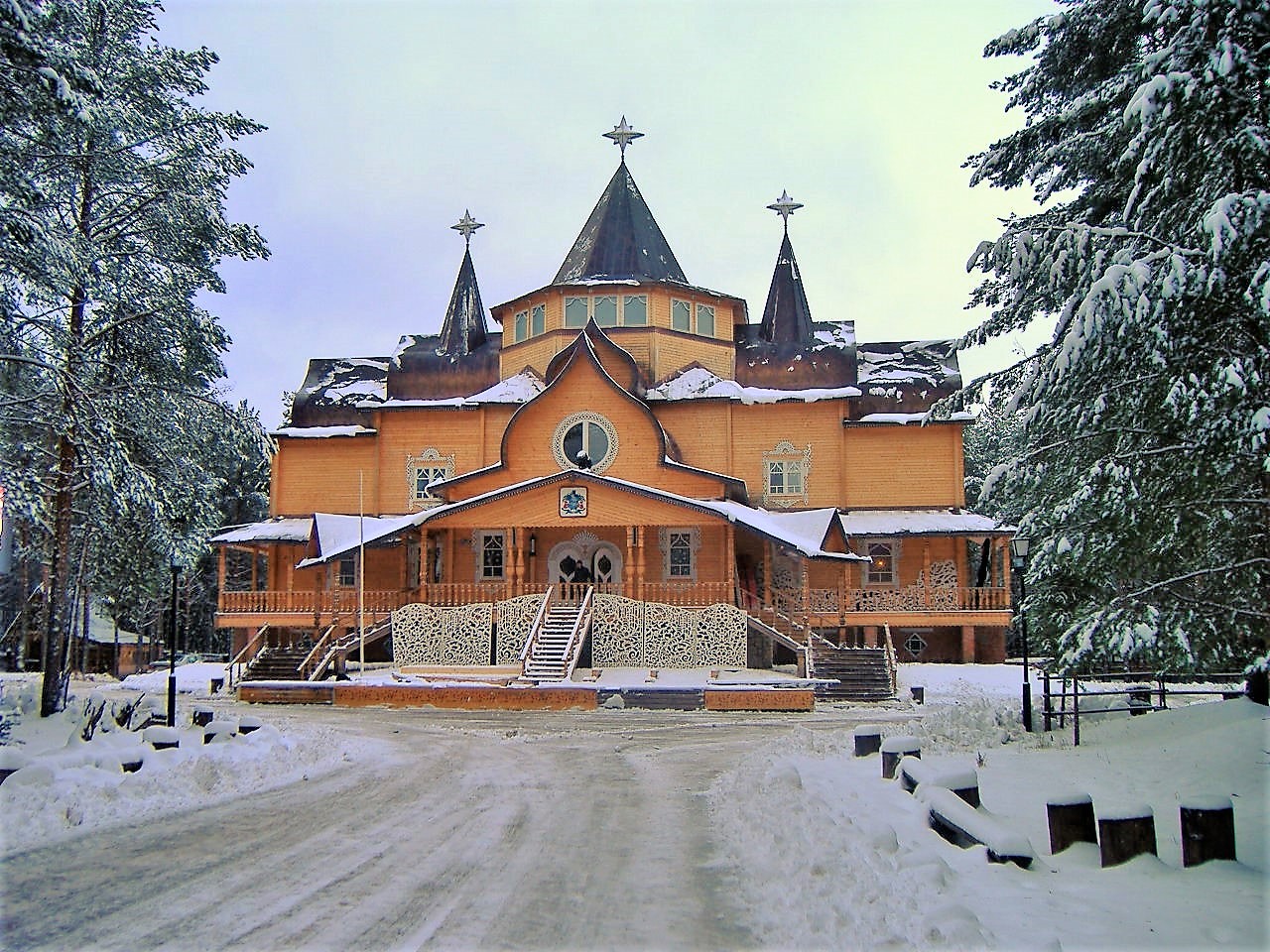
In 1998, Moscow Mayor Yuri Luzhkov and Vologda Region Governor Vyacheslav Pozgalev officially designated Veliky Ustyug as the residence of Ded Moroz -- Grandfather Frost, Russia's equivalent of Santa Claus. The choice was partly a tourism development strategy for a remote, economically struggling town, and it worked spectacularly. During the winter months, Russian families arrive in numbers that would have astonished the medieval merchants. Ded Moroz's residence, a wooden compound in the forest outside town, offers the full experience: meeting the bearded figure, exploring his house, and receiving gifts. The tourism is intensely seasonal -- summer visitors find a quieter town where the architecture, the river, and the northern light are the main attractions. For those who prefer their Russian towns without crowds, summer is the better season. For those who want to see an entire city organized around the mythology of winter gift-giving, December is unbeatable.
From the Air
Located at 60.76°N, 46.30°E at the confluence of the Sukhona and Yug rivers in the far northeast of Vologda Oblast, Russia. The town is visible as a compact settlement at the river junction, with church spires as distinguishing features. Nearest airport: Kotlas (Pinega), ICAO: ULKK, approximately 60 km north. Access is primarily by road (highway M8 via Vologda, then T7) or bus from Kotlas. The confluence of the two rivers forming the Northern Dvina is a prominent navigation landmark from altitude. Terrain is flat river valley with mixed forest. Winter snow cover is extensive from November through April.