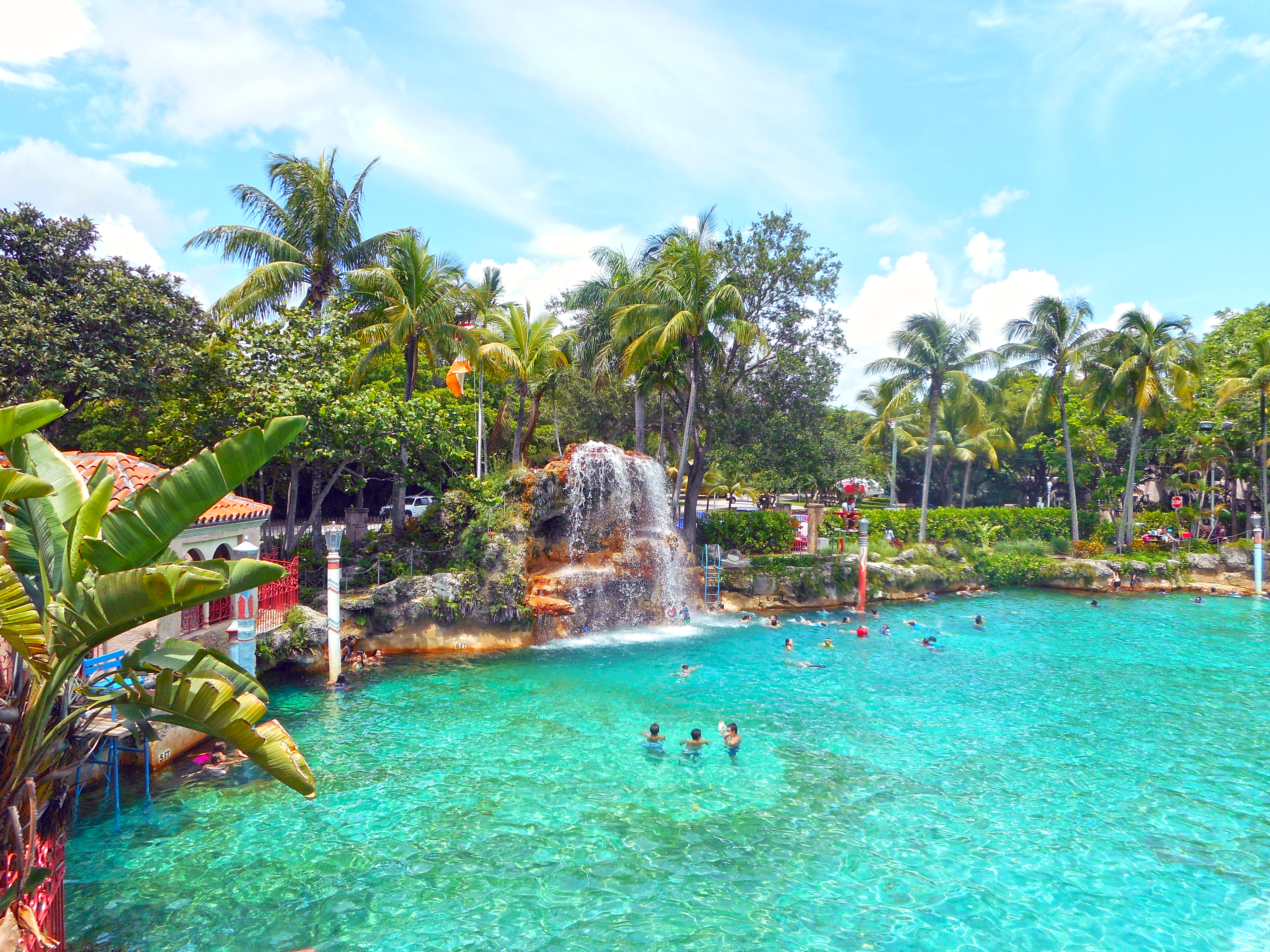
Venetian Pool: The Quarry That Became a Lagoon
It started as a hole in the ground -- a four-acre coral rock quarry, abandoned in 1921, left behind after the limestone was hauled away to build the homes of Coral Gables. The pit was an eyesore in George Merrick's carefully planned Mediterranean Revival city, and nobody wanted to live next to it. So Merrick hired artist-architect Denman Fink and architect Phineas Paist to do something no one had tried: turn the ugly gash in the earth into a Venetian lagoon. They lined the quarry walls with concrete, carved out grottoes and caves, added waterfalls, bridges, and mooring posts styled after Venice, and let the underground aquifer do the rest. When the Venetian Pool opened in 1924, 820,000 gallons of spring water filled what had been worthless rock. It is the only swimming pool listed on the National Register of Historic Places.
Where the Symphony Played Underwater
The quarry's steep coral walls gave the Venetian Pool something unexpected: natural acoustics worthy of a concert hall. Early in its history, the pool was regularly drained completely so the Miami Symphony could perform on the dry quarry floor, musicians seated where swimmers had been floating hours before. The sound bounced off the carved rock walls and carried upward to audiences perched on the edges above. In 2001, to celebrate the 75th anniversary of Coral Gables, the pool was drained once more for an orchestral performance, reviving a tradition that had been dormant for decades. Few swimming pools in the world can claim they doubled as concert venues, but the Venetian Pool was never an ordinary swimming pool.
George Merrick's Dream City
The pool makes sense only in the context of Coral Gables itself. George Merrick envisioned an entire planned city built in Mediterranean Revival style, with plazas, boulevards, and ornamental limestone features drawn from the architecture of southern Europe. The rock quarry was a byproduct of that vision -- coral limestone pulled from the ground to construct the city's homes and commercial buildings. Transforming the quarry into a public amenity was a piece of real estate genius: what had been an unsightly hole became the centerpiece attraction of Merrick's planned community during the Florida land boom of the 1920s. Denman Fink, Merrick's uncle, designed the island, the waterfall, and the Venetian-style bridge that gave the pool its romantic character.
Gondolas, Diving Platforms, and a Century of Change
The pool has been reinvented several times. In its early years, a large island was built in the center so Venetian-style gondolas could dock alongside it, carrying visitors across the turquoise water as though they were gliding down a canal in Venice. The gondolas were eventually removed. A high diving platform was constructed above the grand waterfall, attracting daredevils who leaped from the coral heights into the spring-fed water below; it too was later torn down. A 1989 renovation restored many of the pool's original features, bringing back architectural details that had been lost or altered over decades. Through it all, the spring water kept flowing -- 820,000 gallons replenished daily from artesian wells tapping the underground aquifer, keeping the pool fresh and cool even in the subtropical heat.
Swimming in History
Today the Venetian Pool sits along De Soto Boulevard in Coral Gables, surrounded by the Mediterranean Revival homes that its quarry stone helped build. The coral rock walls rise around the water, lush with tropical vegetation -- vines draping over the carved edges, palm trees shading the walkways. The waterfall still cascades into the pool. The bridge still arches over the turquoise surface. Visitors swim in spring water that has been flowing upward through limestone for thousands of years, in a space that was carved out of the earth a century ago. Coral Gables residents pay a few dollars to swim here; everyone else pays more, but the experience is the same -- floating in what was once a raw hole in coral rock, reimagined as something beautiful during the most extravagant decade in Florida's history.
From the Air
Located at 25.75N, 80.27W in Coral Gables, approximately 6 nm southwest of Downtown Miami. The pool is nestled in a residential neighborhood along De Soto Boulevard and is difficult to spot from altitude due to tree canopy cover, but the turquoise water may be visible at lower altitudes on clear days. Nearest airports: Miami International (KMIA) approximately 3 nm northeast, Opa-Locka Executive (KOPF) 12 nm north. Best viewed at 1,500-2,500 ft AGL. The surrounding Coral Gables neighborhood is recognizable from the air by its Mediterranean Revival architecture and planned street grid.