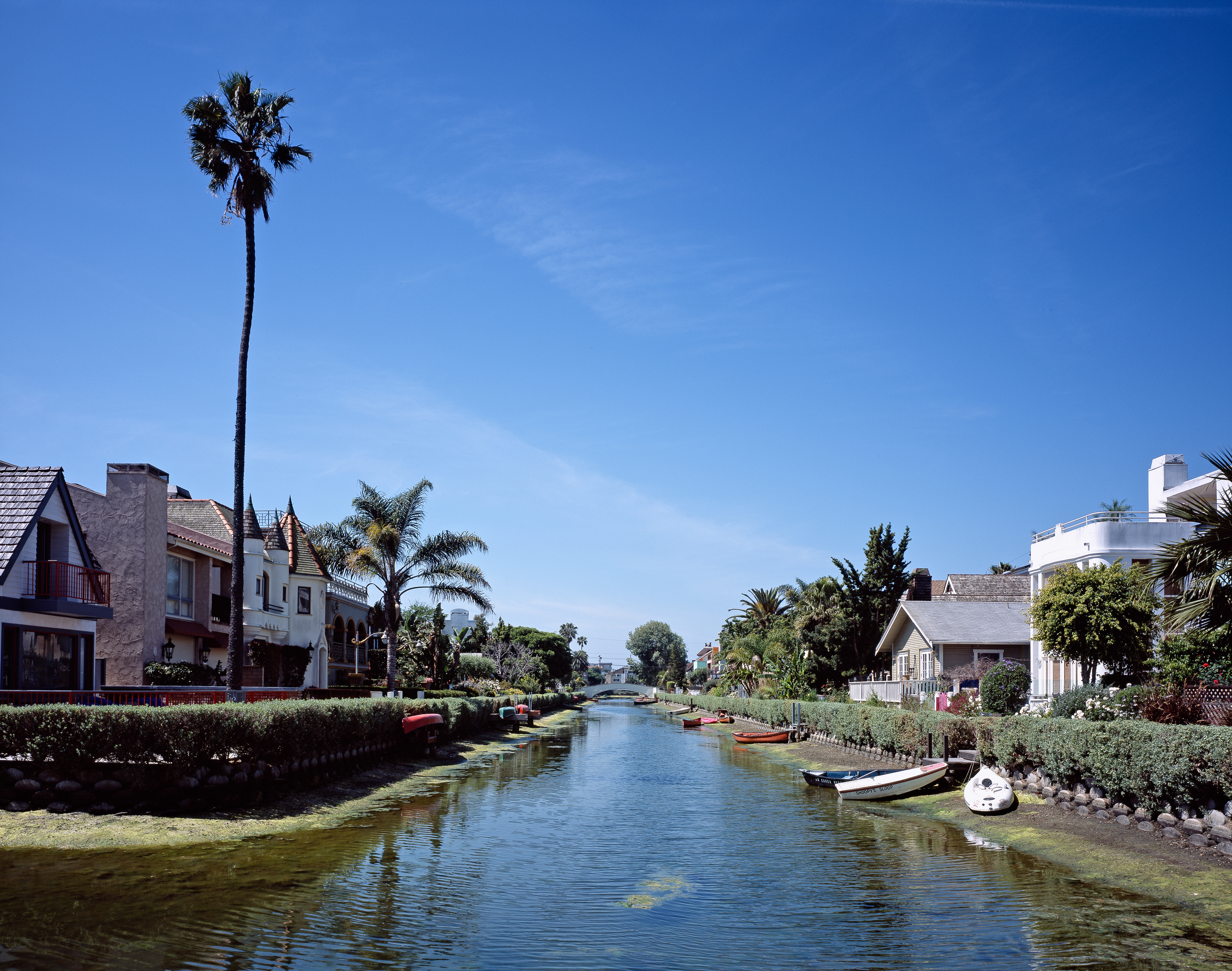
Venice Canal Historic District
In 1905, a tobacco millionaire named Abbot Kinney stood on a stretch of swampy beachfront south of Santa Monica and announced that he would build Venice. Not a theme park version, not a loose approximation, but a genuine attempt to recreate the Italian city on the California coast — with canals, gondoliers, and colonnaded buildings in the Venetian style. The ambition was impractical in almost every conceivable way. The canals that survive from his project, six of them threading through what is now one of the most photographed neighborhoods in Los Angeles, are proof that the impractical sometimes endures.
Kinney's Grand Scheme
Kinney's original development included thirteen canals covering a substantial portion of what is now the Venice neighborhood. Workers dredged the channels through marshland and lined them with concrete; gondoliers were imported from Italy; an auditorium and colonnaded walkways defined the commercial district. The project opened on July 4, 1905, to enormous crowds.
The problem was that Kinney had misjudged the American appetite for a European canal-town aesthetic. Visitors came as tourists but were reluctant to become residents. The lots sold slowly. To attract buyers and foot traffic, Kinney began adding amusements — a miniature railroad, a roller coaster, a dance pavilion. Venice gradually transformed from a cultural experiment into a seaside entertainment district, a shift that pulled it away from its original identity even as it made it financially viable.
Paved Over and Preserved
The automobile changed everything in Los Angeles, as it changed everything everywhere. By the 1920s, the canal system was seen as an obstacle to the flow of traffic rather than an amenity. In 1929, the city paved over seven of the original thirteen canals, converting them to streets. What remained were six channels — the Venice Canal Historic District — covering roughly a mile of waterway through the residential grid west of Lincoln Boulevard.
Survival was not the same as prosperity. For decades the remaining canals were neglected, their banks overgrown, their water quality deteriorating. The surrounding neighborhood, once marketed as a resort community, became affordable by LA standards precisely because of that neglect — which meant it attracted artists, writers, and other people whose work required cheap space more than fashionable addresses.
Restoration and Recognition
The turnaround came in stages. In 1982, the Venice Canal Historic District was added to the National Register of Historic Places, establishing formal recognition of its significance. A decade later, between 1992 and 1993, the city undertook a substantial renovation project — dredging the channels, repairing the retaining walls using a specialized interlocking block system, and improving water circulation from Ballona Lagoon.
The restoration coincided with a broader transformation of the neighborhood. Property values that had been low enough to support artists and counterculture institutions began rising. The canals, once a liability in the age of the automobile, became the neighborhood's primary selling point in an era when walkability and charm commanded premiums. The wooden footbridges crossing the channels, the ducks moving through the water, the eclectic houses pressed close to the banks — these became images widely associated with Los Angeles's more intimate, human-scaled possibilities.
A Living Neighborhood
What distinguishes the Venice canals from a museum exhibit is that people actually live there, in houses along the banks, within a few feet of the water. Residents kayak and paddleboard. Dogs swim. Children fish from the bridges with varying success. On weekend mornings the walkways fill with people moving at the pace that water imposes — slower, more lateral, more attentive to the immediate surroundings than the standard Los Angeles pace of freeway and destination.
Abbot Kinney's original vision of a California Venice was naive in several respects, and it survived only in fragments. But the fragments endure in a city that has demolished most of what came before them, recognized now as a historic district and beloved as a neighborhood in equal measure. The canals did not make Los Angeles into Venice. They made something that has no exact precedent: a Southern California waterway that has been simultaneously threatened, neglected, restored, gentrified, and genuinely cherished.
From the Air
The Venice Canal Historic District lies within the Venice neighborhood of Los Angeles, approximately 2 miles inland from the Pacific Ocean. Los Angeles International Airport (KLAX) is about 4 miles to the south. From the air at low altitude on approach to KLAX, the canal channels are sometimes visible as a geometric pattern in the residential grid west of Lincoln Boulevard, just north of the Marina del Rey harbor complex.