Vergina
Manolis Andronikos had six weeks. In the autumn of 1977, the Greek archaeologist began excavating a hill called the Great Tumulus near the small town of Vergina in northern Greece, convinced it concealed the tombs of the Macedonian kings. Other scholars were skeptical. Previous digs at the site had found palace ruins and a theater but no royal burials. Andronikos dug anyway, and within those six weeks he uncovered four buried tombs -- two of which had never been disturbed. Inside lay golden wreaths, ivory carvings, wall paintings, and the remains of a dynasty that had once conquered the known world.
Where Goats Led a King
Before it was Vergina, this place was Aigai, and before it was Aigai, it was an idea born from an oracle. Diodorus Siculus records that Perdiccas I, fleeing from Argos around 650 BC, was advised by the Pythian priestess to build his capital where goats led him. The name Aigai itself may derive from the Greek word for goat. Whether the story is history or founding myth, the settlement that grew here became the first capital of Macedon, an organized cluster of villages centered on a walled acropolis that never became a large city. Its inhabitants mostly lived in surrounding settlements. But what Aigai lacked in urban scale it made up for in political weight: this was where Macedonian kings were crowned, worshipped, married, and buried, even after Archelaus I moved the administrative capital northeast to Pella at the start of the 4th century BC.
Murder at a Wedding
In 336 BC, Philip II of Macedon was attending his daughter Cleopatra's wedding to King Alexander of Epirus in Aigai's theater when one of his own bodyguards assassinated him. The killing made his son Alexander king at the age of twenty. Philip's funeral was the most lavish ceremony of its kind in Greek history: the king was laid on an elaborate gold and ivory deathbed, wearing a golden oak wreath, and surrendered to the funeral pyre. The theater where he died, the palace where his son was proclaimed ruler, and the tomb where his remains were placed all occupied the same hillside -- a concentration of pivotal history in a space small enough to walk across in minutes. The struggles among Alexander's successors damaged the city in the 3rd century BC, and Gallic mercenaries under Pyrrhus plundered many of the tombs in 276 BC. After Rome overthrew the Macedonian kingdom in 168 BC, both Aigai and Pella were destroyed.
Buried and Found
Archaeologists suspected the burial mounds around Vergina as early as the 1850s. The French archaeologist Leon Heuzey began excavations in 1861 under the sponsorship of Napoleon III but abandoned the work due to malaria. The University of Thessaloniki resumed digging in 1937, only to stop when war with Italy broke out in 1940. Decades of intermittent work uncovered the palace and the theater, but the royal tombs remained hidden beneath the Great Tumulus until Andronikos's breakthrough in 1977. His identification of the occupants has been debated and refined ever since. A 2023 study led by Antonios Bartsiokas of the Democritus University of Thrace concluded that Tomb I contained Philip II, Tomb II held his son Philip III, and Tomb III contained Alexander IV -- Alexander the Great's own son. In 2025, further research suggested that some grave goods in Tomb II may have actually belonged to Alexander the Great himself, inherited by Philip III after Alexander's death.
What the Earth Preserved
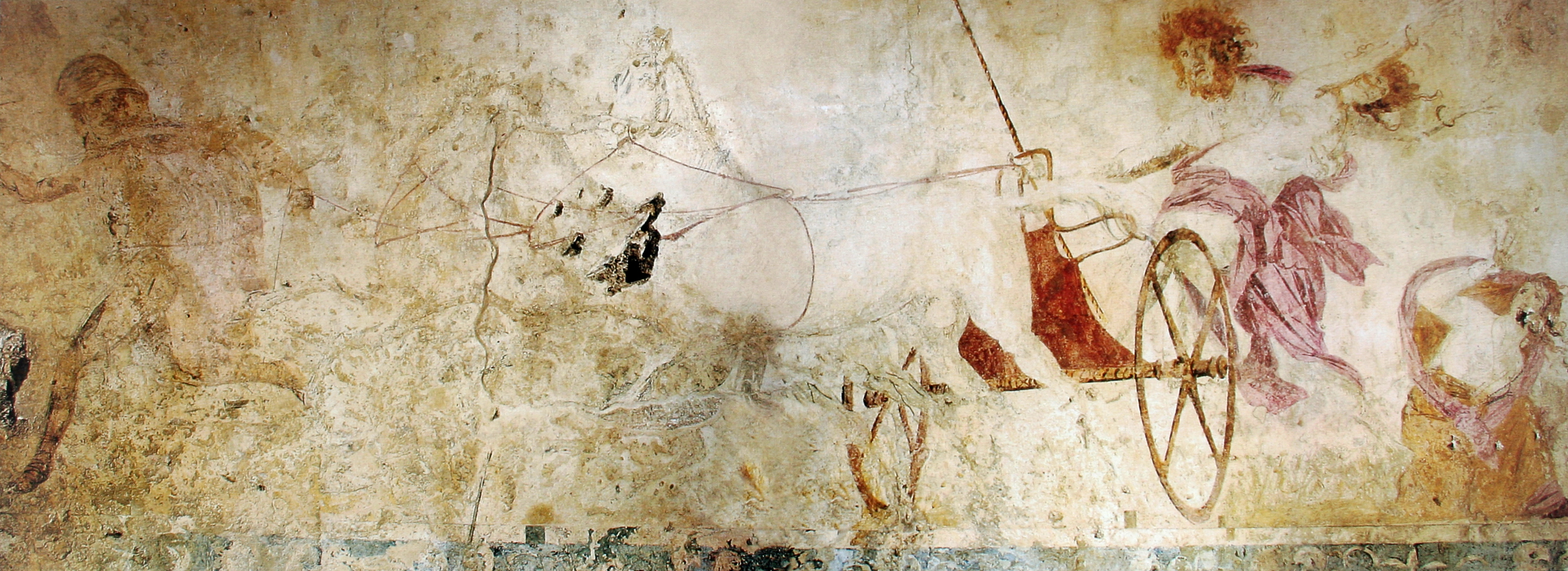
The unlooted tombs yielded treasures that now fill one of Greece's most important museums, built directly over the burial site. A golden larnax bearing the Vergina Sun held royal remains. Above the Doric entrance of one tomb, a wall painting measuring 5.6 meters depicts a hunting scene believed to be the work of Philoxenos of Eretria, thought to show Philip and Alexander together. Over 5,000 square feet of mosaics depict scenes including the abduction of Europa. The Palace of Aigai, the largest building of classical Greece, reopened to the public in January 2024 after a sixteen-year restoration. Nearby, the royal cemetery extends across a wide area containing over 500 grave-mounds, some dating to the 11th century BC. The Cluster of the Queens includes tombs from the era of the Greco-Persian Wars, one identified as belonging to Eurydice, mother of Philip II, complete with an imposing marble throne. UNESCO designated the entire site a World Heritage Site, calling it 'an exceptional testimony to a significant development in European civilization.'
From the Air
Located at 40.49N, 22.32E in the Imathia region of northern Greece, near the city of Veroia. The archaeological site and the Great Tumulus are visible as cleared areas amid agricultural land at the foot of the Pierian Mountains. Thessaloniki Airport Makedonia (LGTS) is approximately 75 km to the east-northeast. The site sits on the western edge of the central Macedonian plain. Best viewed at 3,000-5,000 ft AGL to distinguish the tumulus mounds and palace foundations from the surrounding landscape.