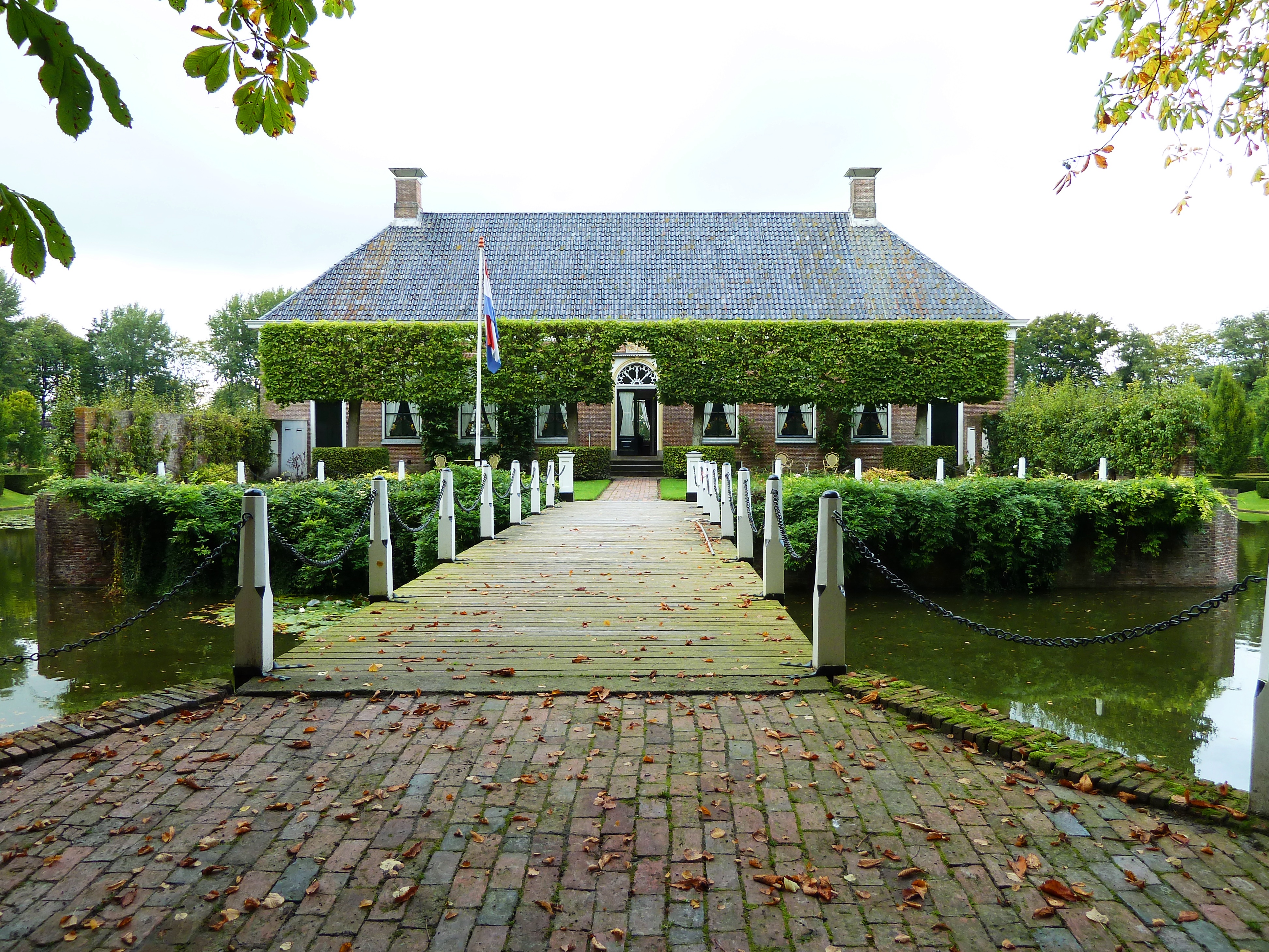
Verhildersum
The city of Groningen sacked this place twice - in 1400 and again in 1514 - and both times someone paid to put it back together. The second rebuild cost 1,200 gold pieces, and the receipt survives. That number is one of the few hard facts the borg of Verhildersum has handed down across six centuries. The rest is moat and farmhouse and a garden laid out by a Renaissance-era mathematician's idea of beauty, sitting just east of the village of Leens in the flat Groningen polderland. Borgs were the fortified manor houses of the old Groningen gentry - more compact than a castle, more defensible than a farm - and Verhildersum is one of the handful that survived to become a museum.
A Woman's Name
Verhildersum means, quite literally, 'the house of the noblewoman Hildert.' The prefix Ver in old Gronings indicated a woman of rank, Hilder was her given name, and the suffix -um meant 'house' or 'farmstead.' Who she was, when she lived, what she did with the land - none of it has come down to us. She is a name on a deed, a syllable in a place. The first written record dates from 1398, when a certain Aylko Ferhildema appears in the documents, almost certainly the same man as Aylko Onsta of Sauwerd, and almost certainly resident at Verhildersum. The Onsta family - prominent Groningen chieftains, hoofdelingen in the Frisian sense - kept the borg in the family for generations. Hildert herself stays anonymous, which is its own kind of permanence.
Twice Razed
The city of Groningen and the surrounding countryside spent much of the late Middle Ages in open conflict. City-Groningers attacked rural strongholds. Rural chieftains attacked city interests. Verhildersum was destroyed in 1400 and again in 1514, both times in the same campaigns that levelled the Onstaborg in Sauwerd, which is how historians infer the family connection. Between the two sackings, the records go silent for over a century. After 1514 the borg was rebuilt for that famous 1,200 gold pieces - exclusive of outbuildings. By 1564, when Aepke Onsta died at the borg, the place was a working manor again. A few years later, during the Eighty Years' War, the tenant Ecke Claessen filed a complaint that he was being forced to house billeted soldiers along with their two wives and a child - all crammed into the same fortified house that had survived two demolitions.
The Schathuis
The most striking outbuilding on the estate was not actually built here. The schathuis - a Frisian word from skat, meaning cattle - went up in 1833 on the grounds of Saaksumborg, a nearby borg that has since vanished entirely. In 1972, when the Verhildersum estate was being restored as a museum, the whole farmhouse was lifted and moved here. Between 1994 and 2012 it housed a fine-dining restaurant called Schathoes Verhildersum, run by chef Dick Soek, that held one Michelin star from 2004 to 2012. The star is gone now and the dining room has become a grand cafe called 't Schathuys, but the building itself - already a transplant from a vanished neighbor - has settled into its second century as if it had always been here.
A Garden by Numbers
Around the borg lies the Verhildersum Estate, 32 hectares of moated grounds, with the formal garden laid out according to the golden ratio - the same proportion that governs nautilus shells and Renaissance facades. The result blends Renaissance geometry with Baroque exuberance: ninety varieties of rose, fifty varieties of clematis, a dedicated herb garden, all enclosed by water. The garden shed itself has a backstory: it is the former tramhouse from the Emmaplein in nearby Haren, repurposed and relocated. Nothing here, it turns out, has stayed exactly where it started. The borg moves through time the way the moats move around it - holding their shape while everything inside them gets rearranged.
From the Air
Verhildersum sits at 53.36 north, 6.39 east, just east of the village of Leens on the flat Groningen polder a few kilometers inland from the Wadden Sea. From cruising altitude in clear weather the moat reads as a small bright rectangle in the green farmland; the village of Leens with its church tower lies immediately to the west. Nearest airport is Groningen Airport Eelde (EHGG), about 35 km south. Recommended viewing altitude 2,000 to 4,000 feet AGL.