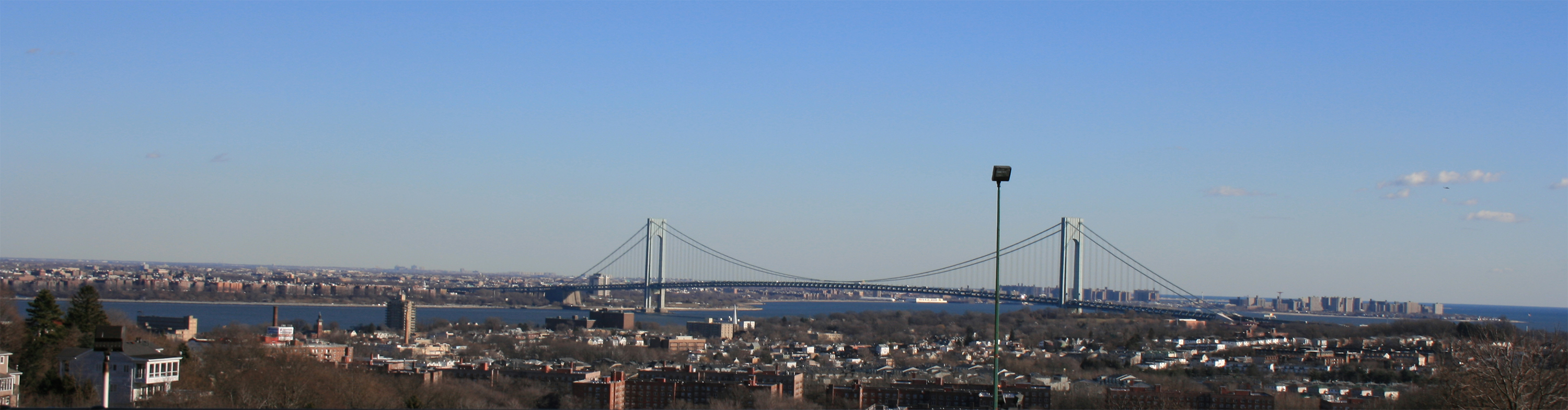
Verrazzano–Narrows Bridge
The name on the bridge was wrong for 54 years. When the Verrazzano–Narrows Bridge was officially named in 1960, an error in the construction contract left out one of the two z's in Giovanni da Verrazzano's surname. The Italian explorer who in 1524 became the first European to enter New York Harbor and the Hudson River spent decades on a bridge spelled with only one z. The correction was finally made in 2018. By then the bridge was already 54 years old, had been crossed by hundreds of millions of vehicles, and had for seventeen years served as the starting point of the New York City Marathon. Some legacies outlast their typos.
Forty Years of Plans That Went Nowhere
The idea of a crossing at the Narrows — the strait connecting Upper New York Bay to Lower New York Bay and the Atlantic — had been floating around since at least 1926, when structural engineer David B. Steinman proposed a bridge. Nothing happened. A Staten Island tunnel was proposed and aborted. Another tunnel proposal arose in the 1930s, then again in the 1940s. Staten Island remained connected to the rest of New York City only by the Staten Island Ferry. It was Robert Moses, the urban planner who remade postwar New York with an almost frightening confidence, who finally pushed the project through. Surveying began in January 1959. When it opened on November 21, 1964, it was 35 years after Steinman's original proposal.
Building the Longest Span
Othmar Ammann, the Swiss-born engineer who had already designed the George Washington Bridge and the Bayonne Bridge, led the project. The numbers are large enough to require a pause: the central span is 4,260 feet, which made it the longest suspension bridge span in the world at its opening, a record it held until Britain's Humber Bridge was completed in 1981. Each anchorage contains 780,000 short tons of steel and concrete. The two towers rise 693 feet above the water. The towers are so far apart that their tops are nearly two inches farther from each other than their bases — the curvature of the Earth is a measurable variable at this scale. Roughly eight thousand workers spent five years building it.
What the Opening Cost
Construction required the demolition of homes in the Bay Ridge neighborhood of Brooklyn to clear the approach. Approximately 7,000 residents were displaced, many of them from an Italian-American community whose families had lived there for generations. Their departure was not voluntary. Robert Moses, whose authority over such decisions was nearly unlimited at the time, moved forward without meaningful consultation. The bridge that now bears the name of an Italian explorer was built partly through the erasure of an Italian-American neighborhood. The community that was displaced never fully reconstituted itself.
What the Bridge Became
The Verrazzano–Narrows Bridge opened on November 21, 1964, seven months after the Unisphere was dedicated at the World's Fair a few miles away in Queens. It brought Staten Island into genuine connection with the rest of the city for the first time. It carries Interstate 278 — the Staten Island Expressway and the Brooklyn–Queens Expressway — on two decks, with thirteen lanes of traffic. Every November, the New York City Marathon begins on the upper deck and proceeds across the bridge toward Brooklyn and ultimately Manhattan. From the water or from the air, the bridge's twin towers and long cables form one of the most recognizable silhouettes in the harbor.
From the Air
The Verrazzano–Narrows Bridge is located at 40.606°N, 74.046°W, spanning the Narrows between Bay Ridge in Brooklyn and Fort Wadsworth on Staten Island. From the air the twin towers and long main span are highly visible, especially when approaching JFK from the south. The bridge marks the entrance to New York Harbor from the Atlantic. Nearest airports: KJFK (John F. Kennedy International) approximately 7 miles northeast, KEWR (Newark) approximately 10 miles west.