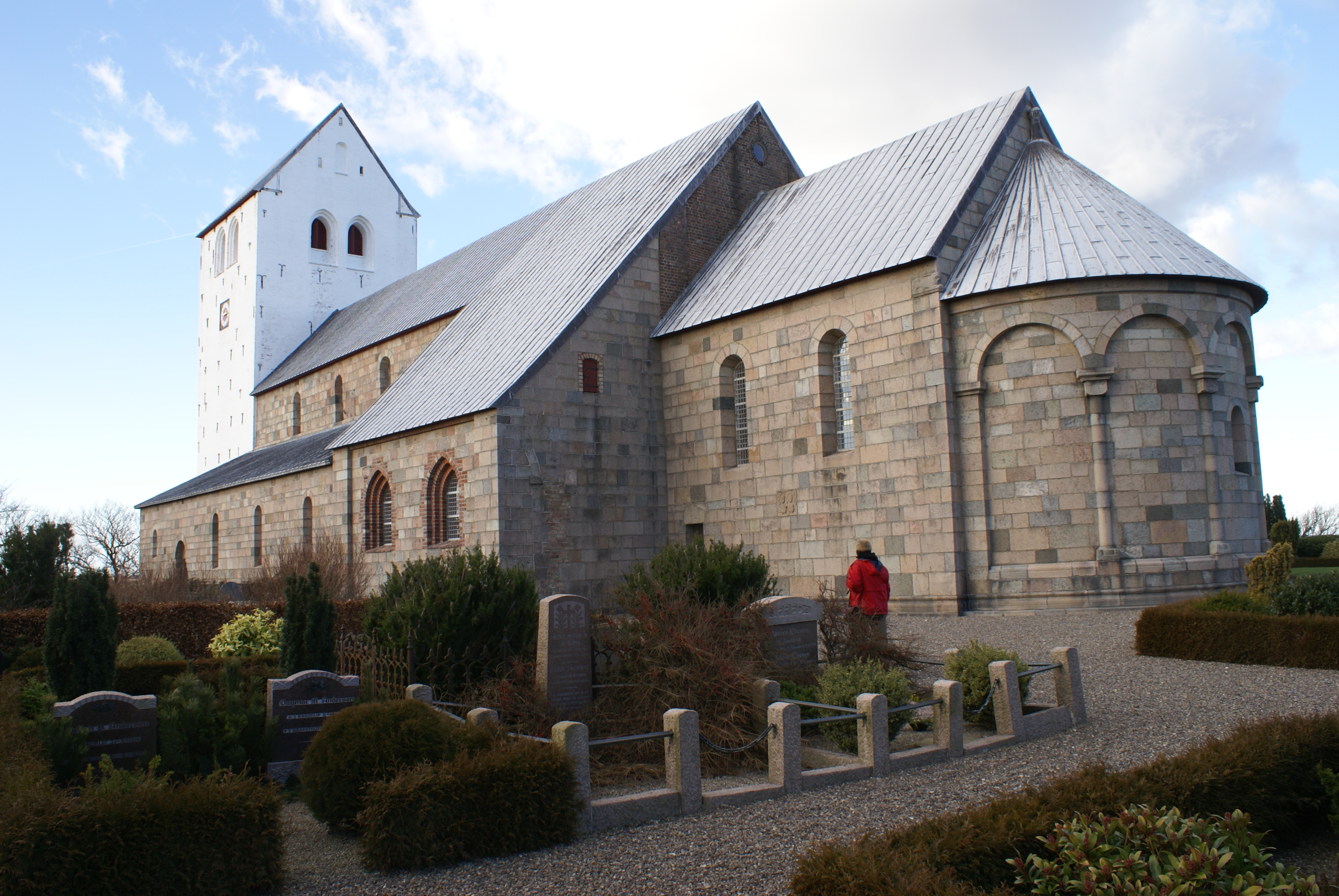
Vestervig Abbey
According to local legend, the priest Thoger slept on the ground at the Vestervig marketplace one night around 1030 AD, and in the morning a spring bubbled up where his head had rested. The Danes called it a miracle, and Thoger -- a Thuringian missionary who had fled Norway after his patron King Olaf II was killed at the Battle of Stiklestad -- finally had his congregation. Nearly a thousand years later, Vestervig Abbey still stands in northern Jutland, its massive red-brick walls holding one of the longest continuous threads of religious history in Denmark.
A Missionary's Winding Road
Thoger, also known as Theodgar, was born in Thuringia and had been living in England when the Norwegian King Olaf II arrived on a Viking expedition. Thoger's reputation as a preacher and healer earned him an invitation to serve as Olaf's personal chaplain. He followed the king back to Norway, then into exile through Sweden and as far as Kiev when Olaf was driven from his throne in 1028. When Olaf returned to Norway in 1030 to reclaim his kingdom by force, he died at the Battle of Stiklestad on 29 July. Olaf was later canonized as Saint Olaf, but Thoger had already fled south, arriving in the Thy district of northern Jutland where the Limfjord meets the North Sea. His early efforts to teach Christianity to the local Danes met with little success -- until the miraculous spring changed everything.
Springs, Saints, and a Missing Leg Bone
The spring at the marketplace was only the first. When Thoger visited a nearby farm called Randrupgard, the farmer complained about his wretched luck with livestock. "Put up the cross of Christ where here none has stood before, so will your luck improve," Thoger told him. A second spring burst from the ground on the spot, and people flocked to it for its healing properties. After Thoger died on 24 June 1067, a delegation traveled to Bishop Albrik in Viborg to have him beatified. King Svend Estridsen objected -- Thoger had been close to his old enemy Olaf -- but the process moved forward, and on 30 October 1117 Thoger's remains were translated into the church. That night, according to tradition, Thoger appeared to the priest dragging one leg. He explained that a bone had been left behind in his old grave. The next morning the grave was opened, the overlooked leg bone was found, and it was placed in the reliquary. Thoger did not appear again.
Canons in White and Black
Vestervig became the seat of a bishop in 1059 when the diocese of Vendsyssel was created. Augustinian Canons established themselves at the abbey no later than 1140, probably arriving from England. Unlike ordinary monks, these were ordained priests who had taken vows of poverty, chastity, and obedience, wearing simple white habits with black scapulars. They taught, preached, and cared for the poor and sick. In the 13th century they rebuilt the church in the large red bricks typical of Danish medieval architecture. The Limfjord's western end had silted shut by then, cutting off the sea route from the North Sea and strangling the international trade that once made Vestervig prosperous. The diocese eventually moved to Borglum Abbey, where coastal access was easier. Local legend hints at livelier connections too: rumor held that the canons dug a tunnel from the abbey to a nearby nunnery at Kappel, though no excavation has ever confirmed it.
Fire, Reformation, and the Captain's Curse
The abbey was dissolved in 1536 when Denmark officially became Lutheran. Its monks drifted into civilian life or left the country. The buildings passed into private hands, and for over a century they served their owners unremarkably -- until Christmas Eve 1703. That night, a ship wrecked on the coast, and the abbey's miserly owner, Peder Moldrup, seized the salvage. As his men stripped valuables from the wreck, the ship's captain spat a prophecy: "If our Christmas Eve is so terrible, then your New Year's Eve shall be worse." Moldrup's wife hung salvaged paper in the loft to dry. On New Year's Eve she went to check on it carrying a candle, and the flame caught. Every building burned except the church itself. Today that surviving church serves as the parish church of Vestervig. Two bells still hang in its tower from the abbey's medieval days: one cast by Sven Andersen in 1513, the other by an unknown bell maker in the 15th century. They ring over a landscape that has kept faith, in one form or another, for nearly a thousand years.
From the Air
Located at 56.77N, 8.32E near the Limfjord in northern Jutland, Denmark. The abbey church is visible as a large red-brick structure in the small village of Vestervig. Nearest airport: Thisted Airport (EKTS), approximately 25 km northeast. Approach from the west to appreciate the flat, windswept landscape where the Limfjord once opened to the North Sea. Fly at 1,500-2,000 ft for clear views of the church and surrounding terrain.