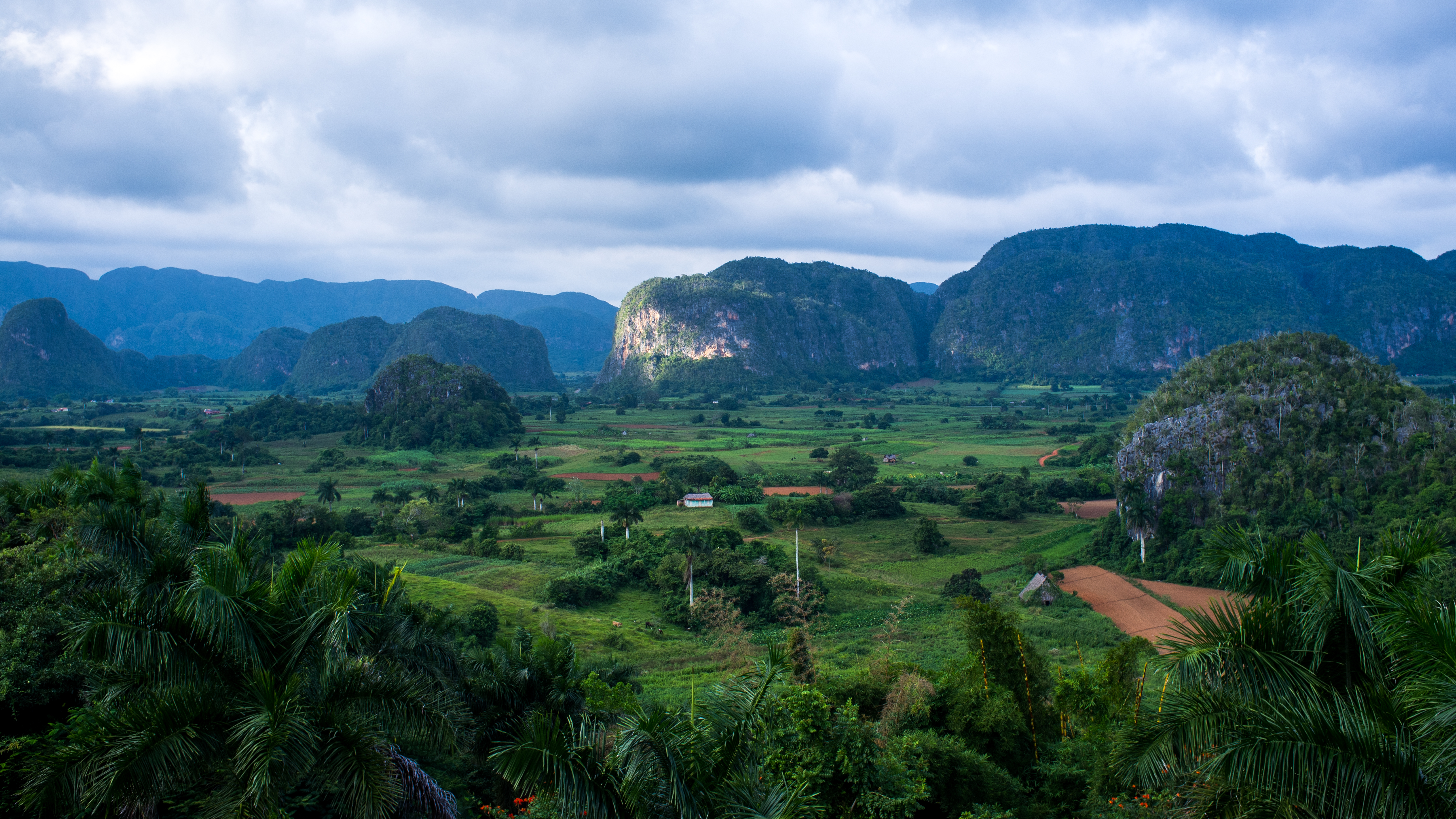
Viñales Valley
The limestone towers appear without warning. Rounded and massive, draped in jungle green, they erupt from the valley floor like the knuckles of some buried giant pressing up through the red Cuban soil. The locals call them mogotes, and in all of Cuba, they exist only here -- in the Viñales Valley, a karstic depression tucked into the Sierra de los Órganos mountains of Pinar del Río Province. The only comparable geological formations on the planet stand thousands of miles away in Southeast Asia, in the karst landscapes of Borneo, Vietnam, and southern China. Yet here in western Cuba, just north of the small town of Viñales, these ancient towers have watched over a valley where farmers still grow tobacco the way their ancestors did centuries ago.
Stone Sentinels of Deep Time
The mogotes of Viñales are survivors. While the softer limestone around them dissolved over millions of years, these harder remnants held fast, sculpted by water and wind into forms that sometimes reach the dimensions of small mountains. Some are sheer-sided pillars; others bulge and lean in shapes that defy easy description. The rocks of the Alturas de Pizarras formations within the valley have been dated as the oldest in Cuba and the entire Caribbean region. Walking among them is like moving through a geological museum where the exhibits are still being shaped, still slowly dissolving and reforming under the tropical rains. Caves riddle the interior of many mogotes, their chambers carved by underground rivers that still flow beneath the valley floor.
Tobacco by Hand
In the flat spaces between the mogotes, the valley's famous tobacco fields stretch out in neat rows, tended by farmers called vegueros who rely on techniques passed down through generations. There are no combine harvesters here, no industrial processing lines. The leaves are picked by hand, hung to dry in thatched curing barns called casas de tabaco, and fermented slowly in the humid Caribbean air. These labor-intensive methods produce tobacco prized for a quality that mechanized farming cannot replicate. It was this living tradition -- agriculture practiced essentially unchanged for centuries within a landscape of extraordinary natural beauty -- that earned the Viñales Valley its inscription as a UNESCO World Heritage Site in 1999. The designation recognized not just the geology or the farming alone, but the rare marriage of the two.
A Refuge for the Rare
The isolation that preserved the mogotes also sheltered an astonishing collection of endemic species. The valley harbors plants found nowhere else, including the mountain palm Gaussia princeps and the ancient cycad Microcycas calocoma, a living fossil that has changed little since the age of dinosaurs. The bird life is equally distinctive. The bee hummingbird -- the smallest bird on Earth, barely larger than a bumblebee -- darts among the flowers. The Cuban trogon, the national bird, flashes red, white, and blue plumage that mirrors the Cuban flag. The Cuban tody, a jewel-bright insect hunter, perches on low branches, while the Cuban solitaire fills the forest with one of the most beautiful birdsongs in the Caribbean. Each of these species evolved here in isolation, shaped by the same forces that carved the stone.
Painted on the Mountain
On the face of a mogote called Pita, in the valley of Dos Hermanas, a massive painting stretches 120 meters high and 160 meters across. The Mural of Prehistory is the work of Leovigildo González Morillo, who served as Director of Cartography at the Cuban Academy of Sciences. Before a single brushstroke was applied, the rock face was washed clean and drainage channels were cut to protect the painting from erosion. Across 12 sections, the mural depicts the evolutionary history of life in the Sierra de los Órganos -- from mollusks and giant prehistoric animals to the Guanahatabeye people, the earliest known inhabitants of western Cuba. It is a bold and unusual work, a contemporary painting on an ancient canvas, and it has become one of the valley's most recognizable landmarks.
A Valley That Endures
Viñales remains a place where the pace of life is set by the growing season and the rhythm of the curing barns. Farmers ride horses along dirt roads between the mogotes, and oxen still pull plows through the rich valley soil. The caves that honeycomb the limestone -- including the Palenque de los Cimarrones, once a refuge for escaped enslaved people -- draw visitors underground into cool chambers decorated by centuries of mineral deposits. Rock climbers test themselves against the mogotes' vertical faces. But the valley's deepest appeal is simpler than any single attraction. It is the experience of standing in a landscape where the oldest rocks in the Caribbean rise above fields cultivated by the same methods for hundreds of years, where the smallest bird in the world hovers beside flowers that grow on no other island. Time moves differently here, and the mogotes, patient as ever, do not seem to mind.
From the Air
Located at 22.62°N, 83.72°W in Pinar del Río Province, western Cuba. The mogotes are dramatically visible from the air as rounded green towers rising from the flat valley floor. Best viewed at 3,000-5,000 feet AGL. The nearest airport is La Coloma (MULM) approximately 40 nm to the south, or Pinar del Río (MUPR). José Martí International Airport (MUHA) in Havana is approximately 100 nm to the east. Clear weather recommended for optimal viewing of the karst formations.