Vicksburg Campaign
"Vicksburg is the key," Abraham Lincoln wrote. "The war can never be brought to a close until that key is in our pocket." Jefferson Davis, from the opposite side, saw it just as clearly: "Vicksburg is the nail head that holds the South's two halves together." Both men were right. Perched on high bluffs above a horseshoe bend in the Mississippi River, the fortress city commanded the last Confederate-controlled stretch of the waterway. For seven months, from December 1862 to July 1863, Ulysses S. Grant threw everything he had at Vicksburg -- failed canal schemes, doomed bayou expeditions, daring nighttime runs past thundering batteries -- until he found a way to crack the Gibraltar of the Confederacy wide open.
Seven Failures and a Stubborn General
Grant's early attempts to reach Vicksburg read like a catalog of frustration. Sherman's assault at Chickasaw Bayou in late December 1862 was repulsed with heavy casualties. Grant's own overland advance collapsed when Confederate cavalry under Earl Van Dorn destroyed his supply depot at Holly Springs. Through the winter of 1863, Grant launched five separate bayou operations, each attempting to use or construct waterways to bypass Vicksburg's guns. His men dug canals across the De Soto Peninsula, tried to blast open the Yazoo Pass by blowing up levees, and sent Admiral Porter's gunboats through choked bayous where willow reeds fouled their paddlewheels and Confederates felled trees across their path. Every expedition failed. Sherman derisively called one canal scheme "Butler's Ditch." But Grant was known for stubborn determination, and he would not quit.
Running the Batteries
Grant's final plan was bold and irreversible. He would march the army down the west bank of the Mississippi, have Admiral Porter run gunboats and transports past Vicksburg's batteries under cover of darkness, then cross the river south of the city. Once past, the boats could never return upstream against the current under those guns. On the moonless night of April 16, 1863, Porter sent seven gunboats and three transports loaded with stores toward the bluff. Confederate sentries spotted them almost immediately. The bluffs erupted with massive artillery fire and bonfires were lit along the banks. Porter, observing that the Confederates were hitting only the high parts of his boats, ordered the fleet to hug the eastern shore directly beneath the cannon. The gamble worked: thirteen men were wounded, none killed, and only one vessel was lost. Six days later, six more supply boats ran the gauntlet. Grant now had what he needed south of the city.
Seventeen Days That Changed the War
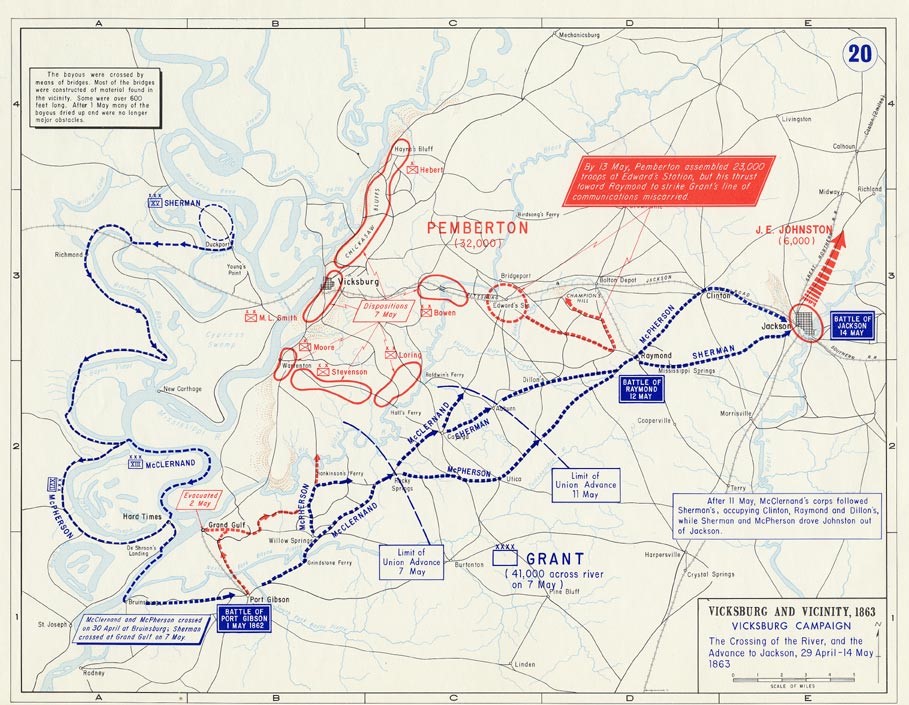
On April 29 and 30, 1863, Grant's army crossed the Mississippi at Bruinsburg -- 17,000 soldiers in the largest American amphibious operation before Normandy. An elaborate series of diversions, including Sherman's feint at Snyder's Bluff and Colonel Benjamin Grierson's daring cavalry raid through central Mississippi, had scattered Confederate attention. The landings occurred without opposition. Over the next seventeen days, Grant drove inland and won five consecutive battles: Port Gibson, Raymond, Jackson, Champion Hill, and Big Black River Bridge. He captured the Mississippi state capital, severed Vicksburg's railroad supply line, and pushed Lieutenant General John C. Pemberton's army back inside the city's fortifications. It was a campaign of relentless speed that historians would later call the most brilliant maneuver warfare ever fought on American soil.
Starved into Surrender
With Pemberton trapped, Grant laid siege. Two direct assaults on May 19 and 22 were repulsed with 3,200 Union casualties, and Grant settled in for a grinding blockade. For six weeks, soldiers and civilians inside Vicksburg endured constant bombardment and dwindling food. Confederate General Joseph E. Johnston gathered forces at Canton to relieve the garrison but moved too slowly, reaching the Big Black River on July 1 only to delay further. On July 4, 1863 -- one day after Lee's defeat at Gettysburg -- Pemberton surrendered the city and his entire army of 29,495 men. It was the second complete Confederate army Grant had captured, the first being at Fort Donelson. Union troops and starving Confederates mingled in the streets, sharing rations. Grant later wrote: "The men of the two armies fraternized as if they had been fighting for the same cause."
The Father of Waters Unveiled
When Port Hudson surrendered five days later on July 9, the entire Mississippi River was in Union hands. The Confederacy was severed in two; Texas and Arkansas were cut off from the eastern states. Within a week, an unarmed ship traveled from St. Louis to Union-held New Orleans without incident. Lincoln declared: "The Father of Waters again goes unvexed to the sea." The full campaign cost 10,142 Union and 9,091 Confederate killed and wounded. Grant received a promotion to major general in the regular army. Historians have consistently ranked Vicksburg among the war's decisive turning points. James M. McPherson called it "the most brilliant and innovative campaign of the Civil War," while the U.S. Army's Field Manual 100-5 described it as "the most brilliant campaign ever fought on American soil." Today, Vicksburg National Military Park preserves the battlefield where Grant's persistence and audacity broke the Confederacy's grip on the Mississippi.
From the Air
Centered at 32.35N, 90.88W at Vicksburg, Mississippi. The Vicksburg National Military Park sprawls across the bluffs overlooking the Mississippi River, with monument-lined ridges and earthworks clearly visible from altitude. The park's tour road traces the siege lines. Nearest airport is Vicksburg-Tallulah Regional Airport (KTVR), approximately 10 nm west across the river. Jackson-Medgar Wiley Evers International Airport (KJAN) is about 35 nm east. The horseshoe bend of the Mississippi and the De Soto Peninsula are prominent landmarks. The battlefield terrain stretches from the river bluffs east toward the Big Black River.