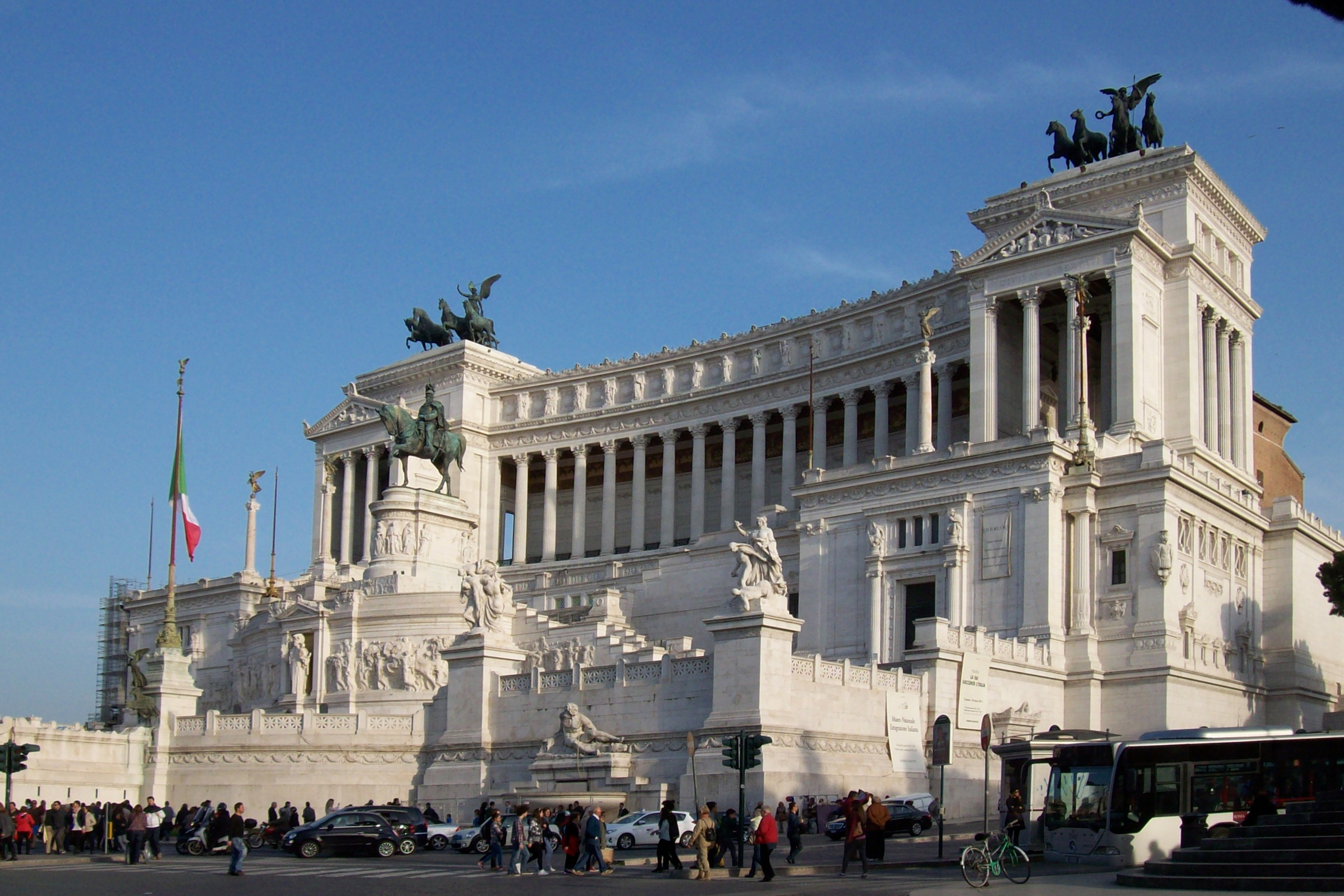
Victor Emmanuel II Monument
Romans have never agreed on what to call it. The official name is the Monumento Nazionale a Vittorio Emanuele II. The state calls it the Altare della Patria -- the Altar of the Fatherland. Locals, with the affectionate cruelty that Romans reserve for their own city, call it the macchina da scrivere (the typewriter) or la torta nuziale (the wedding cake). The nicknames stick because the building earns them: a blinding cascade of white Botticino marble rising from Piazza Venezia, topped by bronze quadrigae and flanked by Winged Victories, built in a neoclassical style so aggressively monumental that it clashes with the warm ochre tones of everything around it. Love it or mock it, you cannot ignore it. That was always the point.
A Nation Needs a Symbol
Victor Emmanuel II died in 1878, seventeen years after becoming the first king of a unified Italy. The new nation, cobbled together from ancient monarchies, papal states, and regional identities, needed a unifying symbol as badly as it needed a parliament. In 1882, a design competition was held, and the young architect Giuseppe Sacconi won with a vision inspired by Hellenistic sanctuaries -- particularly the Pergamon Altar and the Sanctuary of Fortuna Primigenia at Palestrina. King Umberto I laid the foundation stone in 1885. What Sacconi proposed was not merely a statue on a pedestal but a modern forum: three levels connected by grand stairways, dominated by a massive portico with a colonnade, the whole thing designed to serve as a civic gathering place that would embody the ideals of the Risorgimento. The scale was staggering. An entire medieval neighborhood on the northern slope of the Capitoline Hill was demolished to make room.
Fifty Years of Marble
Sacconi never saw his monument finished. He died in 1905, and three successor architects -- Manfredo Manfredi, Pio Piacentini, and Gaetano Koch -- carried the project forward. The monument was officially inaugurated in 1911 for the fiftieth anniversary of the Kingdom of Italy, but construction continued until 1935. The choice of materials proved as controversial as the design. The original plans called for travertine, the warm cream-colored stone that gives most of Rome its character. Instead, Botticino marble from Brescia was used -- a stone so white that it refuses to blend with its surroundings, even after a century of Roman sun and exhaust. The sixteen statues crowning the portico represent the Italian regions as they existed at the time of construction, each carved by a sculptor native to the region depicted. Below them, fourteen statues of Italian cities -- all former capitals of pre-unification monarchies -- were sculpted by a single artist, Eugenio Maccagnani.
The Unknown Soldier
After World War I, the monument gained a new and more solemn purpose. The body of an unknown Italian soldier, killed in the conflict, was interred beneath the central altar in 1921, and a perpetual flame was lit. The Tomb of the Unknown Soldier transformed the Vittoriano from a celebration of monarchy into a national memorial. Two enormous bronze quadrigae -- four-horse chariots -- crown the propylaea at either end of the portico, their Latin inscriptions declaring the twin ideals attributed to Victor Emmanuel II: freedom of the citizens on the right, unity of the homeland on the left. At the base, the Fountains of the Two Seas represent the Adriatic and Tyrrhenian, the bodies of water that bracket the Italian peninsula. The monument's hydraulic system, installed from the beginning, recycles water to avoid waste -- a surprisingly modern touch in a building that otherwise revels in imperial excess.
What Lives Inside
Beyond the external spectacle, the Vittoriano houses the Central Museum of the Risorgimento, accessible from via di San Pietro in Carcere on the monument's left side. The museum covers Italian history from the late 18th century through World War I, with memorabilia, paintings, documents, weapons, and engravings. The Shrine of the Flags collects war flags from dissolved military units and decommissioned ships of every branch of the Italian armed forces -- a quiet, powerful room where national history is measured in folded cloth. The Ala Brasini wing hosts temporary exhibitions in three halls. Since 2020, the monument and the adjacent Palazzo Venezia have been managed together as the VIVE Institute under the Italian Ministry of Culture. Terraces at the top, accessible by elevator since 2007, offer what may be the most comprehensive panoramic view of Rome -- ironic, given that the building itself is the one thing you cannot see from up there.
The Argument That Never Ends
The Vittoriano remains Rome's most polarizing building. Critics have objected since the design phase: the demolition of medieval structures, the jarring whiteness, the sheer bulk that dominates views from across the city. Defenders counter that the monument does exactly what it was designed to do -- assert the existence and significance of a unified Italian state in a city that had been defined by the papacy for a millennium. The mosaics, sculptures, and allegorical figures that cover every surface draw deliberately on Roman imperial precedent, echoing the personifications of provinces that once adorned triumphal monuments. The building's size makes it visible from almost anywhere in central Rome, a navigational landmark as much as a political statement. Whether that visibility is a virtue or an imposition depends on whom you ask, and Romans have been arguing about it for well over a century with no sign of reaching consensus.
From the Air
Located at 41.89°N, 12.48°E at Piazza Venezia in central Rome. The Vittoriano is one of the most visible landmarks from the air -- its brilliant white marble makes it stand out sharply against the surrounding ochre and terra cotta. At 2,000-3,000 ft AGL, it is unmistakable at the southern end of Via del Corso, adjacent to the Capitoline Hill. The Roman Forum lies immediately to the southeast, and the Colosseum is visible beyond. The nearest major airport is Rome Fiumicino (LIRF/FCO), approximately 30 km southwest. Rome Ciampino (LIRA/CIA) lies about 14 km southeast.