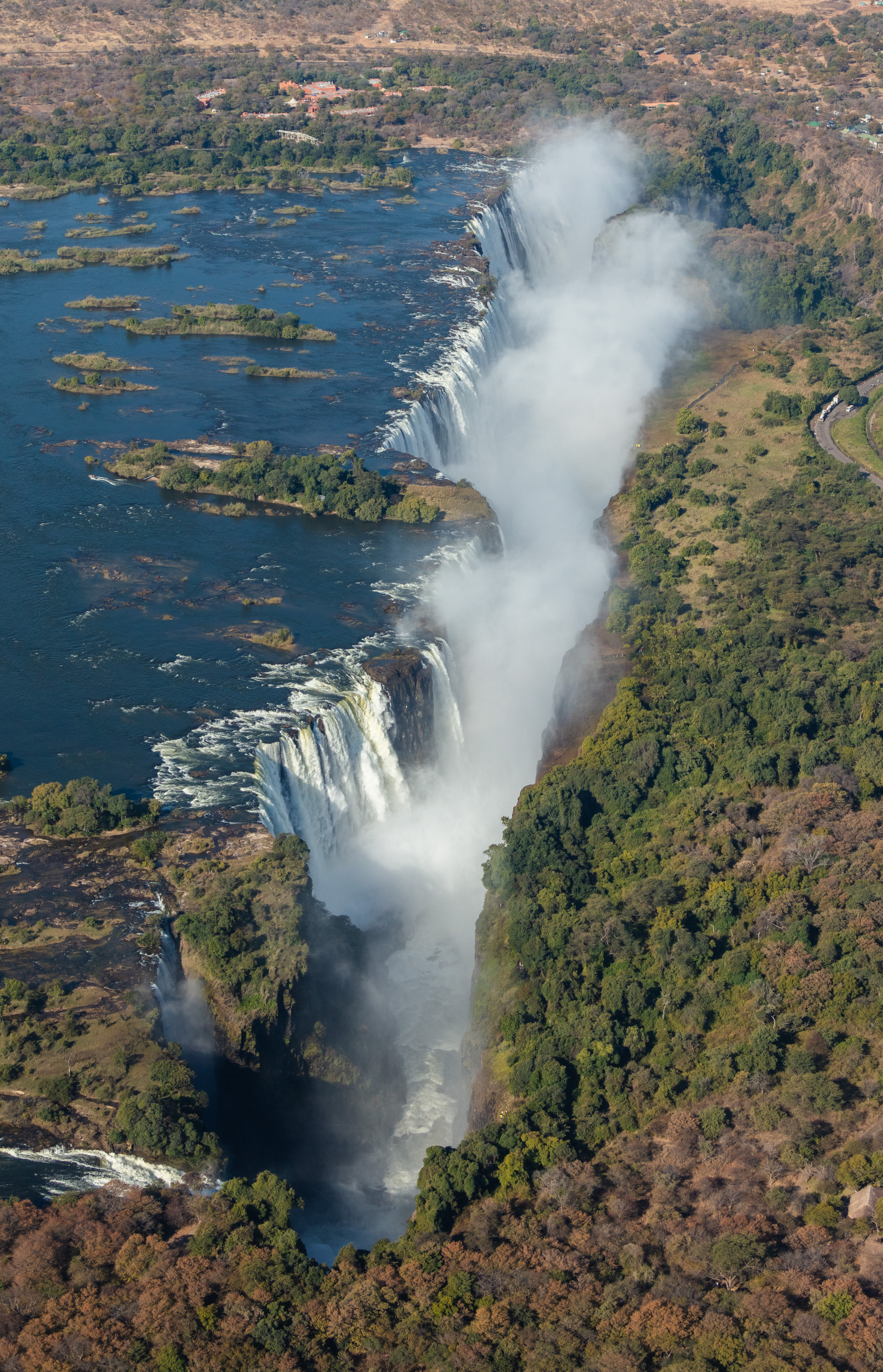
Victoria Falls
The spray rises 400 meters into the African sky, visible from 50 kilometers away - a column of mist that gave Victoria Falls its indigenous name: Mosi-oa-Tunya, 'The Smoke That Thunders.' When Scottish missionary David Livingstone became the first European to witness this spectacle in 1855, he declared it 'scenes so lovely must have been gazed upon by angels in their flight.' The falls stretch 1,708 meters across the Zambezi River, nearly twice the width of Niagara, plunging over 100 meters into a transverse chasm carved through basalt over millions of years. This is not merely a waterfall but a geological wonder in progress - the river has already carved through eight successive gorges over 20,000 years, and the process continues today.
A River Carving Through Time
Victoria Falls exists because of ancient geological forces. During the Jurassic Period, volcanic activity deposited thick basalt across southern Africa. As this lava cooled, cracks formed and filled with softer clay and limestone. Two million years ago, tectonic uplift blocked the ancient Limpopo River's path, creating vast Lake Makgadikgadi in modern Botswana. When this lake overflowed eastward 20,000 years ago, the Zambezi began cutting through the basalt's weak points, creating the first of a series of waterfalls. The falls have since retreated 8 kilometers upstream through seven linked gorges - a geological record visible in the dark basalt walls. The Devil's Cataract, the lowest point of today's falls, will likely become the next gorge as erosion continues its patient work.
Two Nations, One Wonder
Victoria Falls straddles the border between Zambia and Zimbabwe, with each country offering distinct perspectives. The Zimbabwean side provides the classic panoramic view - a network of trails winds through rainforest sustained by the perpetual spray, offering vantage points across the gorge where you face the falls head-on. The Zambian side allows closer approach to the water's edge and access to Livingstone Island, where you can peer over the precipice and, in the dry season, swim in the famous Devil's Pool at the very lip of the falls. The Victoria Falls Bridge, completed in 1905 at Cecil Rhodes' insistence that the spray should touch passing trains, connects both countries and has become a bungee jumping destination where thrill-seekers plunge 111 meters toward the churning Zambezi below.
Seasons of Transformation
The falls transform dramatically between seasons. During the rainy months from November to April, the Zambezi swells to its peak flow - sometimes exceeding 500 million liters per minute - creating a thundering wall of water so massive that the spray obscures the falls themselves. Visitors on the trails get thoroughly drenched, and the constant mist sustains a unique rainforest ecosystem including pod mahogany, ebony, and wild date palms rarely found elsewhere in the region. By October, at the height of the dry season, the flow can drop to a tenth of its peak. Large sections of the rocky lip become visible, even walkable in places, revealing the geological structure usually hidden beneath cascading water. Each season offers a different spectacle.
Adventure Capital of Africa
Victoria Falls has evolved into southern Africa's premier adventure destination. Whitewater rafting through the Batoka Gorge offers Class V rapids with names like 'The Washing Machine' and 'Judgment Day.' Helicopter flights reveal the falls' true scale - the zigzag pattern of successive gorges stretching downstream, the contrast between the placid river above and the chaos below. Sunset cruises on the upper Zambezi drift past hippos and elephants while crocodiles sun themselves on sandbars. For the truly adventurous, the gorge swing sends participants on a 95-meter free-fall followed by a pendulum swing across the chasm. All this occurs within a surprisingly compact area, with the adventure activities, wildlife lodges, and the falls themselves within easy reach of the gateway towns.
Conservation and Climate
Victoria Falls faces an uncertain future as climate change alters rainfall patterns across southern Africa. Severe droughts in recent years have reduced the falls to a trickle during dry seasons, prompting alarming headlines about the falls 'drying up' - though the falls have always varied dramatically with the seasons. The surrounding ecosystem faces mounting pressure from both climate stress and tourism development. Both Zimbabwe's Victoria Falls National Park and Zambia's Mosi-oa-Tunya National Park work to protect the immediate area, while Chobe National Park in nearby Botswana provides broader habitat for the region's elephants, which migrate through the area in herds sometimes exceeding a thousand animals. Visiting responsibly means understanding that this wonder, like all wonders, requires stewardship.
From the Air
Located at 17.93°S, 25.83°E on the Zambia-Zimbabwe border. The falls are visible from altitude as a distinctive line of mist rising from the gorge, especially during high-water months. The Zambezi River flows east to west above the falls, then makes a sharp turn through the zigzag gorge system below. Victoria Falls International Airport (VFA) on the Zimbabwean side is 20km south; Harry Mwanga Nkumbula International Airport (LVI) in Livingstone, Zambia is 10km north. The Victoria Falls Bridge is visible spanning the Second Gorge. Chobe National Park in Botswana lies 70km west.