Victoria Hall Disaster
The children were running toward prizes. A travelling entertainer had been performing magic tricks and distributing toys at Victoria Hall in Sunderland on the afternoon of June 16, 1883, and as the show ended, he announced that children who presented their tickets at the bottom of the stairs would receive special gifts. More than a thousand children surged from the gallery toward a single stairwell. At its base, a door had been bolted nearly shut, leaving only a gap wide enough for one child to pass at a time. The children at the front could not get through. The children behind kept pushing. In the crush that followed, 183 children died.
The Afternoon at Victoria Hall
Victoria Hall was a large performance venue in the centre of Sunderland, capable of holding over a thousand people. The entertainment that afternoon was aimed at children -- conjuring tricks, gifts, and the promise of more prizes to come. The audience was composed almost entirely of children between the ages of three and fourteen, many of them unaccompanied by adults. When the announcement of additional prizes was made, the children in the upper gallery rushed for the staircase leading down to the ground floor. The stairwell was narrow. At its base, a door opened inward and had been secured so that only a small gap remained -- reportedly to allow staff to check tickets one by one. The first children to reach the door squeezed through. Those immediately behind them could not. But the momentum of hundreds of children descending the stairs created a pressure that no child could resist or reverse. Children fell, piled upon each other, and were compressed against the door and the walls of the stairwell.
One Hundred and Eighty-Three
The children who died were killed by compressive asphyxia -- crushed beneath the weight of other children's bodies. They ranged in age from three to fourteen. The British Medical Journal published detailed medical findings on June 23, 1883, documenting the physical evidence of what had happened in that stairwell. The scale of the loss was almost incomprehensible for a single afternoon in a single building. Entire families lost multiple children. Sunderland, an industrial city of substantial size, was nonetheless small enough that nearly everyone knew someone who had died. The grief was communal, total, and public. Parents who had sent their children to an afternoon of entertainment received them back dead. There was no fire, no structural collapse, no external threat -- only a door that opened the wrong way and a crowd of small bodies that could not stop moving forward.
The Nation Responds
Queen Victoria sent a personal message of condolence to the bereaved families and contributed to the disaster fund. Donations poured in from across Britain, totalling five thousand pounds -- used for the children's funerals and a memorial. Newspaper coverage triggered a mood of national outrage that demanded accountability and change. The resulting inquiry focused on the design of the building and particularly on the direction the doors opened. Its conclusions led to legislation requiring that public entertainment venues be fitted with a minimum number of outward-opening emergency exits -- a law that remains in force across Britain today. Every time you push open a fire exit door in a theatre, cinema, or concert hall, you are walking through the legacy of what happened at Victoria Hall. Scottish poet William McGonagall wrote 'The Sunderland Calamity' in response to the disaster, one of his characteristically earnest verses that, for all their awkwardness, captured the raw public emotion of the moment.
The Grieving Mother in Mowbray Park
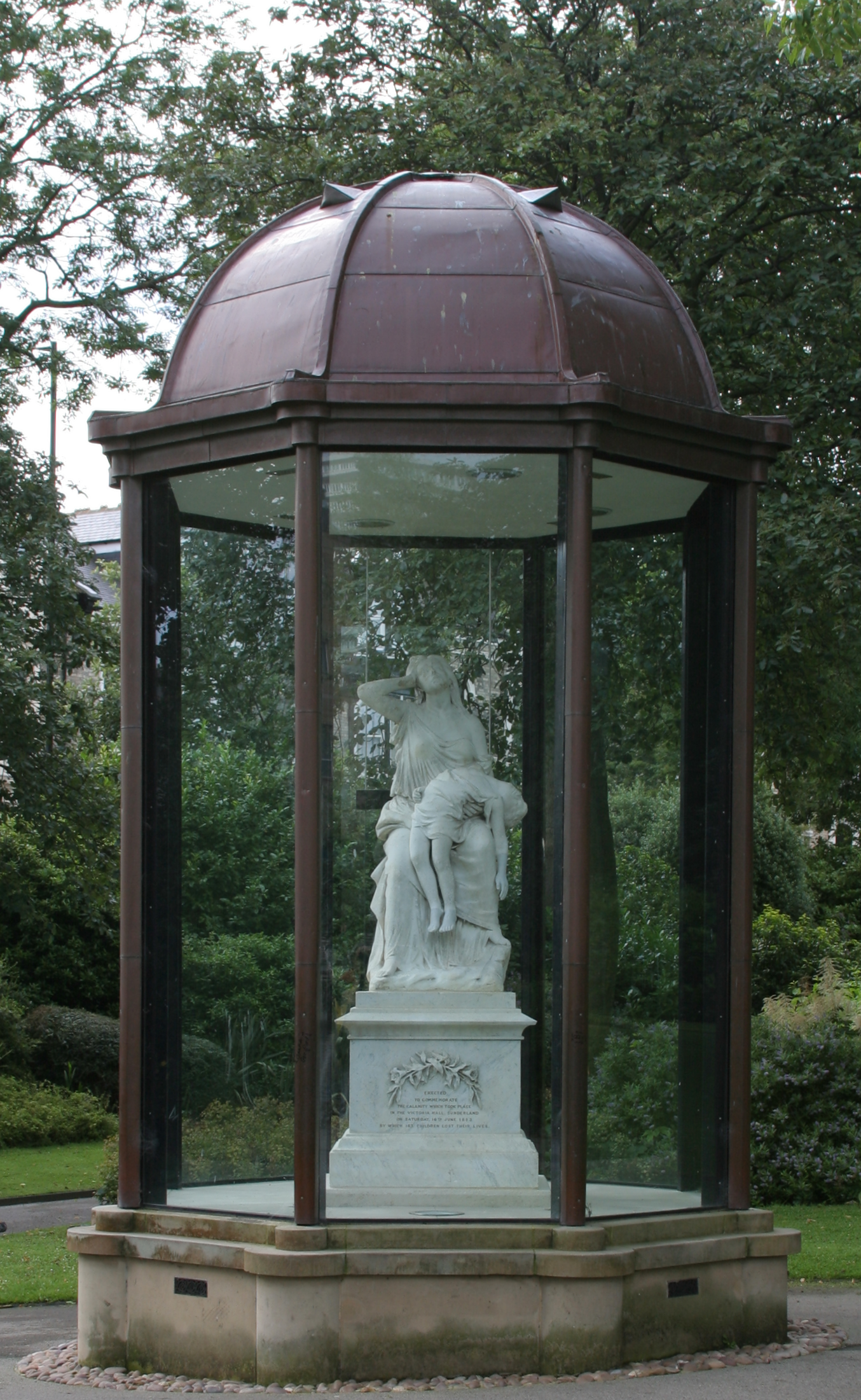
A memorial statue of a grieving mother holding a dead child was erected in Mowbray Park in Sunderland. Over the following decades, the statue was moved to Bishopwearmouth Cemetery, where it fell into disrepair and was vandalized. In 2002, the marble figure was restored at a cost of sixty-three thousand pounds and returned to Mowbray Park under a protective canopy. Annual memorial services, established in 2010 by the Sunderland Old Township Heritage Society, ensure that the disaster is not forgotten. Sunderland has changed enormously since 1883 -- the shipyards that defined it are gone, the population has shifted, the city centre has been rebuilt -- but the memory of those 183 children persists. It persists in the fire safety regulations of every public building in Britain. It persists in the restored statue in the park. And it persists in the simple, terrible knowledge that they were running toward prizes when they died.
From the Air
Victoria Hall stood in central Sunderland at 54.90°N, 1.38°W, on the northeast English coast. Mowbray Park, where the memorial statue now stands, is nearby in the city centre. The River Wear and Sunderland's port are visible from the air. Nearest airport: Newcastle (EGNT), approximately 8 nm to the north.