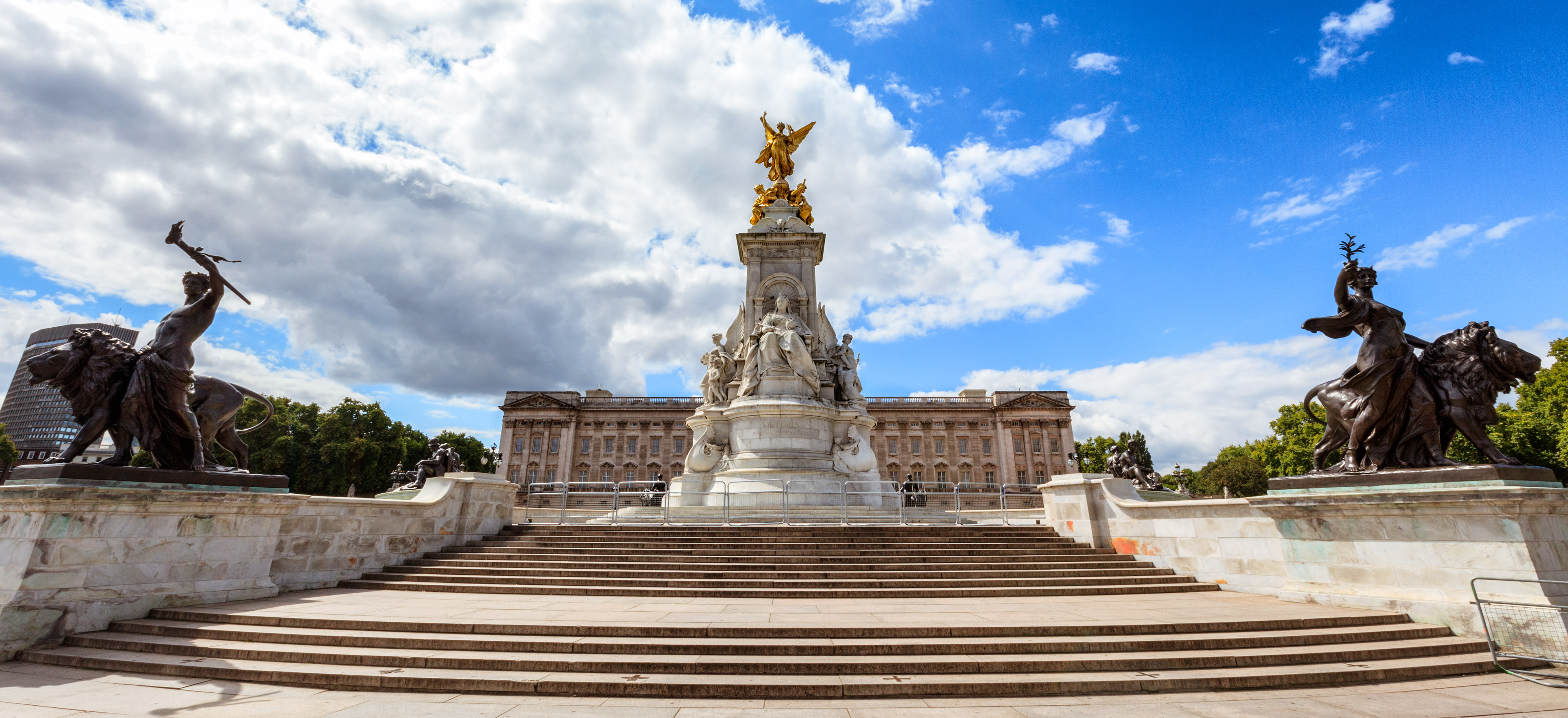
Victoria Memorial, London
When the funds rolled in to build a memorial to Queen Victoria, so much money arrived from across the British Empire that there was too much of it. Contributions came from the Australian Parliament, the New Zealand government, West African communities who sent goods to be sold for the cause, and the British public at large. The surplus did not go to waste. It paid for the construction of Admiralty Arch at the far end of The Mall, and then, astonishingly, for the complete refacing of Buckingham Palace, a job that architect Aston Webb completed in just thirteen weeks thanks to prefabricated stonework. The memorial itself, unveiled in 1911 before the palace's new facade, was the centrepiece of an urban transformation.
An Empire in Marble
Sculptor Thomas Brock was chosen in 1902 after a design competition, and the memorial took shape over the next decade. The central pylon is carved from Pentelic marble, the same stone used for the Parthenon in Athens, while individual figures are rendered in Lasa marble and gilt bronze. At the summit, a gilded Winged Victory stands on a globe, a victor's palm in one hand. Below her, personifications of Constancy and Courage keep watch. Further down sit figures of an enthroned Queen Victoria facing The Mall, Motherhood facing the palace, Justice facing Green Park, and Truth facing southeast. The statue of Truth was carved from a single block of marble weighing 40 tonnes. At nearly 25 metres tall, it remains the tallest monument to a monarch in England.
Two Grandsons and a King
The dedication ceremony on 16 May 1911 was a remarkable gathering. King George V presided, and his first cousin Kaiser Wilhelm II of Germany stood beside him. Both were grandsons of the queen they honoured. They arrived together in a royal procession with their families, accompanied by Members of Parliament and representatives of the armed forces. Winston Churchill, then Home Secretary, carried the text of the speeches. Three years later, the two cousins would be on opposite sides of the First World War. The memorial was not fully completed until 1924, thirteen years after the ceremony, but the parade grounds and gardens that Aston Webb laid out around it gave the approach to Buckingham Palace the theatrical grandeur it retains today.
Guardians of Neptune's Realm
The memorial's sculptural programme carries a persistent nautical theme, reflecting Britain's identity as a naval power. Mermaids and mermen recline on the lower levels, and a hippogriff stands among the surrounding decorative pools. Four bronze statues representing Progress, Peace, Manufacture, and Agriculture anchor the corners. The nautical motif echoes the broader design of The Mall: Admiralty Arch at the other end was named for the naval administration it once housed, and the entire processional route was conceived as a statement of imperial confidence. The memorial is Grade I listed, the highest designation of architectural protection. Its fountains and surrounding gardens make it one of the most photographed spots in London, though few visitors notice the inscription on the bases of Justice and Truth: THE GIFT OF NEW ZEALAND.
Stage for a Modern Kingdom
The memorial has repeatedly served as a backdrop for national celebrations. In June 2012, platforms designed by Mark Fisher were constructed around it for Queen Elizabeth II's Diamond Jubilee Concert, featuring performers from Elton John to Paul McCartney before an audience of 10,000. Three months later, it marked the culmination of the Our Greatest Team Parade for the 2012 Summer Olympics and Paralympics, with 21 floats carrying around 800 athletes past a million cheering spectators, followed by a Red Arrows flypast. During the Olympics themselves, The Mall and the memorial served as the marathon finish line. Standing at the intersection of monarchy, empire, and public spectacle, the Victoria Memorial functions less as a tomb and more as a stage, a white marble platform on which Britain continues to perform its evolving national story.
From the Air
Located at 51.5018N, 0.1406W at the end of The Mall, directly in front of Buckingham Palace. The white marble memorial and its surrounding gardens are clearly visible from the air. Nearest airports: London Heathrow (EGLL) 13 nm west, London City (EGLC) 7 nm east. Best viewed at 1,500-2,500 ft AGL. The Mall runs northeast to Admiralty Arch and Trafalgar Square.