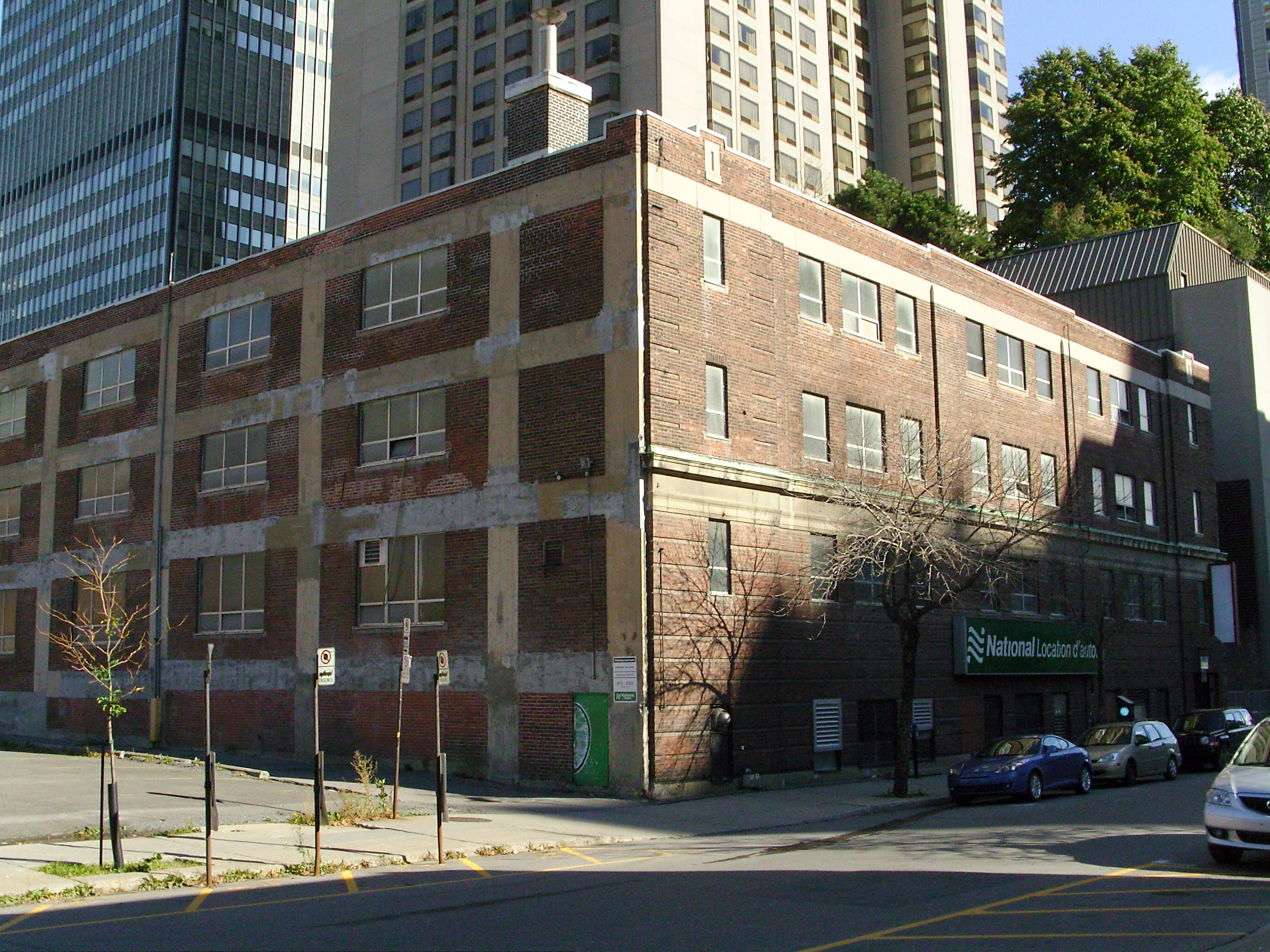
Victoria Skating Rink
The newspaper notice was brief and matter-of-fact. 'A game of Hockey will be played at the Victoria Skating Rink this evening, between two nines chose from among the members,' announced the Montreal Gazette on March 3, 1875. It assured nervous spectators that the game would use 'a flat circular piece of wood, thus preventing all danger of its leaving the surface of the ice.' No one in the audience that evening could have known they were watching the birth of organized ice hockey. The Victoria Skating Rink -- a vaulted indoor arena between Drummond and Stanley Streets in downtown Montreal -- hosted that first game and, in doing so, accidentally defined the dimensions of every NHL rink that would follow. The building is gone now, replaced by a parking garage. But the sport it incubated grew into Canada's national obsession.
Golden Square Mile Ice Palace
The Victoria Skating Club was incorporated on June 9, 1862, backed by the wealthy families of Montreal's Golden Square Mile. Its directors included John Greenshields, whose family ran the largest drygoods wholesale firm in Canada, and James Torrance, whose family operated a prosperous provisions business. With substantial capitalization, they purchased land and built one of the first and largest indoor rinks in North America, opening on Christmas Eve 1862. The rink was not Montreal's first indoor ice surface -- the Montreal Skating Club had opened one on St. Urbain Street in 1859 -- but it quickly became the most prestigious. It was also the first of many Canadian rinks to bear Queen Victoria's name. The building became the first in Canada to be electrified, its ice surface measuring dimensions remarkably close to those of modern NHL rinks. A raised promenade surrounded the ice, letting spectators watch from above, and the whole enterprise sat one block west of Dominion Square, the social heart of Victorian-era Montreal.
The Night Hockey Found Its Shape
James Creighton, a Victoria Skating Club member and figure skating judge, organized the historic match of March 3, 1875. What made this game different from the informal stick-and-ball scrimmages that had been played on frozen ponds for years was its structure: two teams of nine players, designated goaltenders, a referee, a predetermined set of rules, a fixed duration of 60 minutes, and a recorded score. Crucially, Creighton replaced the lacrosse ball with a flat wooden puck to protect the rink's glass windows and the spectators behind them -- possibly the first time such an object was used in a hockey game. The teams included McGill University students, playing with Mic-mac sticks and Starr skates imported from Nova Scotia. By moving the game indoors, the rink's physical walls imposed a nine-per-side limit on teams that had previously ranged into the dozens on open ice. The dimensions of the ice surface, dictated by the distance between Drummond and Stanley Streets, became the template for North American hockey rinks.
From Stanley Cups to Tesla Lectures
The Victoria Rink's sporting legacy deepened over the following decades. It hosted the first Stanley Cup playoffs in 1894, and by then the building had gained an elevated balcony and a projecting loge -- a precursor to today's luxury boxes. In 1896, the rink was connected by telegraph to distribute Stanley Cup series scores between Montreal and Winnipeg in real time, making it the site of the first ice hockey broadcast by wire. The rink was also the home ice of Louis Rubenstein, Canadian and world figure skating champion, who won his first Canadian championship there in 1883. But the Victoria Rink was far more than a sporting venue. In September 1891, the National Electric Association of the United States held its convention there, featuring demonstrations by Thomas Edison and a public lecture by Nikola Tesla. Emma Albani, the celebrated Canadian soprano, performed for 6,000 at a benefit for Notre-Dame Hospital in 1890. The Presbyterian Church in Canada held its founding meeting in the rink on June 15, 1875, and an assembly of Sunday School students in 1887 drew approximately 10,000 children.
Seasons of Transformation
The Victoria Rink reinvented itself with each season. Winter brought pleasure skating and masquerade balls during the Montreal Winter Carnivals of the 1880s. Summer stripped the ice away and turned the cavernous interior into an exhibition hall. The Montreal Horticultural Society held its annual September show there from the 1860s onward, with prizes for agriculture, poultry, painting, and the best solo performer on bugle, fife, and drum. The British Medical Association convened a medical conference in the building in August 1897, displaying pharmaceutical preparations and surgical appliances. Dog shows, vaudeville performances, and trade exhibitions filled the warmer months. The building's versatility made it one of the most important public spaces in Victorian Montreal, a place where the city's cultural, scientific, religious, and sporting lives all intersected under one roof.
A Parking Garage Where History Happened
By 1906, the building needed significant repairs. The Victoria Skating Club sold the site to J. William Shaw, a piano merchant who dreamed of converting it into a 2,500-seat concert hall. High costs and low expected profits killed the plan. Shaw continued operating the rink for skating and minor hockey leagues while introducing car parking during the summer months. Smaller leagues -- the Commercial and Steamship League, the Inter-School League, the Manufacturers' League -- kept playing there. The final notable game, reported by the Montreal Gazette, was a Canadian National Railway Hockey League semifinal on March 3, 1925 -- exactly fifty years to the day after the first game. It drew 1,200 spectators. By the 1920s, the gallery had become unsafe, and Shaw sold the property in 1925 to make way for a parking garage. In 2002, the International Ice Hockey Federation acknowledged the site as 'the birthplace of organized hockey,' and a commemorative plaque was dedicated at the nearby Bell Centre in 2008. The rink is gone, but the game it shaped fills arenas across the world.
From the Air
The Victoria Skating Rink stood at approximately 45.498N, 73.572W in downtown Montreal, between Drummond and Stanley Streets near what is now Dorchester Square. The building no longer exists -- the site is occupied by a parking structure. From the air, look for the cluster of buildings between the Bell Centre to the west and Dorchester Square to the east. The nearby Windsor Hotel site and old Windsor Station are recognizable landmarks. Nearest airports: Montreal-Pierre Elliott Trudeau International (CYUL) 15 km west, Montreal/Saint-Hubert (CYHU) 12 km southeast. Best viewed at 2,000-3,000 feet AGL.