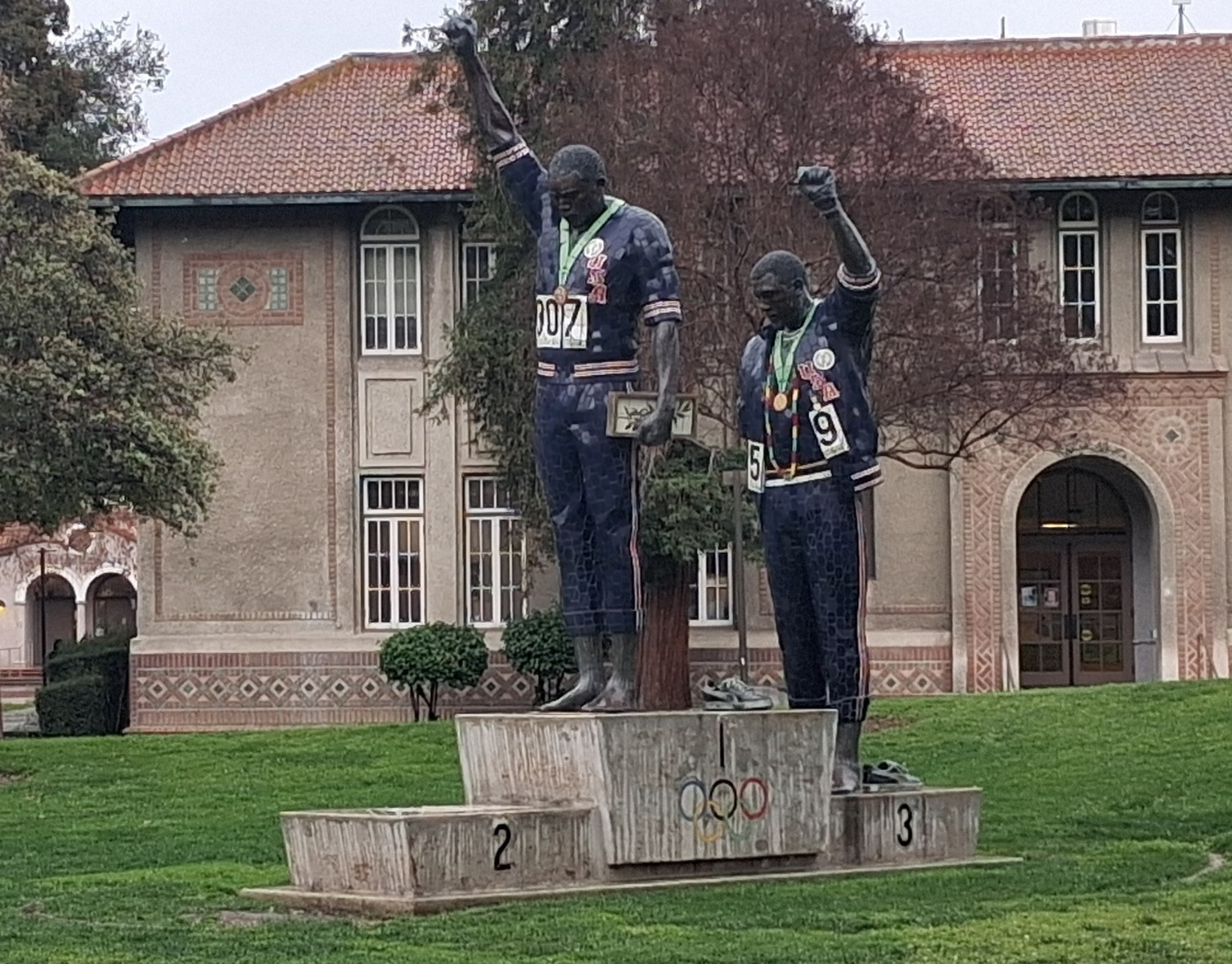
Victory Salute (Statue)
The silver medal position on the podium is empty. That is the first thing visitors notice about the statue next to Tower Hall on the San Jose State University campus -- two figures stand with fists raised, but the second-place step has no one on it. The absence is deliberate, and it is the most powerful part of the monument. Australian sprinter Peter Norman, who stood on that podium in Mexico City in 1968 and wore a human rights badge in solidarity with his fellow medalists, asked to be left out of the sculpture. He wanted visitors to step up and feel what he felt. "Anybody can get up there and stand up for something they believe in," Norman said. "I guess that just about says it all."
Sixteen Seconds in Mexico City
On October 16, 1968, Tommie Smith crossed the finish line of the 200-meter final at the Mexico City Olympics in a world-record 19.83 seconds. His San Jose State teammate John Carlos took bronze. What happened next lasted only as long as the national anthem -- roughly sixteen seconds -- but it became one of the most recognized images of the twentieth century. Standing on the podium in black socks, no shoes, and black gloves, Smith and Carlos bowed their heads and raised their fists as "The Star-Spangled Banner" played. The gesture cost them dearly. They were expelled from the Olympic Village, received death threats, and faced years of professional and personal hardship. Back in San Jose, however, university president Robert D. Clark publicly defended his students -- a stance rare enough at the time that it would later be honored alongside the athletes themselves.
Thirty-Seven Years to Say Thank You
It took more than three decades before San Jose State moved to formally honor Smith and Carlos. The push began in 2002, when student Erik Grotz heard professor Cobie Harris mention that these men had never been recognized by their own university. Grotz partnered with art department chair Robert Milnes to pitch the idea to the student government, which approved it in December 2002 and began raising funds. The Associated Students eventually gathered over $300,000. Portuguese artist Rigo 23 was commissioned for the project -- his first sculpture. He took 3D full-body scans of the aging athletes to capture their musculature accurately. The finished work features two fiberglass figures covered in a mosaic of dark blue, red, and white ceramic tiles, standing on a concrete podium. Rigo 23 signed the back of Smith's shoe; the year 2005 is inscribed on Carlos's.
An Unveiling That Mirrored the Moment
On October 17, 2005, hundreds gathered on the campus lawn between Tower Hall and the building now named for Robert D. Clark. The statue had been moved from its original planned location on the Paseo de San Carlos to this more central spot, partly to acknowledge Clark's courage. Smith and Carlos were both present, as was Peter Norman, who had flown in from Australia. Actor Delroy Lindo spoke. Vice-mayor Cindy Chavez spoke. And then, as the covering came off, "The Star-Spangled Banner" played -- just as it had in Mexico City thirty-seven years earlier. This time, instead of condemnation, Smith and Carlos received honorary doctorate degrees from the university that had once been unable to celebrate them.
A Gathering Place for Dissent
The monument did not become a quiet memorial. Situated less than a third of a mile from San Jose City Hall, Victory Salute has become a natural starting point for campus protests, its raised fists serving as a backdrop and a kind of permission. Student athletes have gathered there to speak against police brutality before marching downtown. Its lawn has hosted rallies and encampments across causes and years. In 2008, a plaque was added after critics pointed out that passersby lacked context for the two shoeless figures with gloved fists. The statue continues to function exactly as public art should -- not as a frozen relic, but as a living site where new generations test the boundaries of protest that Smith and Carlos helped define.
From the Air
Located at 37.335N, 121.883W on the San Jose State University campus in downtown San Jose. Best viewed below 3,000 feet AGL. The campus sits between I-280 and US-101. Nearest airport is San Jose International (KSJC), approximately 2 nautical miles northwest. Reid-Hillview Airport (KRHV) lies about 5 nm southeast. The statue is adjacent to Tower Hall, whose distinctive tower is a useful visual landmark.