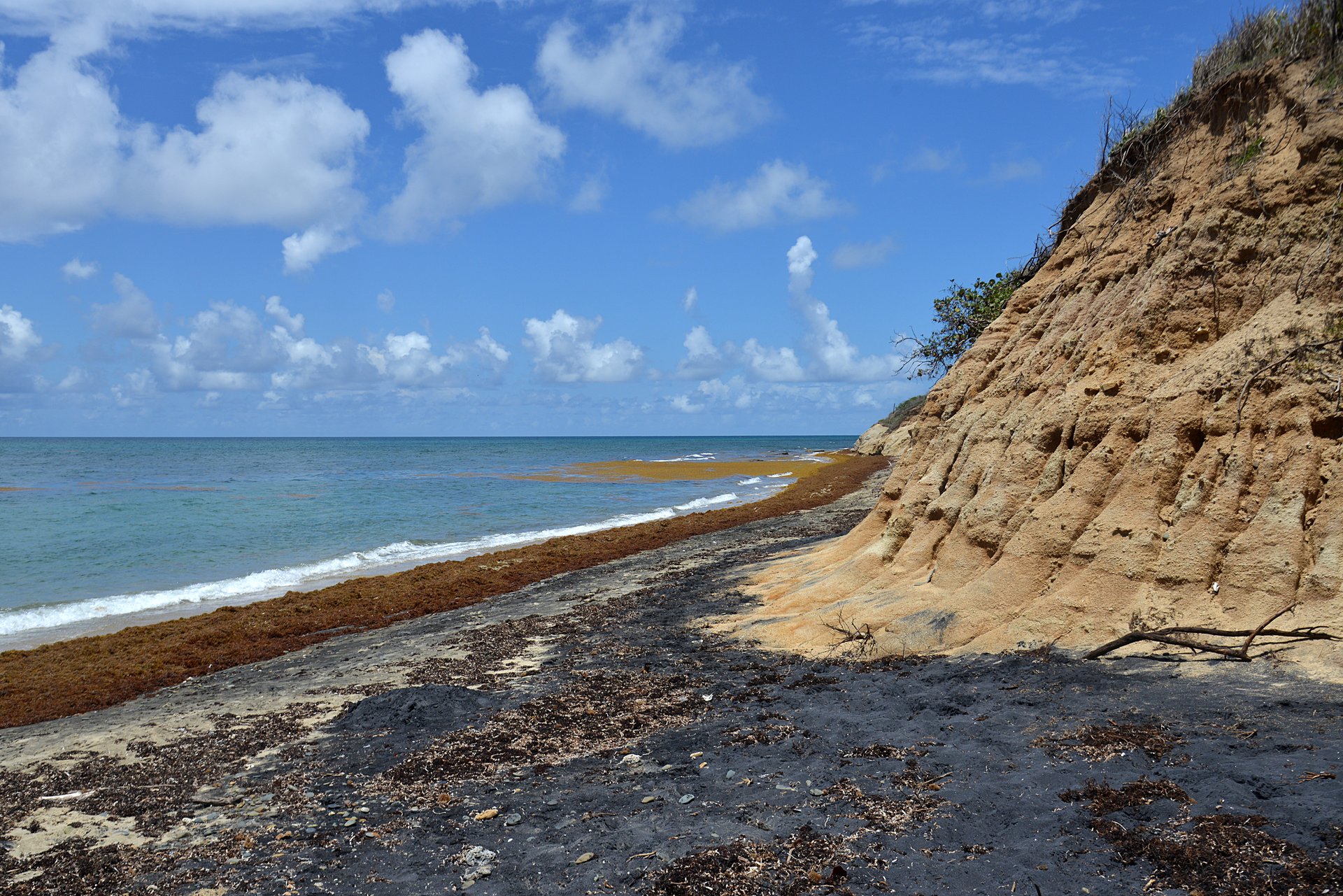
Vieques, Puerto Rico
Paddle a kayak through Mosquito Bay on a moonless night and every stroke of the blade sets the water on fire -- trails of electric blue swirling behind you, fish darting in luminous streaks beneath the hull. Guinness World Records declared this the brightest bioluminescent bay on Earth in 2006, and scientists credit a particular irony for its brilliance: when Spanish colonizers first encountered the glow centuries ago, they believed it was the work of the devil and dropped boulders into the bay's narrow channel to choke it off from the ocean. Instead, they sealed in the very conditions -- warm, sheltered water thick with nutrients from surrounding red mangroves -- that let the dinoflagellate Pyrodinium bahamense flourish. The devil's light only grew brighter. It is a fitting origin story for Vieques, an island whose defining experiences have been attempts at control that ultimately failed.
Sixty Years Under the Crosshairs
In the early 1940s, with World War II expanding across the Atlantic, the U.S. Navy expropriated more than two-thirds of Vieques -- an island just 21 miles long and 4 miles wide, home to roughly 10,000 people -- to use as a training range and ammunition depot. Families were displaced from their land. Sugar plantations that had sustained the local economy were absorbed into military holdings. The civilian population was compressed into a narrow strip in the island's center, between munitions storage on the west end and a live-fire bombing range on the east.
For the next six decades, the Navy conducted approximately 180 days of military exercises per year. Viequenses lived with the sound of ordnance, the vibrations shaking walls and nerves alike. The sugar economy, already declining, collapsed entirely once the land was gone. Median household income fell to $9,331 -- less than a quarter of the U.S. average. Unemployment was widespread, and the kind of development that might have helped was impossible when most of the island belonged to the military.
The Death That Broke the Silence
On April 19, 1999, a Marine Corps F-18 dropped two 500-pound bombs that struck a security post on the range, killing David Sanes Rodriguez, a Puerto Rican civilian employed by the Navy as a security guard, and injuring four others. His death transformed decades of simmering resentment into a broad, sustained movement. Within a year, fourteen protest camps had been established on the bombing range and at other military sites across Puerto Rico. Fishermen in small boats blockaded Navy vessels. Activists, politicians, and religious leaders set up encampments on the restricted land and refused to leave.
The movement drew support that crossed political and cultural lines: the Reverend Al Sharpton and Robert F. Kennedy Jr. were arrested for trespassing on the range, as were numerous Puerto Rican leaders. Singers Ricky Martin and Danny Rivera, boxer Felix "Tito" Trinidad, actor Edward James Olmos, and Guatemalan Nobel laureate Rigoberta Menchu all lent their voices. By 2003, the pressure was irresistible. The Atlantic Fleet Weapons Training Facility on Vieques closed in May of that year. A year later, the Navy shuttered Roosevelt Roads Naval Station on the Puerto Rican mainland, its primary reason for existence gone.
What the Bombs Left Behind
The Navy's departure did not end the reckoning. Researchers documented that Vieques' cancer rate from 1995 to 1999 was 31 percent higher than on the Puerto Rican mainland, though the small population makes statistical certainty difficult. Surveys of a target ship in a shallow bay revealed it had been irradiated during nuclear tests in the Pacific in 1958 before being towed to Vieques. By 2002, thousands of tons of that irradiated steel were unaccounted for. Hundreds of steel drums of unknown origin and unverified contents were found among the wreckage.
The cleanup became -- and remains -- the island's largest employer, contributing over $20 million to the local economy. The former Live Impact Area at the eastern tip of the island is still severely contaminated and fenced off. Environmental groups have documented elevated levels of toxic elements in plant and animal tissue across the island's food web. For Viequenses, the contamination is not an abstract policy question. It is the water they drink, the fish they catch, the soil in which they plant.
An Island Reclaimed
Where bombs once fell, wild horses now graze among the ruins of military bunkers. The former Navy lands were transferred to the U.S. Fish and Wildlife Service and local authorities, and today the Vieques National Wildlife Refuge encompasses stretches of palm-fringed beaches, mangrove lagoons, subtropical dry forest, and coral reefs that were, ironically, preserved by decades of restricted access. The island has no traffic lights, no chain hotels, no cruise ship terminals. TripAdvisor once placed it among the world's top 25 beaches, noting "more than 40 beaches and not one traffic light."
The paso fino horses that roam freely across parts of the island have become an unofficial symbol. In the town of Esperanza, the malacon overlooks calm Caribbean waters. In Isabel Segunda on the north coast, the 300-year-old ceiba tree still stands near the Spanish-era Fortin Conde de Mirasol. The Mosquito Pier -- where the Navy once loaded munitions -- was renamed Puerto de la Libertad David Sanes Rodriguez in 2003. Vieques markets itself under an ecotourism banner now, trading on exactly the underdevelopment the Navy imposed. The irony is not lost on anyone who lives there.
From the Air
Located at 18.13N, 65.43W, approximately 8 miles east of mainland Puerto Rico. Vieques measures 21 miles east-west by 3-4 miles north-south, clearly visible from cruising altitude as an elongated island between the Atlantic and the Caribbean. The former bombing range occupies the eastern third of the island and is identifiable from the air by its lack of development and contrast with the populated central strip. Antonio Rivera Rodriguez Airport (TJVQ/VQS) serves the island. The bioluminescent Mosquito Bay is on the southern coast. Roosevelt Roads (TJRV/NRR) on the Puerto Rican mainland is approximately 8 nm to the west-northwest. Luis Munoz Marin International (TJSJ/SJU) is about 40 nm to the west.