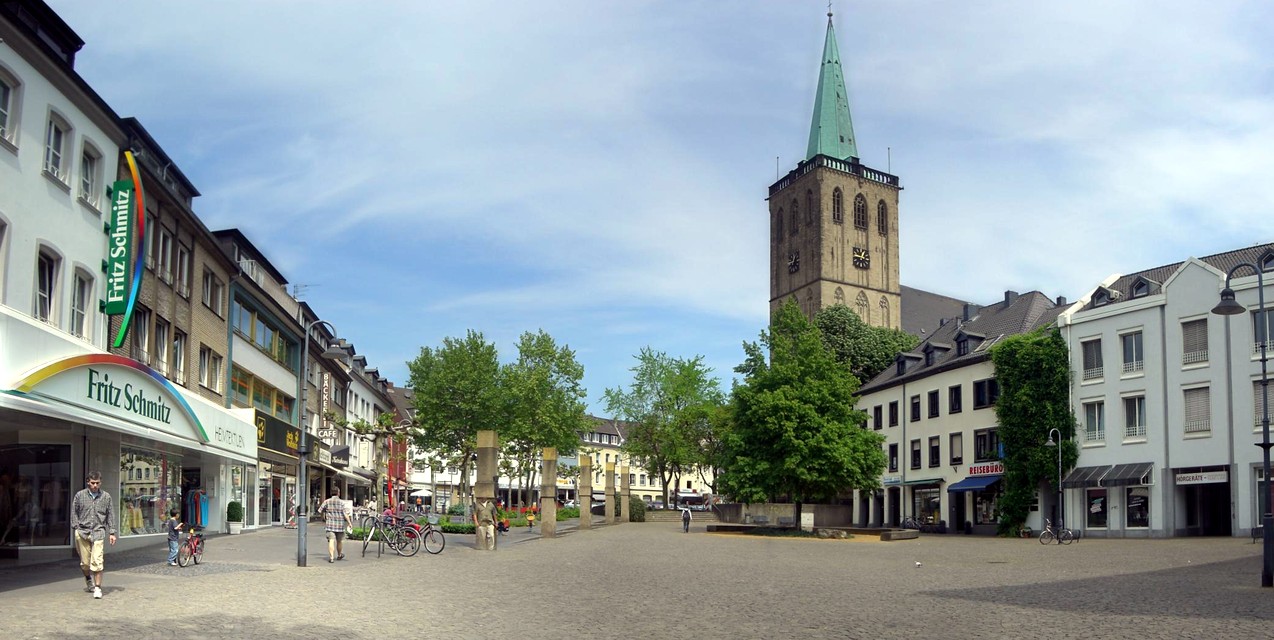
Viersen
Every March, men in dark suits arrive in a town of 76,000 people, lean over green felt under bright lights, and try to make a cue ball touch three cushions before kissing two object balls. This is the World Three-Cushion Billiards Championship for National Teams, one of the most technically demanding events in the sport, and it has called Viersen's Festhalle home for decades. South Korean, Belgian, Dutch, and Turkish players, household names in cue sports, fly into a town most non-Germans cannot place on a map. The tournament is run with the same understated efficiency that defines the rest of Viersen: do something well, do it for a long time, and let the trophies speak for themselves.
Three Towns Stitched Together
Today's Viersen is a deliberate creation. Sucteln, Dulken, and Viersen were three separate, independently-minded towns until 1970, when a North Rhine-Westphalia administrative reform fused them into a single municipality. The village of Boisheim had already joined in 1968. Each of the three former towns still keeps its own carnival parade in February, its own local pride, and its own claim to be the 'real' Viersen. Walk between them on foot and you can feel the seams: medieval church towers spaced too closely together, three town halls instead of one, the layout of an old market square that doesn't quite line up with the modern street grid.
The Foolish Republic of Dulken
Dulken's carnival parade is one of the biggest and most traditional in North Rhine-Westphalia, but the strangest of the local traditions is what happens the day after the last parade: the Dulkener Schoppenmarkt, one of Germany's largest flea and junk markets, sprawls through the streets while everyone is still nursing a carnival hangover. Dulken also has its own Narrenakademie, the 'Academy of Fools,' a satirical institution dating back to 1554 that mock-awards degrees in carnival nonsense. For a place that looks, on first glance, like a sober Rhenish market town, Dulken has an unusually theatrical streak.
The Bismarck Tower
On a small wooded hill on the edge of Viersen rises a stocky stone tower of dark Niederrhein basalt, with battlements and an arched doorway. This is the Viersen Bismarck Tower, one of around 240 such towers built across Germany and Austria between 1869 and 1934 in honor of Chancellor Otto von Bismarck. Most were erected after his death in 1898, when local Bismarck societies competed to commemorate the founder of the German Empire. The Viersen tower was completed in 1900, designed in the heavy, deliberately archaic style typical of the era. It still stands, still climbable on certain days, a stubborn piece of Wilhelmine ambition tucked into the Niederrhein woods.
Chocolate, Cables, and Cue Cases
Viersen's economy is the kind of unflashy industrial backbone the Niederrhein specializes in. Mars Incorporated runs a factory in the Dulken-Mackenstein industrial estate, producing chocolate bars whose wrappers travel further than most Viersen residents ever do. SAB Brockskes, a cable manufacturer founded locally, employs roughly 550 people, most of them in Viersen-Sucteln, and supplies specialized cables to industries from rail to mining. There is no skyline-defining headquarters here, no signature corporate tower. Just companies that have been making the same useful things for the same loyal customers for decades.
The Sound of September
On the fourth weekend of every September, the Viersen International Jazz Festival fills the Festhalle and the surrounding venues. It was founded by Ali Haurand, a Viersen-born double bassist and bandleader who was made a Chevalier des Arts et des Lettres by France for his contributions to European jazz. Haurand died in 2018, but the festival he started keeps going, drawing musicians from across Europe and the United States. Add to that the kite festival in autumn, the children's flea market in summer (the largest of its kind in Germany, where adults are not allowed to sell), and the 'Viersen bluht' floral installations spilling across the pedestrian zone, and a quieter pattern emerges. Viersen does not have to shout. It simply schedules.
From the Air
Viersen sits at 51.26 north, 6.39 east, about 8 km northwest of Monchengladbach and 15 km southwest of Krefeld, with Venlo on the Dutch border roughly 20 km further west. Closest major airport is Dusseldorf International (EDDL), about 35 km east. The town is recognizable from the air by its three distinct historic cores (the old Viersen, Dulken, and Sucteln centers) and a notably green ring of parks and small forests separating it from neighboring municipalities.