Vietnam Military History Museum
The timeline on the museum wall begins in 214 BC and does not end. From the Qin dynasty to the Zhao, from the Han to the Tang, from the Mongols to the Ming, from the French to the Americans - Vietnam's military history reads less like a sequence of wars than a single, unbroken act of resistance stretching across twenty-two centuries. The Vietnam Military History Museum, established on July 17, 1956, exists to tell that story, and its new home - a 38.66-hectare complex that opened on Thang Long Boulevard in November 2024 - finally gives the narrative the physical space it demands.
From the Citadel to the Boulevard
For decades, the museum occupied a site at 28A Dien Bien Phu Street in Hanoi's Ba Dinh District, opposite Lenin Park and within the grounds of the Imperial Citadel of Thang Long. The old building carried its own historical weight - French colonial architecture repurposed to house the story of resistance against French colonialism. But the collection had outgrown its walls. In late 2024, after years of construction, the new museum opened at Km 6+500 of Thang Long Boulevard in Nam Tu Liem District. Four above-ground floors and a semi-basement now house what the original site could only gesture at. In December 2024, the Ministry of National Defense formally merged the old museum's premises back into the Imperial Citadel of Thang Long, returning the heritage site to wholeness.
Twenty-Two Centuries on Display
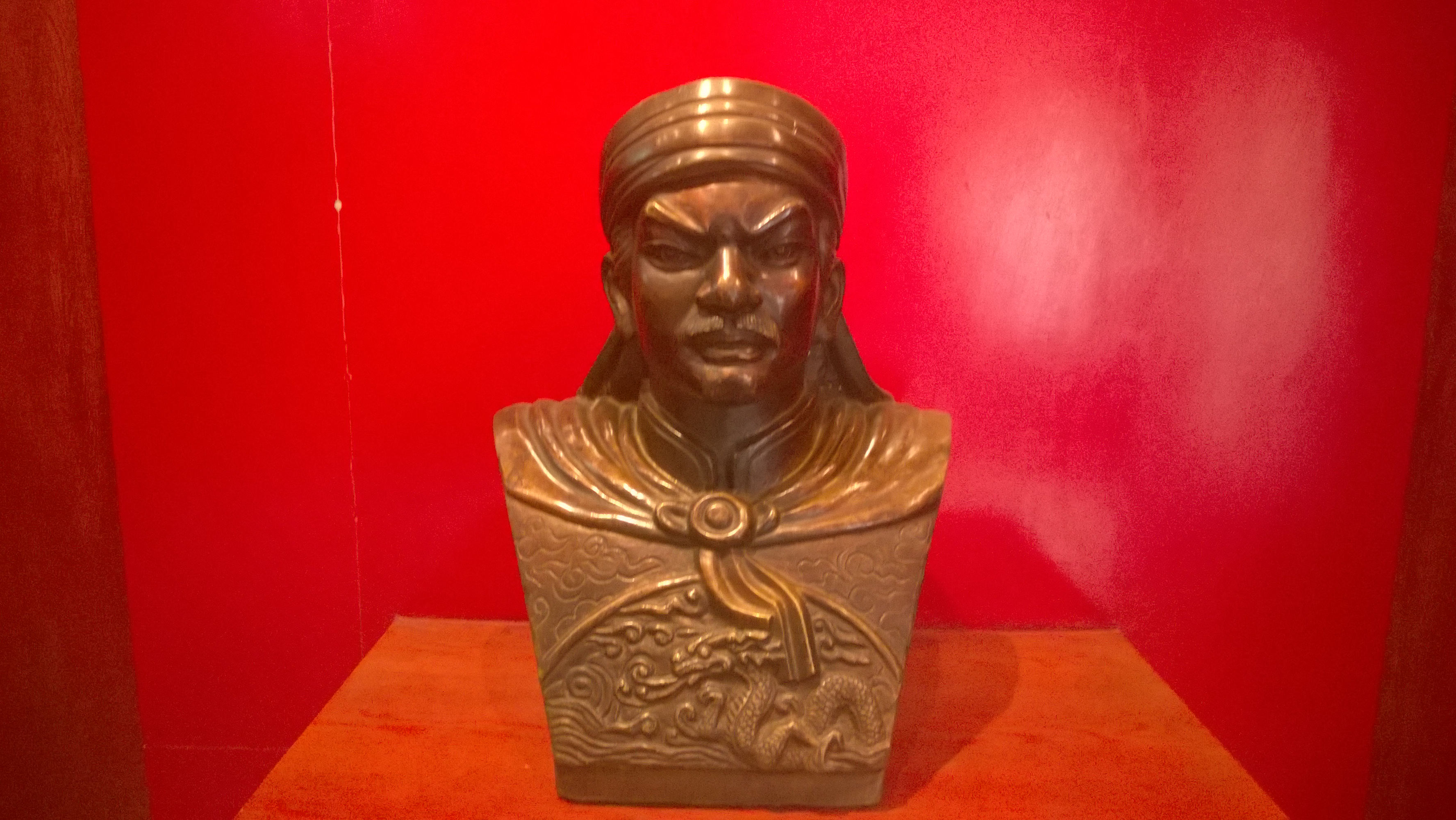
The exhibits move chronologically through Vietnam's long catalog of invasions and resistance. A bust of Tran Hung Dao, the Tran dynasty prince who commanded Vietnamese forces during the Mongol invasions of the 13th century, anchors the pre-colonial galleries. Figurines recreate battle scenarios from centuries of conflict against Chinese dynasties - the Qin, the Han, the Tang, the Song, the Ming. Wall murals reproduce the words of emperors who rallied their people against each successive wave. The collection does not pretend to neutrality; it is a Vietnamese museum telling a Vietnamese story. The placard language is direct: "Resistance war against the French colonists" for 1858-1954, "Resistance war against the American imperialist, liberate the nation" for 1954-1975. Note cards appear in Vietnamese, French, and English, though audiovisual elements are predominantly in Vietnamese.
The Garden of Broken Toys
The outdoor display area is where the museum's narrative becomes tangible. Visitors walk among the wreckage of American military hardware - a term the museum embraces with dark humor by calling the collection the "Garden of Broken Toys." A reconstructed sculpture incorporates fragments of a Boeing B-52 Stratofortress shot down during Operation Linebacker II, the devastating December 1972 bombing campaign against Hanoi. Nearby sit a UH-1H Huey helicopter, Cessna A-37B Dragonfly attack aircraft, and Douglas A-1 Skyraiders. Soviet equipment that served the North Vietnamese military is also on display: T-34 and T-54 tanks, S-75 Dvina surface-to-air missiles, and various calibers of anti-aircraft guns. An M3 Half-track, reportedly captured from the French Groupe Mobile 100 at the Battle of Mang Yang Pass, represents the earlier Indochina War.
What the Walls Remember
The museum's founding traces back to a decree signed by Ho Chi Minh on November 23, 1945 - just weeks after Vietnam declared independence - ordering the preservation of cultural heritage. Between 1945 and 1954, as the First Indochina War raged, the Ministry of Defense directed its units to collect documents, images, and artifacts even as history was still being made. By late 1954, after the French defeat at Dien Bien Phu, a 13-member committee began organizing these materials into what would become the Military Museum. The institution opened in 1956, barely a year after the country's partition. Posters and newspapers from the American war era document international opposition to U.S. involvement, with materials from countries as far-flung as Congo, the Netherlands, Venezuela, and Cuba. The global solidarity collection makes a pointed argument: Vietnam's resistance was never Vietnam's alone.
From the Air
The new museum is located at 21.01N, 105.75E on Thang Long Boulevard in Nam Tu Liem District, western Hanoi. The 38.66-hectare complex is visible from altitude as a large modern building with extensive outdoor display areas. Nearest airport is Noi Bai International (VVNB), approximately 15 km north. The old museum site at 28A Dien Bien Phu Street in Ba Dinh District is near the Ho Chi Minh Mausoleum and the Imperial Citadel of Thang Long, both recognizable landmarks from the air.