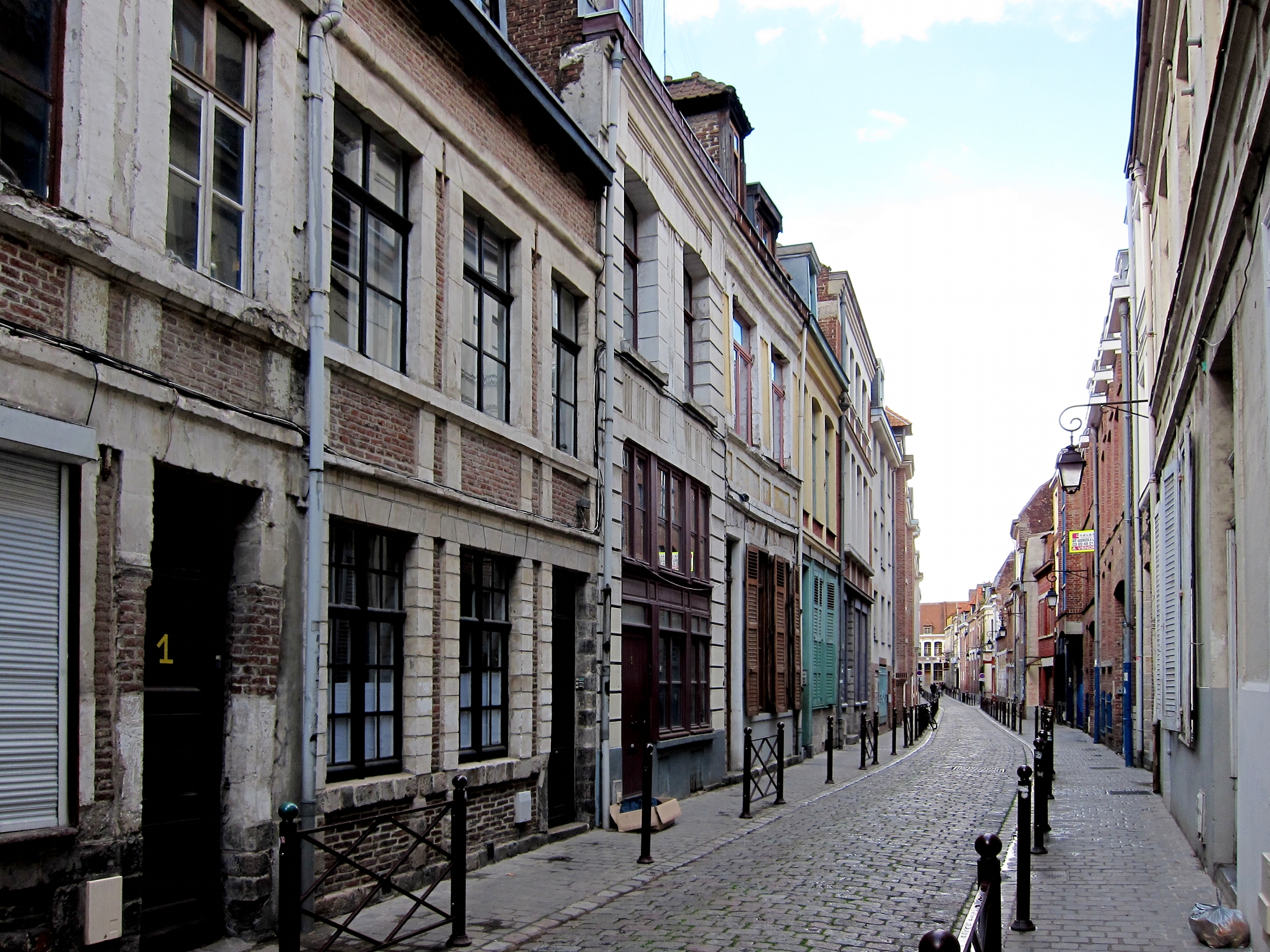
Vieux-Lille
In the 1960s the city of Lille drew a line on a map: a four-lane expressway, cutting north through the old quarter, connecting the centre to the new economic developments around Roubaix and Tourcoing. The neighbourhood in the way had a bad reputation — narrow cobbled streets, immigrant families living in subdivided seventeenth-century houses, the kind of place affluent Lillois had been quietly avoiding for a generation. Bulldozing it would have been easy. Around the same time, the working-class Saint-Sauveur district on the other side of town was being demolished in exactly that style. Vieux-Lille got lucky. The expressway was killed in planning. The mayor who killed it, Pierre Mauroy — later prime minister of France under Mitterrand — chose restoration instead. Within twenty years the cobbles had been re-laid, the brick facades cleaned, and the families pushed out by property prices that have climbed every year since. The neighbourhood survived. Most of the people who lived there did not stay.
Where Lille Actually Began
Vieux-Lille is older than its name. The original eleventh-century settlement gathered around the motte castrale where Notre-Dame de la Treille cathedral now stands, with the early castrum extending south to Place aux Oignons and the medieval forum lying in the triangle between rue Basse, rue Esquermoise and rue de la Grande-Chaussée. The faubourg de Weppes around Sainte-Catherine church was absorbed by an extension of the walls around 1370, becoming the city's fifth parish. The grounds of the demolished Château de Courtrai — a fortress Philip IV of France built in 1298 after his victorious siege, knocked down on the orders of the Habsburg emperor in 1577 — were enclosed in the 1619–1622 enlargement. And the area north of rue du Pont-Neuf, with its strikingly regular linear streets, dates from Vauban's expansion after Louis XIV annexed Lille in 1670. Walk a hundred metres in any direction in Vieux-Lille and you cross a different century of city wall.
Brick, Sandstone, and the Lille Span
What gives Vieux-Lille its visual unity is a particular vernacular of seventeenth- and eighteenth-century Flemish brickwork: deep red brick laid with pale Lezennes stone or Béthisy sandstone, tall narrow facades pressed shoulder-to-shoulder, scrolled and stepped gables, and the distinctive arched window frames the locals call the "Lilloise span." Whole streets — rue de la Monnaie, rue de la Grande-Chaussée, rue des Chats-Bossus, rue Basse — are lined with row after row of seventeenth-century arcaded houses in this Lille style, almost identical in proportion but each one different in ornament: a carved keystone, a sun-burst, a sculpted lion, a date. Other streets show the eighteenth-century classical Lille style with French-style townhouses inspired by Paris. The medieval wooden houses are essentially all gone. What survives is the seventeenth century rebuilding it as brick — and the brick has lasted. The Hospice Comtesse, founded in 1237 by Countess Jeanne, lost most of its medieval fabric to fires; its present buildings date from the fifteenth, seventeenth and eighteenth centuries, and have housed a museum of Flemish interiors since 1962.
9 rue Princesse
On 22 November 1890, in a four-storey brick house at 9 rue Princesse, Charles de Gaulle was born. His mother Jeanne's parents owned the house; he was baptised a few streets away at the church of Saint-André, the former Carmelite chapel built between 1701 and 1758. The family moved to Paris not long after, and de Gaulle spent most of his life elsewhere — but he came back to Lille throughout his career, and in 1945, after France's liberation, he returned to a hero's welcome. The house at rue Princesse became a museum in 1983 and reopened in 2005 with new exhibition rooms about his life and the history of the Free French. Among the period furniture is the bed in which his mother gave birth to him. The square at the centre of Lille, just south of Vieux-Lille, was renamed Place du Général-de-Gaulle in September 1944 — the same liberation week, the same gesture, repeated all over France.
Restoration and Its Cost
By the 1980s, the old quarter had its expressway cancelled and its restoration underway. Mauroy's successive mandates poured public money into the brick. Facades were stripped of paint and grime; cobbles were re-laid; the Couvent des Minimes, a 1619 Flemish-style convent disused since the Revolution, was bought by Charles Kindt in 1988 and turned into the four-star Alliance Golden Tulip hotel. The Halle aux Sucres, once a warehouse for sugar and grain on the Basse-Deûle, became a cultural venue. The Hospice Comtesse became a museum. By 2000, Vieux-Lille was the most fashionable address in the city — luxury boutiques along rue de la Grande-Chaussée, three-Michelin-star restaurants tucked into former bourgeois townhouses, antique dealers along rue Royale. The 20,000 residents who live there today are not, by and large, the children of the families who lived there in 1960. Gentrification is a quiet word for a heavy thing. The cobbles are the same. Almost nothing else is.
From the Air
50.6385°N, 3.0638°E. Vieux-Lille is the dense, irregular old quarter immediately north of Place du Général-de-Gaulle, bounded roughly by Avenue du Peuple-Belge to the east (the buried course of the old Basse-Deûle), the citadel green wedge to the west, and rue du Pont-Neuf separating its medieval southern half from its Vauban-era northern grid. From above, look for: a tight cluster of dark slate roofs interrupted by the pale modern facade of Notre-Dame de la Treille cathedral, the rectangular green of the Citadel star fort to the north-west, and the much larger Grand'Place rectangle to the south. Recommended viewing altitude 1,500–2,500 ft AGL — low enough to read the seventeenth-century street pattern. Nearest airports: Lille-Lesquin (LFQQ) 5 nm south; Brussels (EBBR) 50 nm east; Charles de Gaulle (LFPG) 100 nm south.