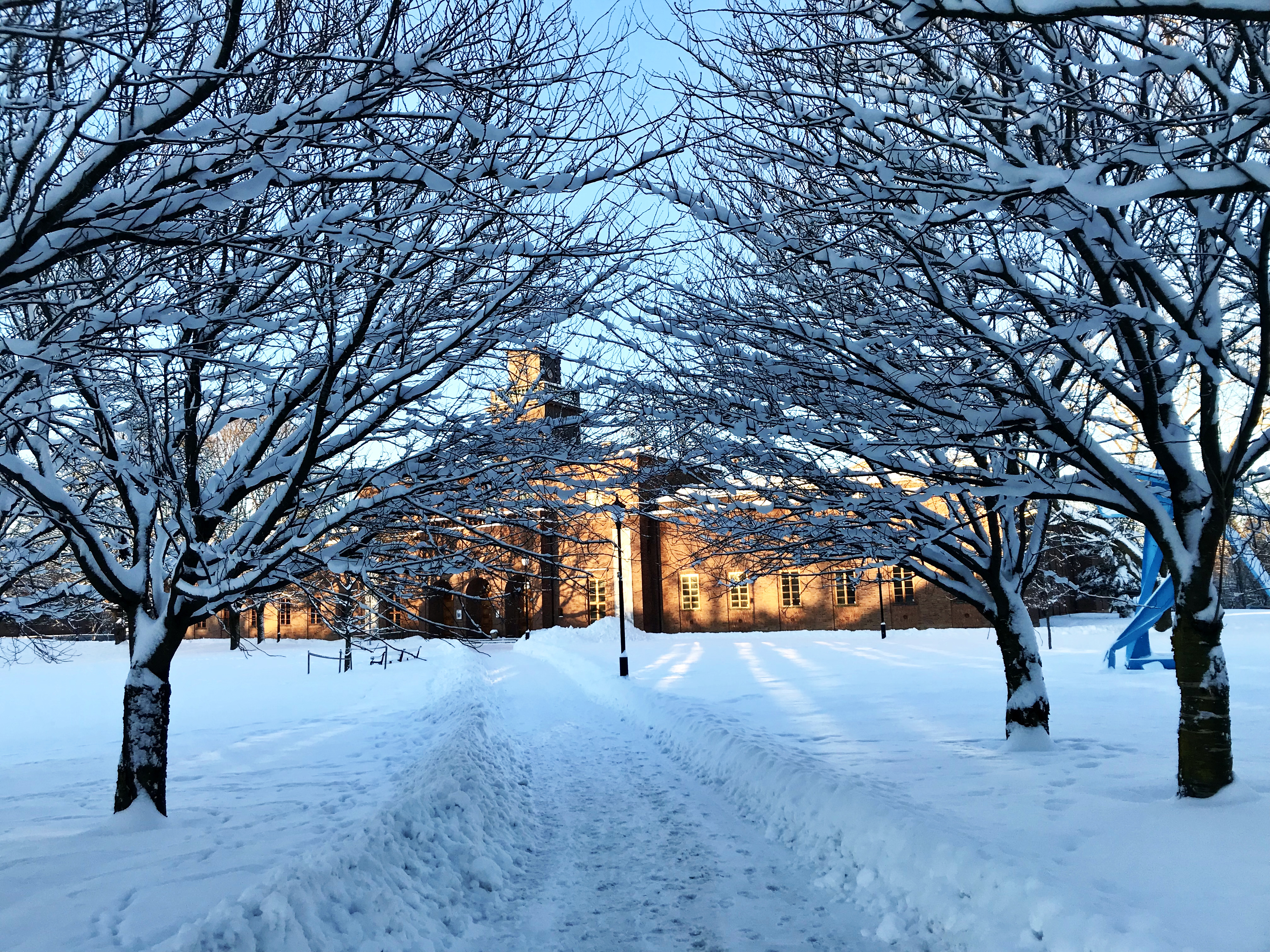
Vigeland Museum
Gustav Vigeland designed his own burial urn. He cast it in bronze and placed it in the tower of the building where he lived and worked, above the apartment on the second floor where he spent his final years. When he died in 1943, his ashes went into the urn he had made, in the tower of the studio the city had built for him, next to the park filled with his sculptures. It was the last act in one of the most unusual deals in the history of public art: an entire artistic legacy traded for a place to work.
The Bargain
In 1919, Gustav Vigeland made Oslo Municipality an offer. He would donate his complete body of work, not just the sculptures but his woodcuts, drawings, sketches, photographs, letters, and personal library, if the city would provide him with a proper studio. The timing was driven by necessity: the part of Oslo where Vigeland lived and maintained his atelier was being demolished for urban redevelopment. He needed a new workspace, and the city wanted a legacy. The agreement stipulated that Vigeland's studio could be converted into a museum after his death. Even his apartment on the third floor would be preserved. Construction began in 1921 as soon as the contract was formalized, and Vigeland moved in two years later, a year before the middle section and northern wing were even completed. The southern wing followed in 1930.
The Building as Monument
Architects Lorentz Harboe Ree and Carl Buch designed the museum in a neoclassical style that ranks among Norway's finest examples of the form. The building's proportions are deliberate and austere, a frame meant to focus attention on the art rather than compete with it. Inside, the exhibition halls hold the permanent collection that tells the story of Vigeland's life and artistic evolution, from early figurative works through the monumental pieces that would define Frogner Park. Temporary exhibitions of contemporary and historical three-dimensional art rotate through the galleries, placing Vigeland's work in conversation with sculptors across eras. Visitors who book in advance can tour the preserved apartment where Vigeland lived, seeing the rooms exactly as the sculptor left them, an intimate counterpoint to the grand public installations just north in the park.
A Sculptor Among Giants
Vigeland was born in 1869 in Mandal, on Norway's southern coast, and died in Oslo in 1943. In the intervening 74 years, he produced a body of work that placed him alongside the major European sculptors of his era. A 2019 exhibition organized for his 150th anniversary positioned him alongside Bourdelle, Maillol, Meunier, and Rodin, the company he had kept in ambition if not always in international reputation. His fame rests primarily on the Vigeland installation in Frogner Park, immediately north of the museum, where more than 200 sculptures in bronze, granite, and wrought iron depict the full arc of human life from birth to death. But the museum reveals the breadth behind the fame: the woodcuts, the preparatory drawings, the smaller studies that show an artist working through ideas obsessively before committing them to stone or metal.
Living Legacy in Frogner
The museum sits at Nobels gate 32, just south of Frogner Park, in a cultural cluster that includes Frogner Manor with the Oslo Museum and the Henriette Wegner Pavilion, a small art gallery. The distinction between museum and park matters: inside the building are the private works, the process, the life; outside in the park are the public results, the monumental statement. Together they form a portrait more complete than either could offer alone. The museum remains owned by Oslo municipality through its cultural department, a continuation of the original 1919 agreement. Vigeland gave the city everything he made. The city gave him a place to make it, and then kept its promise to preserve both the work and the place where it was created. His ashes remain in the tower, overlooking it all.
From the Air
Located at 59.92N, 10.70E in the Frogner district of western Oslo, immediately south of Frogner Park. The neoclassical museum building and the adjacent Vigeland installation in the park, with its distinctive Monolith column, are visible from the air. Nearest major airport is Oslo Gardermoen (ENGM), approximately 40 km northeast. The park and museum sit about 2 km west of the Royal Palace along the same latitude. Best viewed at 2,000-3,000 ft AGL.